Atlantic Salmon
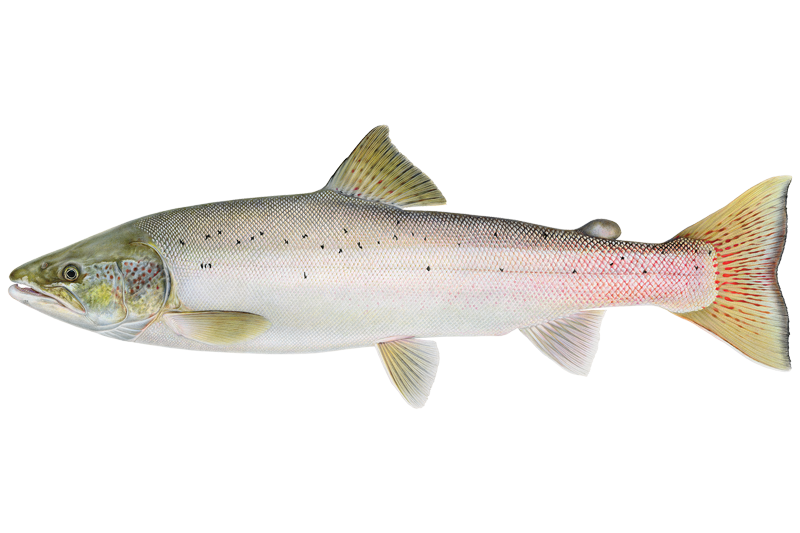
Atlantic salmon are native to Ireland and return from ocean feeding grounds to spawn in the rivers where they hatched — a cycle that has shaped Irish angling culture for centuries.
Ireland holds some of the strongest salmon runs in Western Europe, with over 80 rivers open to fishing. The pursuit ranges from big productive systems like the Moy to intimate Connemara spate rivers, on fly or spinning gear.
Scientific Name: Salmo salar
Also known as Springer, Grilse, Bradán (Irish)
- Fresh-run fish are steel-blue and silver with small black spots; colour dulls to bronze or red as they spend time in freshwater heading upstream to spawn.
- Males develop a pronounced hook on the lower jaw (kype) as spawning approaches; sea lice on a fresh fish confirm it arrived recently from salt water.
- Grilse (one winter at sea) typically run 2–4 kg; springers (two or more winters) average larger, with the Irish record standing at 25.85 kg (57 lb).
- Juvenile parr resemble small brown trout but carry well-defined dark oval blotches (parr marks) along the flanks and are generally more silvery.
What to know
Habitat Distribution
- Native to Ireland and found in most river systems — one of the most widespread fish in the country, present in rivers draining to both the Atlantic and Irish Sea coasts.
- Spawning and juvenile habitat is fast, well-oxygenated river with clean gravel beds and cool water; parr require stony runs with good cover from aquatic vegetation.
- Adults enter freshwater from the sea and move upstream through river systems; they also run into interconnected lough systems such as the Ballynahinch catchment in Connemara.
- Smolts migrate to sea — ultimately reaching feeding grounds off Greenland and Norway — before returning as adults to their natal river.
Key Locations
- River Moy, County Mayo — Ireland's most productive salmon river by catch, with numerous accessible fisheries around Ballina and a massive annual run of grilse from early summer.
- Munster Blackwater, Counties Cork and Waterford — a major spring and summer river with most fisheries concentrated between Fermoy and Lismore; in good years rivals the Moy in total catch.
- Ballynahinch River, Connemara, County Galway — a classic Connemara spate system draining into Bertraghboy Bay; all fish entering the system pass through the Ballynahinch Estate, making it one of the most consistent salmon and sea trout fisheries in the west.
- River Laune, County Kerry — one of the top specimen-producing rivers in Ireland, draining Lough Leane near Killarney and running strong spring and summer fish.
- River Galway (Corrib), County Galway — a short, powerful river running through Galway city, offering accessible urban salmon fishing with a well-known weir pool.
Specific Spots
- Named salmon pools on larger rivers like the Moy hold fish stacked in predictable lies — deeper, slower water immediately downstream of fast runs where salmon rest on their upstream journey.
- Current breaks behind boulders or along the edge of fast water give resting fish a place to hold without fighting the full flow — prime spots to swing a fly or work a spinner.
- On spate rivers, fish move quickly after rain raises levels; the tail of a pool and the crease where fast water meets slow are the first places to cover when a river comes into condition.
- On lough systems, salmon cruise shoreline shallows and river mouths, especially when fresh fish are running — trolling or drifting these areas with a fly or lure covers ground effectively.
Atlantic Salmon FAQ
Answers from onWater's species guide.
What are the best lures and bait for Atlantic Salmon?
Silver and copper spoons (Toby-style) and bar spoons are the workhorses of Irish salmon spinning, silver in clear water, copper or gold in peaty or coloured conditions.
What flies work for Atlantic Salmon?
Tube flies and Waddington-mounted patterns in black-and-yellow, orange, or red-and-black are the backbone of Irish salmon fly fishing, larger and heavier in high cold water, smaller and sparser as summer low water arrives.
When is the best time to fish for Atlantic Salmon?
Spring (January–April): Springers, larger, multi-sea-winter fish, begin running; the season opens on some rivers as early as January, though the best spring fishing typically builds through March and April.
How do you catch Atlantic Salmon?
Most Irish salmon fishing is done by wading and casting across and downstream, swinging a fly or working a spinner through named pools and runs.
What do Atlantic Salmon eat?
Adult salmon stop feeding once they enter freshwater, their stomachs are empty, so every take is a reaction, not hunger. Flies and lures work by triggering aggression, curiosity, or a residual feeding reflex conditioned by years at sea.
See it in the app
Most maps show you water.
onWater shows you Atlantic Salmon.



- 01 · Species map filter
Map every Atlantic Salmon water
Pick Atlantic Salmon and the map zeroes in on the waters they call home. No more guessing which lake holds them.
- 02 · Waterbody species
Tap any water. See what lives there.
Species, behavior and seasonal patterns for every lake, river and pond, before you leave the driveway.
- 03 · Angler Intelligence
Ask how to catch Atlantic Salmon
Tactics, gear and timing from onWater's AI fishing guide, tuned to the species and the water you're on.
Stop guessing where Atlantic Salmon are.
Open the map, filter by Atlantic Salmon, and head to water that holds them. Download onWater and plan your next trip in minutes.
- Species map filter
- Angler Intelligence
- Fishing journal
Explore other species
Trout, bass, salmon, panfish and everything in between. Each guide unpacks the behavior, seasons, and tactics that put fish in the net.
No species information available.

Smarter Fishing Starts in the App.
onWater Fish gives you everything you need to plan smarter, fish better, and own every trip from first cast to last.