Rainbow Trout
Rainbow trout are not native to the UK — brown trout holds that title. Rainbows were introduced from North America in the early 20th century for fish farming, and stocked fish have since established in some rivers and stillwaters.
Today they're the backbone of the UK's put-and-take stillwater fishery, with hundreds of day-ticket lakes and reservoirs across England, Wales, and Scotland offering accessible sport. Wild-breeding populations are rare but do exist.
Scientific Name: Oncorhynchus mykiss
Also known as Steelhead (sea-run form), Rainbow, Bow
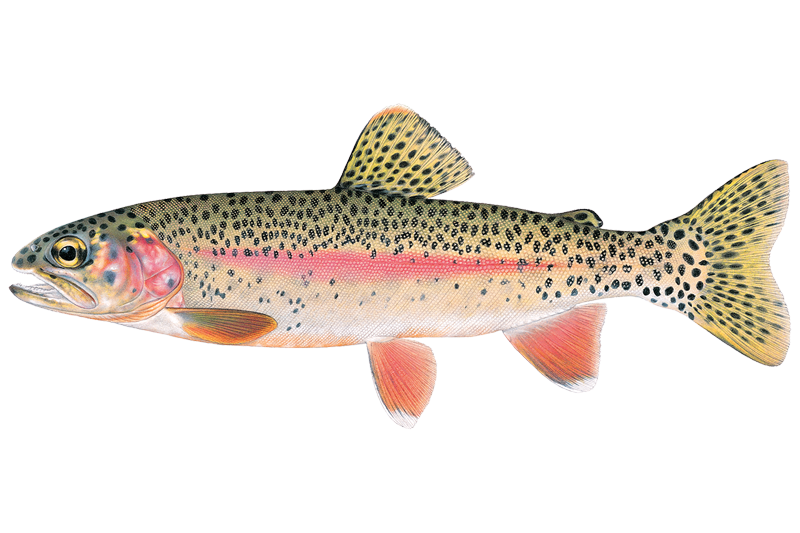
- Steel-blue to olive-green back fading to silver sides, with a vivid pink-to-red lateral stripe running from gill to tail — the feature that names the fish.
- Dense black spotting across the back, dorsal fin, and tail; spots extend onto the adipose fin, distinguishing rainbows from brown trout at a glance.
- Stocked fish in UK stillwaters typically run 1–3 lb; larger specimens of 5–10 lb are common on managed reservoirs, and fish over 20 lb have been recorded from specialist waters.
- Hatchery-bred colour variants — blue trout and golden trout — are the same species in a different coat, occasionally stocked on some UK fisheries.
What to know
Habitat Distribution
- Not native to the UK; introduced from North America and now widely stocked in stillwaters, reservoirs, and some rivers across England, Wales, and Scotland.
- Self-sustaining wild populations are uncommon — most UK rainbows are stocked fish — but feral fish do persist in a handful of rivers, particularly in the south and west.
- Prefer cold, well-oxygenated water; most at home in clear stillwaters, chalk streams, and fast-flowing rivers where water temperatures stay cool through summer.
- Stillwater fisheries — from small day-ticket lakes to large reservoirs — are the primary habitat anglers encounter them in across the UK.
Key Locations
- River Test, Hampshire — one of England's most celebrated chalk streams, with clear spring-fed water and a mix of stocked and wild fish.
- River Itchen, Hampshire — chalk stream known for gin-clear water and entirely wild trout on some beats; considered by many the benchmark for UK trout fishing.
- River Frome, Dorset — another southern chalk stream holding trout alongside grayling and salmon.
- River Usk, Wales — popular trout river flowing past the Brecon Beacons, with fish reported to 5 lb and excellent bank fishing.
- River Wharfe, Yorkshire — well-known northern trout river offering a different character to the southern chalk streams.
Specific Spots
- On stillwaters, fish patrol the margins and drop-offs early and late in the day; focus on the windward bank where surface food concentrates.
- In rivers, look for rainbows holding in the same lies as brown trout: behind boulders, at the tail of pools, and along current seams where food is delivered without much effort.
- On chalk streams like the Test and Itchen, fish hold tight to weed beds — ranunculus in particular — using the cover to intercept drifting invertebrates.
- In reservoirs, depth matters with season: fish ride the thermocline in summer, pushing shallower in cooler months when surface temperatures drop.
Rainbow Trout FAQ
Answers from onWater's species guide.
What are the best lures and bait for Rainbow Trout?
Small spinners (Mepps-style) and silver or gold spoons in sizes 1–3 are reliable across UK stillwaters; the flash and vibration trigger takes even from fish that aren't actively feeding.
What flies work for Rainbow Trout?
Buzzers (midge pupa imitations) fished static or on a slow figure-of-eight retrieve are the most consistently productive flies on UK stillwaters year-round; Diawl Bach and Shipman's Buzzer are nationally established patterns.
When is the best time to fish for Rainbow Trout?
Stillwater fisheries are often open year-round, with many UK day-ticket lakes stocking heavily through spring and autumn when water temperatures suit the fish. Summer fishing on stillwaters can slow in warm spells as fish go deep; early mornings and evenings remain the most productive windows.
How do you catch Rainbow Trout?
Most UK rainbow fishing happens on stillwater day-ticket fisheries, where anglers work the margins and drop-offs with buzzers or lures from the bank or a boat.
What do Rainbow Trout eat?
Aquatic invertebrates form the core diet, mayfly nymphs, caddis larvae, midge pupae (buzzers), and shrimps. On stillwaters, buzzer fishing with Diawl Bach or Shipman's Buzzer patterns (both imitate midge pupae rising to the surface) accounts for a huge proportion of UK rainbow catches.
See it in the app
Most maps show you water.
onWater shows you Rainbow Trout.



- 01 · Species map filter
Map every Rainbow Trout water
Pick Rainbow Trout and the map zeroes in on the waters they call home. No more guessing which lake holds them.
- 02 · Waterbody species
Tap any water. See what lives there.
Species, behavior and seasonal patterns for every lake, river and pond, before you leave the driveway.
- 03 · Angler Intelligence
Ask how to catch Rainbow Trout
Tactics, gear and timing from onWater's AI fishing guide, tuned to the species and the water you're on.
Stop guessing where Rainbow Trout are.
Open the map, filter by Rainbow Trout, and head to water that holds them. Download onWater and plan your next trip in minutes.
- Species map filter
- Angler Intelligence
- Fishing journal
Explore other species
Trout, bass, salmon, panfish and everything in between. Each guide unpacks the behavior, seasons, and tactics that put fish in the net.
No species information available.
Smarter Fishing Starts in the App.
onWater Fish gives you everything you need to plan smarter, fish better, and own every trip from first cast to last.