Common Carp
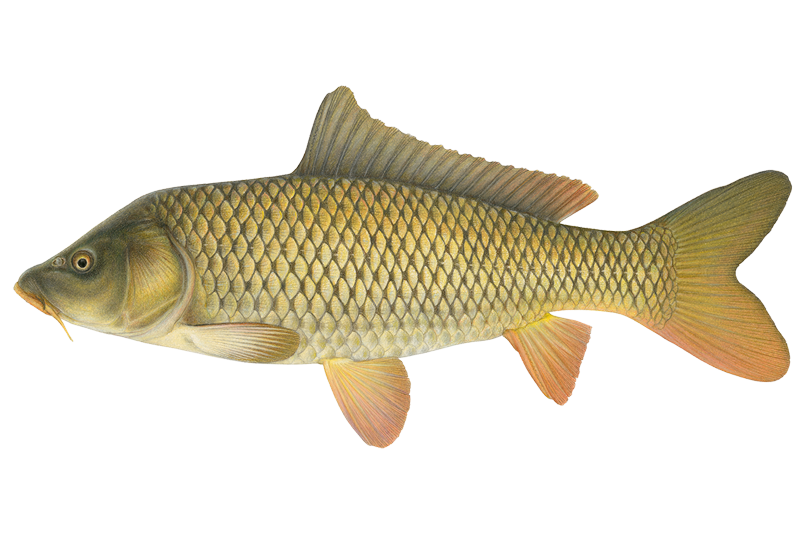
Common carp are the backbone of UK coarse fishing. Introduced in the 13th or 14th century as a food fish, they've been selectively bred and stocked across England, Wales, Scotland and Northern Ireland for centuries.
Today they're targeted everywhere from commercial day-ticket lakes to quiet estate ponds and canal towpaths — a fish that rewards patience, watercraft and careful bait presentation as much as any tackle choice.
Scientific Name: Cyprinus carpio
Also known as Carp, Common, Wildies
- Fully scaled from gill plate to tail root in neat, regular rows — the key distinction from mirror carp (irregular large plates) and leather carp (almost no scales).
- Deep, powerful body with a noticeably arched back, broad tail wrist, and a downturned protrusible mouth carrying two pairs of barbules — one at the lip corners, one set back on the upper jaw.
- Colouration runs from pale gold in clear shallow commercials to deep bronze, olive-brown or near-black in older fish from weedy estate lakes; lower fins carry a distinctive orange-red tint.
- UK fish typically run 5–25lb depending on venue and stock age; anything over 30lb is a genuine specimen. The British rod-caught record stands at 64lb 6oz.
What to know
Habitat Distribution
- Non-native, introduced to the UK in the medieval period; now present throughout England, Wales, Scotland and Northern Ireland in still and slow-moving waters.
- Most abundant in purpose-built commercial fisheries, gravel pits, estate lakes and reservoirs — waters with rich bottom food and plenty of cover.
- Also found in canals across the canal network, though in smaller numbers; canal fish rarely reproduce naturally as water temperatures often stay too low for successful spawning.
- Tolerates slow rivers and large ponds; avoids fast, cold, well-oxygenated upland streams where they struggle to feed and grow.
Key Locations
- Linear Fisheries, Oxfordshire — a complex of gravel pits with a long history of producing large commons and mirrors, well known among specimen hunters.
- Wasing Estate, Berkshire — produced the current British record mirror carp; a benchmark venue for big-fish carp angling.
- The Avenue, Shropshire — home water of the British record common carp at 64lb 6oz.
- Canal network (Canal & River Trust waters) — accessible, no-frills carp fishing available to licence holders across England and Wales, particularly on the Grand Union and Kennet & Avon canals.
- Commercial day-ticket fisheries across the Midlands and South of England — the most accessible entry point for beginners, with high stocking densities and well-managed facilities.
Specific Spots
- Weed beds and lily pad margins — carp root through bottom debris here for snails, larvae and worms, and the cover overhead makes them confident feeders.
- Gravel bars and plateaus in gravel pits, where natural food concentrates and fish patrol predictable routes between deeper water and shallower feeding areas.
- Overhanging trees and snaggy timber — carp use these as shade and refuge; surface baits like floating crust work well tight to the canopy in warm weather.
- Canal lock cuttings and boat-mooring bays, where disturbed sediment and accumulated food scraps draw fish into confined, fishable areas.
Common Carp FAQ
Answers from onWater's species guide.
What are the best lures and bait for Common Carp?
Boilies in 10–20mm sizes are the go-to hookbait on most UK venues; shelf-life and frozen versions both work, with fishmeal, fruit and spice flavour profiles all having proven track records.
When is the best time to fish for Common Carp?
Late spring and summer (roughly May–September), the prime period; warm water pushes fish into the margins and onto the surface, and feeding activity is at its highest. Autumn (October–November), fish feed hard ahead of winter, often responding well to high-protein boilies; a productive window before temperatures drop.
How do you catch Common Carp?
Most UK carp anglers fish from the bank with ledgered boilies or method feeders, often pre-baiting a swim with free offerings to build fish confidence before presenting a hookbait.
What do Common Carp eat?
Natural diet includes midge larvae, water fleas, snails, worms, small mussels, aquatic plant material and fish spawn, bottom-rooting behaviour that stirs up silt and signals feeding fish to watching anglers.
Where do Common Carp live?
Non-native, introduced to the UK in the medieval period; now present throughout England, Wales, Scotland and Northern Ireland in still and slow-moving waters. Most abundant in purpose-built commercial fisheries, gravel pits, estate lakes and reservoirs, waters with rich bottom food and plenty of cover.
See it in the app
Most maps show you water.
onWater shows you Common Carp.



- 01 · Species map filter
Map every Common Carp water
Pick Common Carp and the map zeroes in on the waters they call home. No more guessing which lake holds them.
- 02 · Waterbody species
Tap any water. See what lives there.
Species, behavior and seasonal patterns for every lake, river and pond, before you leave the driveway.
- 03 · Angler Intelligence
Ask how to catch Common Carp
Tactics, gear and timing from onWater's AI fishing guide, tuned to the species and the water you're on.
Stop guessing where Common Carp are.
Open the map, filter by Common Carp, and head to water that holds them. Download onWater and plan your next trip in minutes.
- Species map filter
- Angler Intelligence
- Fishing journal
Explore other species
Trout, bass, salmon, panfish and everything in between. Each guide unpacks the behavior, seasons, and tactics that put fish in the net.
No species information available.
Smarter Fishing Starts in the App.
onWater Fish gives you everything you need to plan smarter, fish better, and own every trip from first cast to last.