Brook Trout
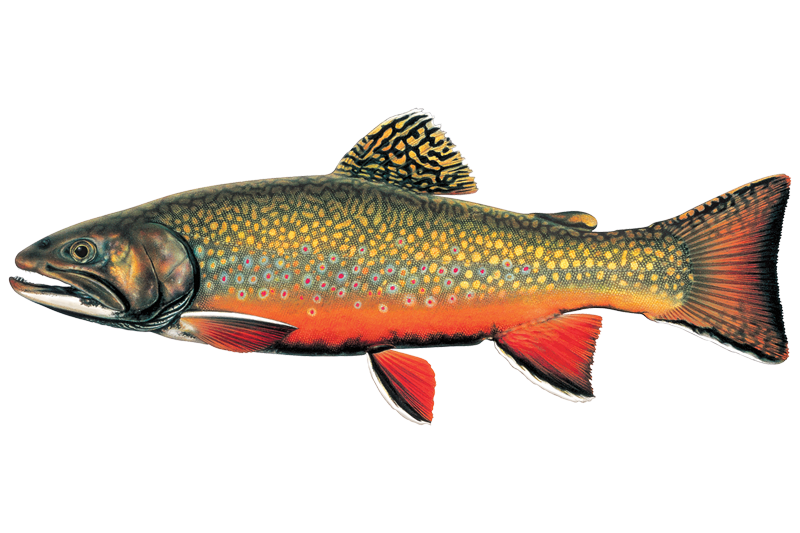
Brook trout aren't native to the UK — they're a North American char introduced during the Victorian era and again in the 1970s.
Small self-sustaining populations persist in a handful of upland lakes, mainly in Wales and Scotland, where old stocked fish bred successfully.
Catching one from a wild UK water is a genuine challenge and a niche pursuit, usually involving a long walk into remote hill country.
Scientific Name: Salvelinus fontinalis
Also known as Brookie, American brook trout, brook char, speckled trout
- Olive-green back with pale worm-like markings (vermiculations) that extend onto the dorsal fin — no other UK salmonid has this pattern.
- Sides carry red spots ringed with blue halos; belly shades from cream to vivid orange-red on spawning males.
- Lower fins are orange with a crisp white-then-black leading edge — the clearest single ID feature when the fish is in hand.
- UK wild fish are typically small: most run 6–10 inches, with anything over 12 inches a genuine find in remote hill waters.
What to know
Habitat Distribution
- Not native to the UK; introduced populations trace back to Victorian-era stocking and further introductions in the 1970s.
- Wales holds the most documented populations, in upland lakes — particularly in Snowdonia — where stocked fish established self-sustaining groups.
- Scotland is also mentioned by anglers, mainly in remote lochs where old stocked populations appear to have bred on.
- Very occasionally turns up in stocked stillwater fisheries in Wales, but wild river populations are rare and hard to pin down.
Key Locations
- Snowdonia, North Wales — upland lakes in this area hold some of the most documented self-sustaining brook trout populations in the UK, remnants of Victorian and 1970s introductions.
- Remote Scottish lochs — anglers report brook trout in isolated hill lochs, though specific waters are rarely publicised and finding them involves research and legwork.
- Inlet streams of Welsh upland lakes — worth exploring on foot as fish move into these flows seasonally.
Specific Spots
- Inlet streams feeding upland lakes are worth exploring — brook trout move into these cold, well-oxygenated flows, especially around spawning time.
- In lakes, look for spring-fed shallows and gravelly margins where groundwater keeps temperatures low even in summer.
- In any stream, focus on undercut banks, pocket water behind boulders, and the heads of small pools — anywhere current slows and cover exists overhead.
Brook Trout FAQ
Answers from onWater's species guide.
What are the best lures and bait for Brook Trout?
Small spinners (sizes 0–1, like a Mepps or similar blade lure) are effective in streams and loch margins, the flash and vibration draw strikes even in peat-stained water. A small worm fished naturally under a float or free-lined into pools is a reliable fallback, particularly in coloured water after rain.
What flies work for Brook Trout?
Small dry flies, an Elk Hair Caddis or a simple Parachute Adams (both imitate adult flies sitting on the surface), work well when fish are rising in calm conditions on hill lochs or slow pools.
When is the best time to fish for Brook Trout?
Summer (June–August) is the most practical time to reach remote upland waters on foot, and brook trout remain active in cold hill lochs when lowland fishing slows. Autumn brings spawning behaviour, males colour up and fish become more visible, though many anglers choose to leave them undisturbed during this period.
How do you catch Brook Trout?
Most UK anglers targeting brook trout combine a hill walk with fishing, approaching remote upland lakes and their feeder streams on foot. Fly fishing with small dries and nymphs is the most common method; light spinning gear with small spinners or a worm works too.
What do Brook Trout eat?
Insects make up the bulk of the diet in upland UK waters, terrestrials like beetles and ants blown onto the surface, plus whatever aquatic flies are hatching. Small dry flies and nymphs covering these are the go-to starting point. Larger fish will take small fish, worms, and leeches.
See it in the app
Most maps show you water.
onWater shows you Brook Trout.



- 01 · Species map filter
Map every Brook Trout water
Pick Brook Trout and the map zeroes in on the waters they call home. No more guessing which lake holds them.
- 02 · Waterbody species
Tap any water. See what lives there.
Species, behavior and seasonal patterns for every lake, river and pond, before you leave the driveway.
- 03 · Angler Intelligence
Ask how to catch Brook Trout
Tactics, gear and timing from onWater's AI fishing guide, tuned to the species and the water you're on.
Stop guessing where Brook Trout are.
Open the map, filter by Brook Trout, and head to water that holds them. Download onWater and plan your next trip in minutes.
- Species map filter
- Angler Intelligence
- Fishing journal
Explore other species
Trout, bass, salmon, panfish and everything in between. Each guide unpacks the behavior, seasons, and tactics that put fish in the net.
No species information available.
Smarter Fishing Starts in the App.
onWater Fish gives you everything you need to plan smarter, fish better, and own every trip from first cast to last.