Atlantic Salmon
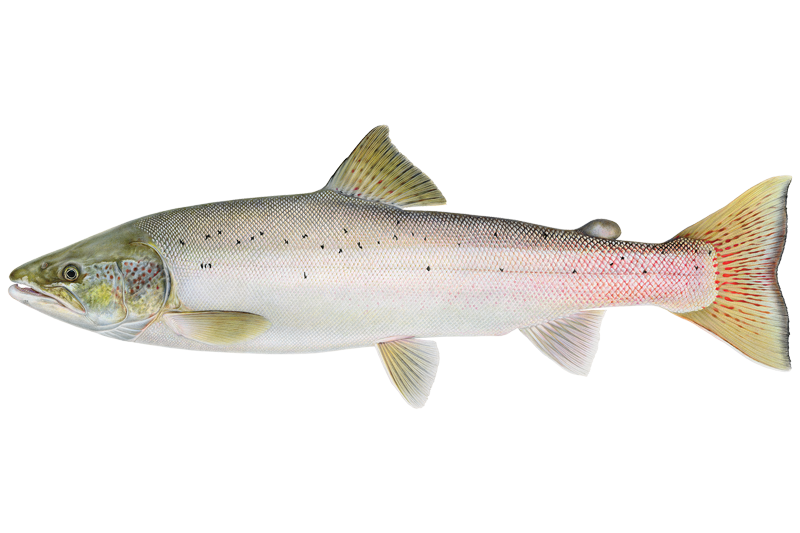
Atlantic salmon are the centrepiece of UK game fishing — a native, anadromous fish that returns from the North Atlantic to spawn in the rivers where it hatched.
Fishing for them is almost entirely a river pursuit, tied to seasonal runs that vary river by river. Scotland, Wales, and parts of northern and south-west England all hold fishable populations, with beats on famous rivers booked years in advance.
Scientific Name: Salmo salar
Also known as Salmo, springer (early-run fish), grilse (one-sea-winter fish), back-ender (autumn fish)
- Silver-flanked with a scattering of small black spots concentrated on the head and upper sides; much smaller, sparser spots than brown trout.
- Narrow tail wrist (caudal peduncle) with a forked tail — a reliable field mark separating salmon from sea trout at a glance.
- Jaw extends back only to the level of the eye in sea-fresh fish; breeding males develop a pronounced hooked lower jaw (kype).
- Typical river fish run 8–14 lb; spring fish on rivers like the Wye regularly exceed 20 lb; grilse average 4–7 lb.
What to know
Habitat Distribution
- Native to the UK; found in rivers draining into the North Atlantic and Irish Sea across Scotland, Wales, and parts of northern and south-west England.
- Adults spend 1–3 years feeding at sea before returning to freshwater; juveniles (parr and smolts) live in rivers for 1–6 years depending on how far north the river is.
- Spawning takes place in clean, fast-flowing gravel shallows (redds) in the upper reaches of rivers and their tributaries.
- Each river holds a genetically distinct stock — chalk-stream salmon of the Hampshire Basin are distinct enough that researchers have proposed classifying them as a separate subspecies, S. salar calcariensis.
Key Locations
- River Tweed, Scottish Borders — one of the UK's most productive salmon rivers, with strong autumn runs and large fish; the Upper Tweed fishes well from September through October.
- River Tay, Perthshire — Scotland's largest river, known for early spring fish and consistent runs throughout the season.
- River Wye, Wales/England border — famous for large spring fish over 20 lb; the Usk, running through Brecon and Abergavenny, is currently the most productive salmon river in Wales.
- River Helmsdale and River Halladale, Caithness and Sutherland — classic northern spate rivers with good summer and autumn runs.
- River Camel, Cornwall — one of the few south-west England rivers with a salmon run that extends into late autumn and early winter.
Specific Spots
- Holding lies in deep pools, behind large boulders, and at the tail of pools where current slows — salmon rest here between upstream pushes and are most likely to take a fly.
- Run fish move through streamy, broken water between pools; covering these transitional runs during a fresh spate often produces takes from fish that haven't settled.
- On big rivers like the Tweed or Wye, fish stack in deeper channel bends and below weirs when water is low; a rise in river level after rain pushes them upstream through shallower runs.
- On smaller spate rivers in Scotland and Wales, fish concentrate in the first deep pool above tidal water when flows are low, then scatter upriver once a flood arrives.
Atlantic Salmon FAQ
Answers from onWater's species guide.
What are the best lures and bait for Atlantic Salmon?
Devon Minnows (a spinning bait that imitates a small fish) and Toby-style spoons are traditional UK salmon lures, particularly effective in high, coloured water early in the season.
What flies work for Atlantic Salmon?
Tube flies and Waddington shanks dressed with hair wings, patterns like the Willie Gunn, Cascade, and Ally's Shrimp, are the go-to choices in high or coloured water; the larger profile and movement trigger a reaction from resting fish.
When is the best time to fish for Atlantic Salmon?
Spring (January–May): the earliest and often largest fish enter rivers like the Wye and Tay; cold, high water suits large flies and spinning gear. Summer (June–August): summer salmon and grilse run together; the River Test and lower Wye fish well when rainfall keeps levels up; low, warm water can shut sport down.
How do you catch Atlantic Salmon?
Most UK salmon fishing is done by wading and casting across and downstream, either swinging a fly or spinning a lure through known holding pools and runs.
What do Atlantic Salmon eat?
Adult salmon returning to rivers stop feeding once they enter freshwater, they are not eating when you catch them. Flies and lures trigger a reaction response, not hunger; presentation, size, and colour relative to water height and clarity matter more than matching any forage.
See it in the app
Most maps show you water.
onWater shows you Atlantic Salmon.



- 01 · Species map filter
Map every Atlantic Salmon water
Pick Atlantic Salmon and the map zeroes in on the waters they call home. No more guessing which lake holds them.
- 02 · Waterbody species
Tap any water. See what lives there.
Species, behavior and seasonal patterns for every lake, river and pond, before you leave the driveway.
- 03 · Angler Intelligence
Ask how to catch Atlantic Salmon
Tactics, gear and timing from onWater's AI fishing guide, tuned to the species and the water you're on.
Stop guessing where Atlantic Salmon are.
Open the map, filter by Atlantic Salmon, and head to water that holds them. Download onWater and plan your next trip in minutes.
- Species map filter
- Angler Intelligence
- Fishing journal
Explore other species
Trout, bass, salmon, panfish and everything in between. Each guide unpacks the behavior, seasons, and tactics that put fish in the net.
No species information available.
Smarter Fishing Starts in the App.
onWater Fish gives you everything you need to plan smarter, fish better, and own every trip from first cast to last.