Common Carp
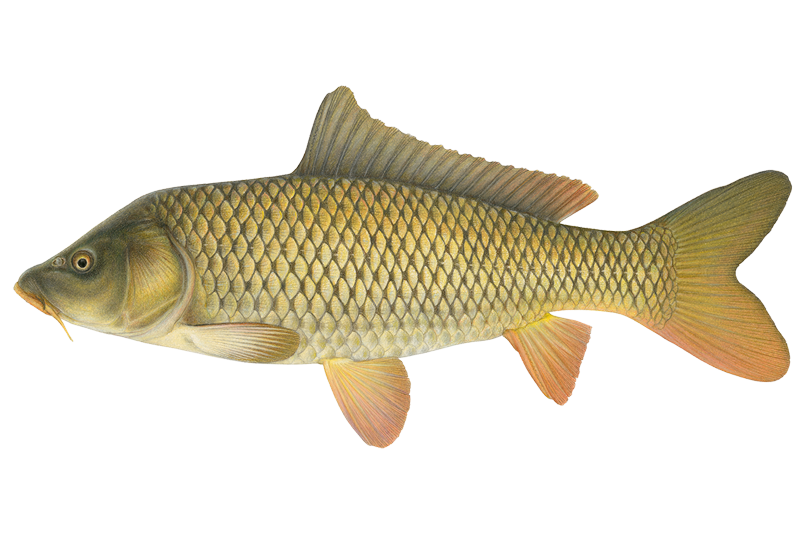
A heavy-bodied Eurasian import that's now established in 49 states, common carp turn up in everything from urban park ponds to Great Lakes bays to brackish tidal embayments.
Once dismissed as a trash fish, they've become one of freshwater's most technical sight-fishing targets — a wary, hard-pulling quarry that fly anglers compare to bonefish on the flats.
Scientific Name: Cyprinus carpio
Also known as European carp, Eurasian carp, German carp, Mirror carp, Israeli carp
- Two pairs of barbels at the corners of a downturned mouth — the single best field mark for separating carp from native bigmouth buffalo, which has none.
- Deep, thick-bodied build with a long dorsal fin and a serrated leading spine on both the dorsal and anal fins.
- Scale pattern varies by lineage: standard fish carry uniform concentric scales, mirror carp show scattered oversized scales on otherwise naked skin, and leather carp are nearly scaleless.
- Most caught fish run 2–10 lb with 15–20 lb fish common in productive water; 40-plus pounders show up in the right systems, and the IGFA all-tackle record sits at 75 lb 11 oz.
What to know
Habitat Distribution
- Non-native across the entire lower 48 and Hawaii, with self-sustaining populations everywhere from the Great Lakes to Western reservoirs to Southern river systems; only Alaska is uncolonized.
- Lakes, ponds, and slow river reaches with soft sediment are the core habitat, but they also push into brackish estuaries and tidal embayments along the Atlantic, Gulf, and Pacific coasts.
- Exceptional tolerance for silt, low oxygen, and pollution lets them thrive in waters that won't hold most gamefish — including urban canals, irrigation ditches, and turbid agricultural lakes.
- Feeding activity peaks roughly 55–75°F; below 50°F metabolism slows hard and fish stack into the deepest, most stable water available.
Specific Spots
- Soft-bottom flats and weedy coves where rooting fish leave telltale silt clouds — "mudding" is the single most reliable visual cue that carp are actively feeding.
- Shallow flats sitting next to a drop-off get used hard in spring and early summer for warming, feeding, and spawning; in summer heat fish slide deep at midday and return shallow at dawn and dusk.
- Gravel points, blown-down timber, undercut banks, and weed edges hold fish that orient repeatedly to the same piece of structure — worth remembering specific spots between trips.
- Backwater bays and slack-water current breaks in rivers concentrate feeding fish, especially around creek mouths where soft bottom meets a slight current edge.
Common Carp FAQ
Answers from onWater's species guide.
What are the best lures and bait for Common Carp?
Boilies, dense, flavored dough balls with a hardened shell, are the premier bait for serious carping, in both sweet (strawberry, pineapple, Scopex) and fishmeal flavors. Pre-baiting a spot for a day or two before fishing dramatically improves the catch.
What flies work for Common Carp?
Crawfish patterns are arguably the most productive single category, both standing IGFA fly-rod tippet-class records came on craws. Tie or buy them weighted enough to sink fast without splashing down on top of the fish.
What do Common Carp eat?
Carp root through soft bottom for chironomid larvae, caddis, worms, snails, crayfish, and fish eggs, the work bread-and-butter for weighted nymphs (size 6–10 olive, black, brown), Woolly Worms, and crawfish patterns. Both standing IGFA fly-rod tippet records were set on craw imitations.
Where do Common Carp live?
Non-native across the entire lower 48 and Hawaii, with self-sustaining populations everywhere from the Great Lakes to Western reservoirs to Southern river systems; only Alaska is uncolonized.
See it in the app
Most maps show you water.
onWater shows you Common Carp.



- 01 · Species map filter
Map every Common Carp water
Pick Common Carp and the map zeroes in on the waters they call home. No more guessing which lake holds them.
- 02 · Waterbody species
Tap any water. See what lives there.
Species, behavior and seasonal patterns for every lake, river and pond, before you leave the driveway.
- 03 · Angler Intelligence
Ask how to catch Common Carp
Tactics, gear and timing from onWater's AI fishing guide, tuned to the species and the water you're on.
Stop guessing where Common Carp are.
Open the map, filter by Common Carp, and head to water that holds them. Download onWater and plan your next trip in minutes.
- Species map filter
- Angler Intelligence
- Fishing journal
Explore other species
Trout, bass, salmon, panfish and everything in between. Each guide unpacks the behavior, seasons, and tactics that put fish in the net.

Find which waters have the species you want to catch

Redfish
Sciaenops ocellatus

Black Drum
Pogonias cromis

Spotted Seatrout
Cynoscion nebulosus

Weakfish
Cynoscion regalis

White Seabass
Atractoscion nobilis

Atlantic Croaker
Micropogonias undulatus

Spot
Leiostomus xanthurus

Northern Kingfish
Menticirrhus saxatilis

Southern Kingfish
Menticirrhus americanus

California Corbina
Menticirrhus undulatus

Whiting
Menticirrhus littoralis

Snook
Centropomus undecimalis

Tarpon
Megalops atlanticus

Ladyfish
Elops saurus

Bonefish
Albula vulpes

Mangrove Snapper
Lutjanus griseus

Red Snapper
Lutjanus campechanus

Lane Snapper
Lutjanus synagris

Mutton Snapper
Lutjanus analis

Yellowtail Snapper
Ocyurus chrysurus

Cubera Snapper
Lutjanus cyanopterus

Vermilion Snapper
Rhomboplites aurorubens

Gag Grouper
Mycteroperca microlepis

Red Grouper
Epinephelus morio

Black Grouper
Mycteroperca bonaci

Goliath Grouper
Epinephelus itajara

Scamp
Mycteroperca phenax

Snowy Grouper
Hyporthodus niveatus

Black Sea Bass
Centropristis striata

Kelp Bass
Paralabrax clathratus

Barred Sand Bass
Paralabrax nebulifer

Spotted Sand Bass
Paralabrax maculatofasciatus

Bluefish
Pomatomus saltatrix

Crevalle Jack
Caranx hippos

Permit
Trachinotus falcatus

Florida Pompano
Trachinotus carolinus

Greater Amberjack
Seriola dumerili

Almaco Jack
Seriola rivoliana

Yellowtail
Seriola lalandi

Blue Runner
Caranx crysos
Smarter Fishing Starts in the App.
onWater Fish gives you everything you need to plan smarter, fish better, and own every trip from first cast to last.