Brown Trout
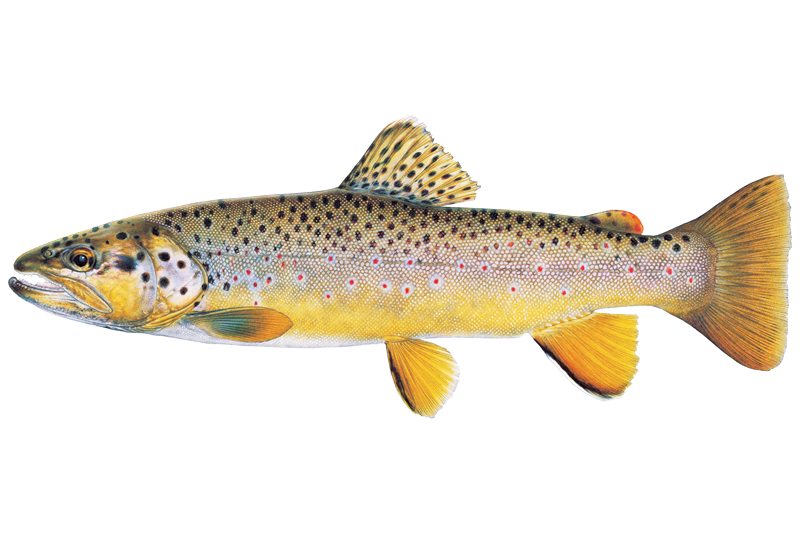
Brown trout were introduced to Chile in the late 1800s and early 1900s and have been reproducing wild ever since — no stocking required.
Today they're the technical centerpiece of Chilean Patagonia fly fishing, found from the Lake District south through Aysén and into Tierra del Fuego.
Resident fish in spring creeks and rivers reward careful presentation; sea-run fish from Tierra del Fuego return from the ocean as genuinely large specimens.
Scientific Name: Salmo trutta
Also known as Trucha marrón, trucha fario, trucha café
- Golden-brown to olive flanks covered in black and red spots, each red spot often ringed with a pale halo — the clearest field mark separating browns from rainbow trout.
- Tail is nearly square, not forked; the adipose fin is typically orange-tinged, useful when distinguishing a brown from a rainbow in hand.
- Resident river fish commonly run 17–24 inches; spring-creek fish in the 6–12 lb class are reported from Río de las Chinas tributaries and Estancia del Zorro waters.
- Sea-run fish from Tierra del Fuego return from the ocean at salmon-like sizes, often exceeding 25 inches and occasionally reaching 30 inches or more.
What to know
Habitat Distribution
- Introduced — first hatched at Chivilingo Creek near Concepción in 1888, then established at scale from 1905 onward via government programs; now wild and self-sustaining across southern Chile.
- Widely distributed across still and running waters throughout southern Chile, from the Los Lagos region south through Aysén and into Patagonia around Puerto Natales and Tierra del Fuego.
- Resident fish occupy cold, clear rivers, spring creeks, and glacial lakes; sea-run fish (anadromous morph) migrate to the ocean from Tierra del Fuego river systems and return to freshwater to spawn.
- Spring creeks fed by groundwater — like the tributaries of Río de las Chinas near Puerto Natales — hold some of the largest resident browns, with stable flows and abundant insect life year-round.
Key Locations
- Río Futaleufu (Los Lagos) — powerful freestone river known for large resident browns alongside rainbow trout.
- Río Palena and Río Yelcho (Los Lagos / northern Aysén) — remote drainages with low pressure and wild fish throughout.
- Coyhaique area rivers — Paloma, Simpson, Azul, and surrounding streams in Aysén provide varied brown and rainbow trout fishing within reach of lodge infrastructure.
- Río de las Chinas tributaries and Lago Sarmiento (Magallanes, near Puerto Natales) — spring-creek sight fishing for large resident browns, with fish in the 8–14 lb class reported in summer.
- Lago Zenteno (Aysén/Patagonia) — known as a trophy brown trout lake, with fish regularly in the 17–20 inch range and larger.
Specific Spots
- Undercut banks and streamside overhangs are classic holding lies — browns use the shade and overhead cover to sip surface insects while staying out of the main current.
- Current seams where fast water meets slow — the edge of a riffle dropping into a pool — concentrate drifting food and give fish a short sprint to feed without burning energy.
- In lakes like Lago Zenteno and Lago Sarmiento, browns cruise shallow marl flats and shoreline structure at dawn, making sight fishing on foot possible.
- On spring creeks, look for fish holding in the slow, weedy channels where baetis and other small mayflies hatch consistently — these fish are visible and selective.
Brown Trout FAQ
Answers from onWater's species guide.
What are the best lures and bait for Brown Trout?
Small to medium minnow-style hard baits (Rapala-type floating and suspending lures in 5–9 cm) are reliable across Chilean rivers and lakes, worked with a twitch-and-pause retrieve along current seams and drop-offs.
What flies work for Brown Trout?
Dry flies: Parachute Adams, Elk Hair Caddis, and small Comparaduns (sizes 14–18) imitate the mayflies and caddisflies that hatch consistently on Chilean spring creeks; large foam attractors like a Fat Albert or Chernobyl Ant draw surface strikes from bigger fish along grassy banks.
When is the best time to fish for Brown Trout?
December–February (austral summer): Peak dry-fly season on spring creeks and rivers; the biggest resident browns are most active and visible, and insect hatches are reliable.
How do you catch Brown Trout?
Most anglers in Chile pursue brown trout by wading or floating rivers, with guided drift-boat trips common on larger rivers like the Futaleufu and Palena. Spring-creek fishing near Puerto Natales is almost entirely sight fishing on foot, spotting individual fish and presenting a dry fly or nymph to a specific target.
What do Brown Trout eat?
Aquatic insects drive most of the dry-fly action: small mayflies (baetis duns in particular), caddisflies, and midges. A Parachute Adams, Elk Hair Caddis, or small Comparadun in sizes 14–18 covers the majority of surface-feeding situations on Chilean spring creeks and rivers.
See it in the app
Most maps show you water.
onWater shows you Brown Trout.



- 01 · Species map filter
Map every Brown Trout water
Pick Brown Trout and the map zeroes in on the waters they call home. No more guessing which lake holds them.
- 02 · Waterbody species
Tap any water. See what lives there.
Species, behavior and seasonal patterns for every lake, river and pond, before you leave the driveway.
- 03 · Angler Intelligence
Ask how to catch Brown Trout
Tactics, gear and timing from onWater's AI fishing guide, tuned to the species and the water you're on.
Stop guessing where Brown Trout are.
Open the map, filter by Brown Trout, and head to water that holds them. Download onWater and plan your next trip in minutes.
- Species map filter
- Angler Intelligence
- Fishing journal
Explore other species
Trout, bass, salmon, panfish and everything in between. Each guide unpacks the behavior, seasons, and tactics that put fish in the net.
No species information available.

Smarter Fishing Starts in the App.
onWater Fish gives you everything you need to plan smarter, fish better, and own every trip from first cast to last.