Yellow Perch
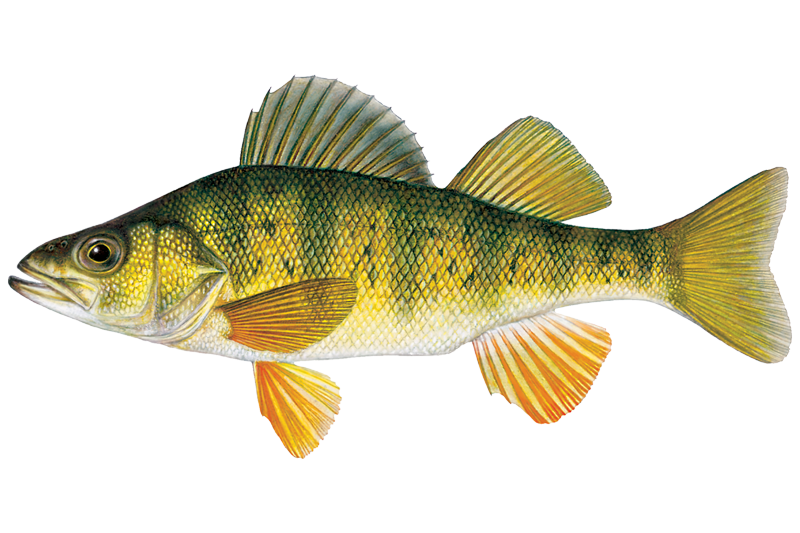
Yellow perch are the backbone of ice fishing culture across Canada — from Lake Simcoe and Lake Erie in Ontario to Lake Winnipeg and Last Mountain Lake on the Prairies.
They school tightly, bite readily, and end up in the frying pan more often than almost any other freshwater species. Open-water anglers target them too, but it's the winter fishery that draws the crowds.
Scientific Name: Perca flavescens
Also known as Perch, striped perch, American perch, perchaude (Quebec)
- Yellow to gold body with a white belly and six to eight dark vertical bars running down the sides — the stripes are the quickest field ID.
- Two distinct dorsal fins: the front one is spiny and fans out when the fish is stressed; the rear has soft rays. Forked tail, amber pectoral fins.
- Most fish run 6–9 inches; anything pushing 12–14 inches is a quality fish on waters like Lake Simcoe. Maximum weight around 1.9 kg, though fish over a pound are noteworthy.
- Can be confused with walleye fry or juvenile pike, but the bold vertical bars and the two separated dorsal fins make adult perch easy to distinguish.
What to know
Habitat Distribution
- Native across a huge swath of Canada — from Nova Scotia and Quebec west through the Great Lakes basin, across the Prairie provinces, and north to Great Slave Lake and the Mackenzie River drainage in the Northwest Territories.
- Introduced to several watersheds in British Columbia, including the Pend Oreille, Kootenay, and Okanagan drainages, where they are considered non-native and can compete with trout.
- Most abundant in Manitoba lakes and the Great Lakes drainage; Lake Winnipeg, Lake Manitoba, and Last Mountain Lake are among the top Prairie fisheries.
- Prefer clear to moderately clear lakes with moderate weed growth and bottoms of sand, gravel, or muck — also found in slow river pools and large ponds.
Key Locations
- Lake Simcoe, Ontario — the premier ice fishery in the province, with a self-sustaining population and fish regularly reaching 12–14 inches.
- Lake Erie, Ontario — productive open-water perch fishing, though the lake rarely freezes well enough for a reliable ice season.
- Lake Winnipeg and Lake Manitoba, Manitoba — among the top perch fisheries in the country for both numbers and size.
- Last Mountain Lake, Saskatchewan — a well-known Prairie perch destination with consistent numbers.
- Lake Nipissing and the bays of Lake Huron's north shore, Ontario — strong populations with lighter fishing pressure than the main Great Lakes fisheries.
Specific Spots
- Submerged weed edges and lily pad lines hold perch through most of the open-water season — the vegetation concentrates the invertebrates and small baitfish they feed on.
- Under the ice, perch school over soft-bottom flats adjacent to deeper water; finding one hole that produces usually means the school is right there, so work the area methodically before moving.
- On Canadian Shield lakes, bays and coves along the north shores of Lake Huron and Lake Superior hold perch that see far less pressure than the main-lake fisheries.
- Drop-offs where weedy shallows meet deeper water are reliable transition zones, especially during low-light periods when perch move up to feed.
Yellow Perch FAQ
Answers from onWater's species guide.
What are the best lures and bait for Yellow Perch?
Small jigs (1/32 to 1/8 oz) tipped with live bait, wax worms, maggots, or a small minnow, are the go-to presentation both through the ice and in open water. Tungsten jigs sink faster and give better feel in deeper water.
When is the best time to fish for Yellow Perch?
Ice season (roughly December through March in most of Ontario and the Prairies) is peak time, perch school tightly under the ice and are highly catchable. Spring open water, once ice-out settles and water warms, sees perch moving shallow to spawn and feed aggressively in the weeds.
How do you catch Yellow Perch?
Most Canadian anglers target perch through the ice, drilling multiple holes over soft-bottom flats and jigging vertically until they locate a school. In open water, drifting or anchoring along weed edges and working small jigs or live bait under a bobber accounts for the majority of fish from boats and shore.
What do Yellow Perch eat?
Invertebrates and aquatic insects, mayfly nymphs, chironomid larvae (bloodworms), and small crayfish, make up the bulk of the diet in most Canadian lakes. Small jigs tipped with a wax worm or maggot imitate this forage well, especially through the ice. Perch also eat minnows and small baitfish, including young perch.
Where do Yellow Perch live?
Native across a huge swath of Canada, from Nova Scotia and Quebec west through the Great Lakes basin, across the Prairie provinces, and north to Great Slave Lake and the Mackenzie River drainage in the Northwest Territories.
See it in the app
Most maps show you water.
onWater shows you Yellow Perch.



- 01 · Species map filter
Map every Yellow Perch water
Pick Yellow Perch and the map zeroes in on the waters they call home. No more guessing which lake holds them.
- 02 · Waterbody species
Tap any water. See what lives there.
Species, behavior and seasonal patterns for every lake, river and pond, before you leave the driveway.
- 03 · Angler Intelligence
Ask how to catch Yellow Perch
Tactics, gear and timing from onWater's AI fishing guide, tuned to the species and the water you're on.
Stop guessing where Yellow Perch are.
Open the map, filter by Yellow Perch, and head to water that holds them. Download onWater and plan your next trip in minutes.
- Species map filter
- Angler Intelligence
- Fishing journal
Explore other species
Trout, bass, salmon, panfish and everything in between. Each guide unpacks the behavior, seasons, and tactics that put fish in the net.
No species information available.
Smarter Fishing Starts in the App.
onWater Fish gives you everything you need to plan smarter, fish better, and own every trip from first cast to last.