White Sucker
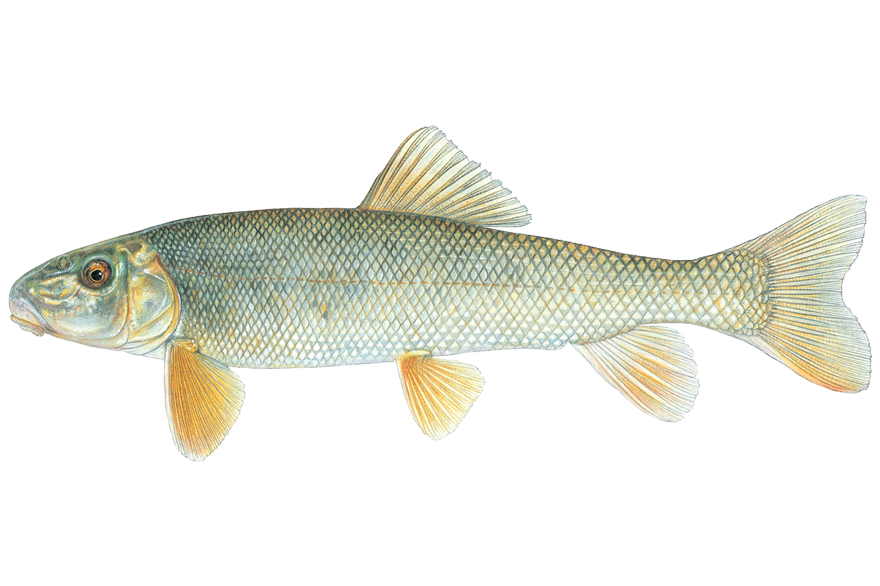
White suckers are one of Canada's most abundant freshwater fish, native from Newfoundland and Labrador clear across to British Columbia and into the Yukon and Northwest Territories.
Most anglers encounter them accidentally while fishing for perch or bass, but a small devoted following targets them directly — especially during spring spawning runs when they pile into small streams by the thousands.
They also rank among the best live bait available for pike, walleye, and catfish.
Scientific Name: Catostomus commersonii
Also known as Common sucker, brook sucker, bay fish, mullet, freshwater mullet, meunier noir
- Long, cylindrical body; olive-brown to grey on the back fading to a cream or white belly — darker overall during the spring spawn.
- Round, downward-pointing mouth rimmed with thick, rubbery lips built for vacuuming the bottom; no barbels, which separates them from catfish.
- Single flat dorsal fin, forked tail with a strong notch; scales grow noticeably larger toward the tail.
- Typical fish run 1–3 lb and 30–45 cm; fish over 5 lb and approaching 50 cm are considered large.
What to know
Habitat Distribution
- Native across Canada — one of the widest freshwater distributions of any Canadian fish, present in every province and territory from Newfoundland to B.C. and into the Yukon and Northwest Territories.
- Found in all of the Great Lakes and their tributary systems, as well as major interior drainages including the Red River, Lake Winnipeg, and Lake of the Woods watersheds.
- Occupy lakes, rivers, streams, and ponds; generally hug shallow water under 10 m and stay close to the bottom year-round, with a slight shift to deeper nearshore areas in winter.
- Highly tolerant of degraded water conditions — they survive where many other species can't — but their presence in clean, fast streams is also a reliable sign of a healthy ecosystem.
Key Locations
- Lake Winnipeg and the Red River (MB) — high densities year-round, with strong spring runs up tributary streams.
- Lake of the Woods (MB/ON border) — productive sucker water with easy access from both provinces.
- Whiteshell River system (MB) — classic spring spawning-run destination.
- Great Lakes tributaries (ON) — spring runs concentrate fish in accessible streams across southern Ontario.
- Rivers near Edmonton and Calgary (AB) — locally popular with Alberta anglers targeting suckers from shore in spring.
Specific Spots
- During spring spawning runs, concentrate in the riffles and tail-outs of small tributary streams — fish the current seams where suckers rest between pushes upstream.
- Outside of spawning, work soft-bottomed shallows along lake margins and slow river pools where they root through silt and sand for food.
- In rivers, look for them in the slower water just downstream of rapids or behind mid-channel boulders — current breaks where they hold without fighting heavy flow.
- Research from northern Ontario shows consistent use of the same nearshore areas season after season, so a productive shallow flat tends to hold fish reliably.
White Sucker FAQ
Answers from onWater's species guide.
What are the best lures and bait for White Sucker?
Earthworms are the standard bait, a small piece fished on a light hook with just enough weight to hold bottom in current covers the spring run and lake fishing alike.
When is the best time to fish for White Sucker?
Spring spawning run, the peak season; fish concentrate in tributary streams in large numbers when water temperatures climb to around 10°C, making them easy to locate and catch. Summer, fish scatter into lake shallows and slow river pools; still catchable on bottom rigs but less concentrated than during the run.
How do you catch White Sucker?
Most Canadian anglers target white suckers from shore during the spring spawning run, fishing worms on the bottom in small tributary streams where fish stack up in the current.
What do White Sucker eat?
Bottom feeders that suck up worms, aquatic insect larvae (including mayfly and midge nymphs), snails, clams, crayfish, algae, and fish eggs, a small hook baited with a piece of earthworm fished on or near the bottom covers most of this diet in one presentation.
Where do White Sucker live?
Native across Canada, one of the widest freshwater distributions of any Canadian fish, present in every province and territory from Newfoundland to B.C. and into the Yukon and Northwest Territories.
See it in the app
Most maps show you water.
onWater shows you White Sucker.



- 01 · Species map filter
Map every White Sucker water
Pick White Sucker and the map zeroes in on the waters they call home. No more guessing which lake holds them.
- 02 · Waterbody species
Tap any water. See what lives there.
Species, behavior and seasonal patterns for every lake, river and pond, before you leave the driveway.
- 03 · Angler Intelligence
Ask how to catch White Sucker
Tactics, gear and timing from onWater's AI fishing guide, tuned to the species and the water you're on.
Stop guessing where White Sucker are.
Open the map, filter by White Sucker, and head to water that holds them. Download onWater and plan your next trip in minutes.
- Species map filter
- Angler Intelligence
- Fishing journal
Explore other species
Trout, bass, salmon, panfish and everything in between. Each guide unpacks the behavior, seasons, and tactics that put fish in the net.
No species information available.

Smarter Fishing Starts in the App.
onWater Fish gives you everything you need to plan smarter, fish better, and own every trip from first cast to last.