White Crappie
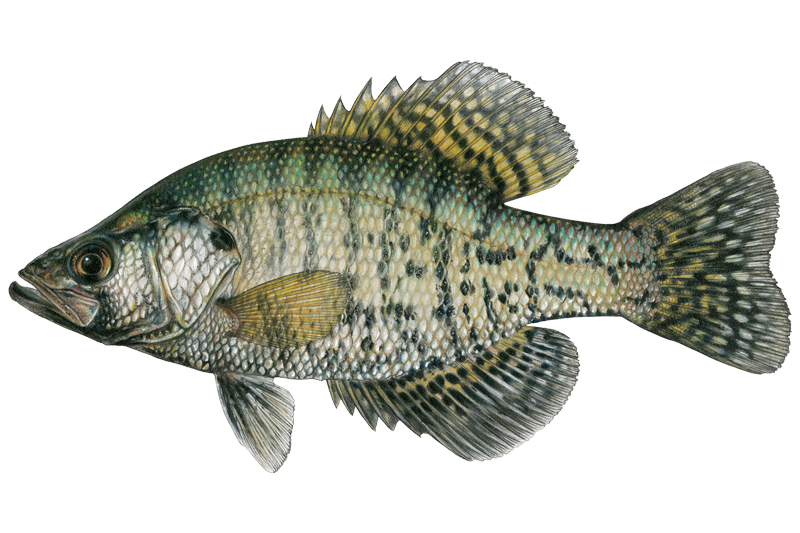
White crappie are native to southern Ontario — part of the Great Lakes and Hudson Bay (Red River) drainages — and show up in select waters across Quebec and the Ontario–Manitoba border region.
They're less common than black crappie in Canada and less well-known to local anglers, which means pressure is light and good fish are there for those who look.
Spring and fall are the prime windows, with slab-sized fish possible in waters like Lake of the Woods and Rainy Lake.
Scientific Name: Pomoxis annularis
Also known as Crappie, silver perch, goldring, white perch, sac-a-lait
- Silvery body with faint olive-green or brown shading on the back and 8–10 dark vertical bars along the sides — bars, not scattered spots like a black crappie.
- Six dorsal fin spines (black crappie has 7–8) and a dorsal fin that starts noticeably farther back on the body — the quickest field ID between the two species.
- Slightly more elongated and less deep-bodied than a black crappie; breeding males go nearly black on the head and breast.
- Typical Canadian fish run 8–12 inches; Rainy Lake and Lake of the Woods have produced slabs in the 10–19 inch range on a smelt-rich diet.
What to know
Habitat Distribution
- Native to southern Ontario through the lower Great Lakes basin and the Hudson Bay drainage (Red River system); also present in select Quebec waters.
- In Ontario, concentrated in the lower Great Lakes area, the Lake of the Woods system, and Rainy Lake near the Minnesota border — the northern edge of the species' natural range.
- Prefers weedy, sheltered bays, mouths of tributary streams, and slow-water areas in lakes and rivers — tolerates turbidity better than black crappie and can thrive in slightly stained water.
- Quebec anglers encounter white crappie in the Outaouais (Ottawa River) region, though the fishery there is lightly pursued compared to trout and walleye.
Key Locations
- Rainy Lake, Northwest Ontario — near the Minnesota border, with a smelt forage base that produces unusually large crappie for this latitude.
- Lake of the Woods, Ontario — one of the most consistently productive crappie fisheries in Canada, with guide operations specifically targeting the species.
- Lower Great Lakes area, southern Ontario — the core of the species' native Canadian range, with fish in weedy bays and tributary mouths.
- Outaouais (Ottawa River) region, Quebec — white crappie present but lightly fished; an underutilized fishery for anglers willing to explore.
Specific Spots
- Shallow, weedy bays with wood or dock cover in spring — crappie move inshore to spawn and stack up around any hard structure they can find.
- Man-made boat cuts, canals, and flooded timber hold fish through the season; crappie suspend at mid-depth alongside submerged objects rather than hugging the bottom.
- In summer, schools push deeper along drop-offs and weed edges, often suspending 8–15 feet down where they can intercept baitfish moving through the water column.
- In fall, fish slow down and pull tight to heavier cover — docks, laydowns, dense weed mats — and react better to a slower, more deliberate presentation.
White Crappie FAQ
Answers from onWater's species guide.
What are the best lures and bait for White Crappie?
Small tube jigs and curly-tail grubs on 1/32–1/8 oz jig heads are the most versatile option, fish them under a float or on a slow, steady retrieve through the water column.
When is the best time to fish for White Crappie?
Spring (April–May in southern Ontario), fish move into shallow bays and tributary mouths as ice clears; the spawn makes them concentrated and catchable near cover. Summer, schools suspend along deeper weed edges and drop-offs; early morning and evening produce the most action.
How do you catch White Crappie?
Most Canadian crappie fishing happens from a boat, working shallow bays and structure with a float-and-jig or live minnow rig in spring, then following schools to deeper water and weed edges through summer. Shore fishing from docks and boat cuts is productive during the spring spawn when fish move into the shallows.
What do White Crappie eat?
Small baitfish are the main forage in productive Canadian waters, Rainy Lake crappie feed heavily on smelt, which is why fish there grow to slab size. Match this with small tube jigs, curly-tail grubs, or live minnows fished under a float.
Where do White Crappie live?
Native to southern Ontario through the lower Great Lakes basin and the Hudson Bay drainage (Red River system); also present in select Quebec waters.
See it in the app
Most maps show you water.
onWater shows you White Crappie.



- 01 · Species map filter
Map every White Crappie water
Pick White Crappie and the map zeroes in on the waters they call home. No more guessing which lake holds them.
- 02 · Waterbody species
Tap any water. See what lives there.
Species, behavior and seasonal patterns for every lake, river and pond, before you leave the driveway.
- 03 · Angler Intelligence
Ask how to catch White Crappie
Tactics, gear and timing from onWater's AI fishing guide, tuned to the species and the water you're on.
Stop guessing where White Crappie are.
Open the map, filter by White Crappie, and head to water that holds them. Download onWater and plan your next trip in minutes.
- Species map filter
- Angler Intelligence
- Fishing journal
Explore other species
Trout, bass, salmon, panfish and everything in between. Each guide unpacks the behavior, seasons, and tactics that put fish in the net.
No species information available.

Smarter Fishing Starts in the App.
onWater Fish gives you everything you need to plan smarter, fish better, and own every trip from first cast to last.