Tiger Trout
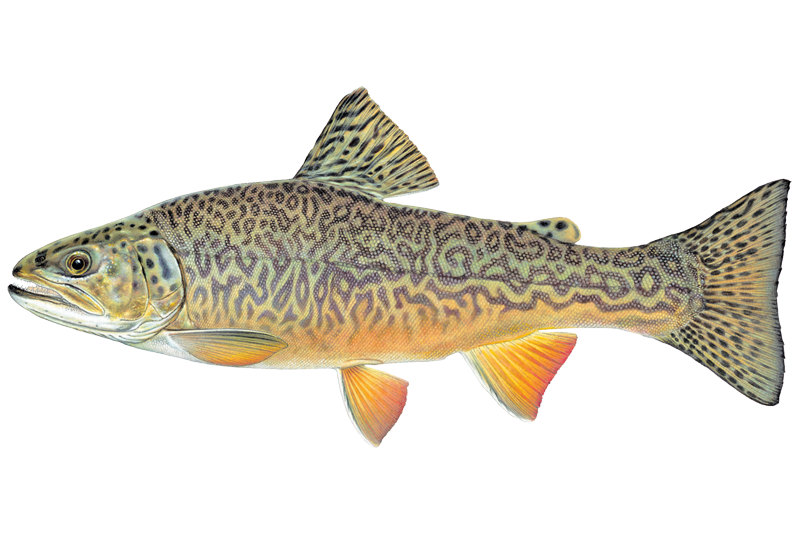
Tiger trout are a sterile hybrid — brook trout crossed with brown trout — stocked into select lakes and ponds in Alberta and Manitoba, with occasional wild-caught fish turning up in Nova Scotia rivers where both parent species share water.
Because they can't reproduce, every tiger trout in a Canadian lake got there through a hatchery program.
That sterility frees up energy for fast growth and an unusually aggressive feeding response, which is exactly why stocking programs use them and why anglers chase them.
Also known as Tiger, Zebra trout
- Bold, maze-like vermiculations (worm-pattern markings) cover the flanks and back — darker and more pronounced than the subtle worm-marks on a brook trout, with no distinct spots like a brown trout.
- Belly runs orange-yellow; fins carry the brook trout's crisp white-and-black leading edges, which help separate them from both parent species at a glance.
- Stocked fish in Alberta and Manitoba commonly run 14–22 inches; fish pushing 26–28 inches have been recorded in Manitoba's stocked lakes.
What to know
Habitat Distribution
- Not native anywhere in Canada — every population comes from hatchery stocking programs run by Alberta Environment and Parks (AEP), the Alberta Conservation Association (ACA), and Manitoba fisheries managers.
- In Alberta, stocked primarily into cold stillwaters: lakes, ponds, and select reservoirs across the province, often sharing water with rainbows and brook trout.
- In Manitoba, stocked into designated lakes as a specialty fishery targeting open-water and hard-water (ice fishing) seasons.
- Rare wild-caught fish have been documented in Nova Scotia's Cornwallis River, where naturally occurring brook and brown trout populations overlap closely enough to produce the hybrid.
Key Locations
- Stocked lakes and ponds across Alberta, managed through Alberta Environment and Parks and the Alberta Conservation Association — Lower Chain Lakes is one documented example.
- Designated stocked lakes in Manitoba, where the species has developed a dedicated following among open-water and ice anglers; Manitoba's record fish have reached 28 inches.
- Cornwallis River, Nova Scotia — a documented site for naturally occurring wild tiger trout where brook and brown trout populations overlap.
Specific Spots
- In stillwaters, work the transition zones between shallow shoals and deeper water — tigers cruise these edges hunting smaller fish pushed up from the depths.
- Inlet streams and aeration points concentrate forage fish and draw tigers in, especially during warm summer afternoons when oxygen levels drop in the main basin.
- Weedline edges and submerged structure (timber, rock piles) give tigers a staging area to cut off baitfish — presentations worked parallel to these edges draw reaction strikes.
- In rivers like the Cornwallis, look for current breaks behind boulders and undercut banks where brown and brook trout typically hold — wild tigers use the same lies.
Tiger Trout FAQ
Answers from onWater's species guide.
What are the best lures and bait for Tiger Trout?
Minnow-profile hard baits, jointed Rapalas and similar stick baits in silver, gold, or natural perch patterns, are the most consistent producers, retrieved with an erratic stop-and-go action that triggers reaction strikes.
What flies work for Tiger Trout?
Large streamers are the first choice for tigers actively hunting baitfish, Zonkers and Muddler Minnows (both imitate small fish and sculpin) on a sinking line, stripped with short, sharp pulls to mimic a fleeing minnow.
When is the best time to fish for Tiger Trout?
Open water: May, June, September, and October are the most productive months in Manitoba, when water temperatures sit in the tiger's preferred range and fish are actively feeding near the surface.
How do you catch Tiger Trout?
In Alberta and Manitoba, most anglers fish tigers from shore or small boats on stocked stillwaters, working shoal edges and drop-offs with minnow-profile lures or streamers. Ice fishing is a legitimate and popular approach in Manitoba through the hard-water months.
What do Tiger Trout eat?
Smaller fish make up the bulk of the diet once tigers reach any size, stocked alongside perch, shiners, or other trout, they'll target them actively.
See it in the app
Most maps show you water.
onWater shows you Tiger Trout.



- 01 · Species map filter
Map every Tiger Trout water
Pick Tiger Trout and the map zeroes in on the waters they call home. No more guessing which lake holds them.
- 02 · Waterbody species
Tap any water. See what lives there.
Species, behavior and seasonal patterns for every lake, river and pond, before you leave the driveway.
- 03 · Angler Intelligence
Ask how to catch Tiger Trout
Tactics, gear and timing from onWater's AI fishing guide, tuned to the species and the water you're on.
Stop guessing where Tiger Trout are.
Open the map, filter by Tiger Trout, and head to water that holds them. Download onWater and plan your next trip in minutes.
- Species map filter
- Angler Intelligence
- Fishing journal
Explore other species
Trout, bass, salmon, panfish and everything in between. Each guide unpacks the behavior, seasons, and tactics that put fish in the net.
No species information available.

Smarter Fishing Starts in the App.
onWater Fish gives you everything you need to plan smarter, fish better, and own every trip from first cast to last.