Striped Bass
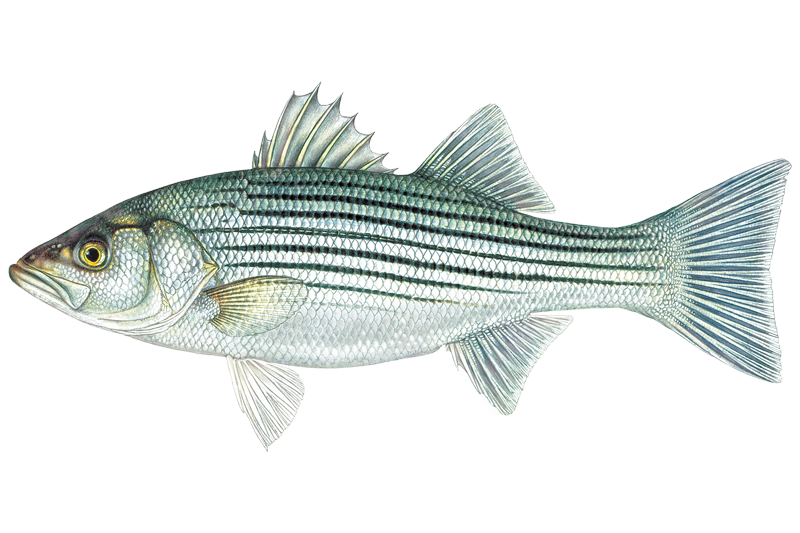
Striped bass are native to Canada's Atlantic coast, with the Miramichi River system as the core of the Canadian population. After a near-collapse in the late 1990s and a moratorium in the early 2000s, the stock has rebounded strongly.
Today, anglers fish them from shore and in estuaries across New Brunswick, Nova Scotia, PEI, and Quebec's Gaspé coast — a genuine conservation success story that's still unfolding.
Scientific Name: Morone saxatilis
Also known as Striper, linesider, rockfish
- Silvery body with seven or eight continuous dark horizontal stripes running from behind the gills to the tail — the clearest field mark for ID.
- Back ranges from olive-green to steel blue or near-black; belly is white to silver-iridescent. Stout, muscular build.
- Females grow larger than males; typical fish in Canadian waters run a few pounds up to the mid-teens, with larger fish present and growing as the population matures.
- Can live up to 30 years and reach over 70 pounds, though fish that size are rare in Canadian waters given the stock's recent recovery.
What to know
Habitat Distribution
- Native to the Atlantic coast of Canada; the Miramichi River in New Brunswick is the primary spawning system for the Canadian population — a distinct strain from US fish.
- After spawning, fish disperse through the southern Gulf of St. Lawrence, reaching the Northumberland Strait, PEI estuaries, Nova Scotia's Minas Basin and Atlantic coast rivers, and brackish waters along the Gaspé and St. Lawrence in Quebec.
- Anadromous — adults live in salt and brackish water most of the year, moving into freshwater rivers and tidal tributaries to spawn over gravel in running water.
- Juveniles spend their early years in rivers and estuaries before moving to saltwater; adults use river mouths, tidal flats, and open coastal water seasonally.
Key Locations
- Miramichi River, New Brunswick — the core spawning system for the Canadian population; fish stage in the estuary after spawning.
- Northumberland Strait — the shallow, warm waters between NB, NS, and PEI concentrate post-spawn fish through summer.
- Prince Edward Island estuaries — multiple river mouths and tidal inlets hold fish through the season; accessible from shore.
- Minas Basin and Atlantic coast river estuaries, Nova Scotia — the Shubenacadie and St. John systems are known striper waters.
- Gaspé Peninsula and St. Lawrence brackish water, Quebec — a more remote option drawing surfcasters willing to make the trip for fish in rugged coastal scenery.
Specific Spots
- River mouths and tidal estuaries concentrate fish as they stage before and after spawning — current seams where fresh and salt water meet are reliable holding areas.
- Shallow tidal flats and sandbars, especially at dawn and dusk, draw feeding fish chasing baitfish pushed by tidal movement.
- Rocky points, jetties, and rip lines along the Gaspé and PEI coastlines create current breaks where stripers stack to intercept prey moving with the tide.
- Drop-offs at the edges of tidal channels hold fish during midday heat; work the transition zone between shallow flats and deeper water.
Striped Bass FAQ
Answers from onWater's species guide.
What are the best lures and bait for Striped Bass?
Bucktail jigs (1–3 oz) are the most versatile lure in the striper toolkit, cast them into current, let them sink, and retrieve with a lift-and-drop to imitate a wounded baitfish.
What flies work for Striped Bass?
Clouser Minnows (which imitate baitfish with their weighted eyes and bucktail wing) in white, chartreuse, or olive are the single most reliable striper fly across all Canadian waters, carry them in sizes 1/0 to 3/0.
When is the best time to fish for Striped Bass?
Late spring through early summer: fish move into estuaries and tidal rivers post-spawn; catch-and-release rules apply in many areas during the spawn itself. Summer: the main open-water season across the southern Gulf of St.
How do you catch Striped Bass?
Most Canadian striper fishing happens from shore, surfcasting with cut bait or lures along tidal flats, river mouths, and rocky points. Fly anglers wade estuaries and tidal edges, especially on PEI and in Nova Scotia.
What do Striped Bass eat?
Adults eat smaller fish, herring, mackerel, sand lance, and whatever baitfish are locally abundant, which makes matching the local bait size and profile the most important decision when choosing a lure or fly.
See it in the app
Most maps show you water.
onWater shows you Striped Bass.



- 01 · Species map filter
Map every Striped Bass water
Pick Striped Bass and the map zeroes in on the waters they call home. No more guessing which lake holds them.
- 02 · Waterbody species
Tap any water. See what lives there.
Species, behavior and seasonal patterns for every lake, river and pond, before you leave the driveway.
- 03 · Angler Intelligence
Ask how to catch Striped Bass
Tactics, gear and timing from onWater's AI fishing guide, tuned to the species and the water you're on.
Stop guessing where Striped Bass are.
Open the map, filter by Striped Bass, and head to water that holds them. Download onWater and plan your next trip in minutes.
- Species map filter
- Angler Intelligence
- Fishing journal
Explore other species
Trout, bass, salmon, panfish and everything in between. Each guide unpacks the behavior, seasons, and tactics that put fish in the net.
No species information available.

Smarter Fishing Starts in the App.
onWater Fish gives you everything you need to plan smarter, fish better, and own every trip from first cast to last.