Splake
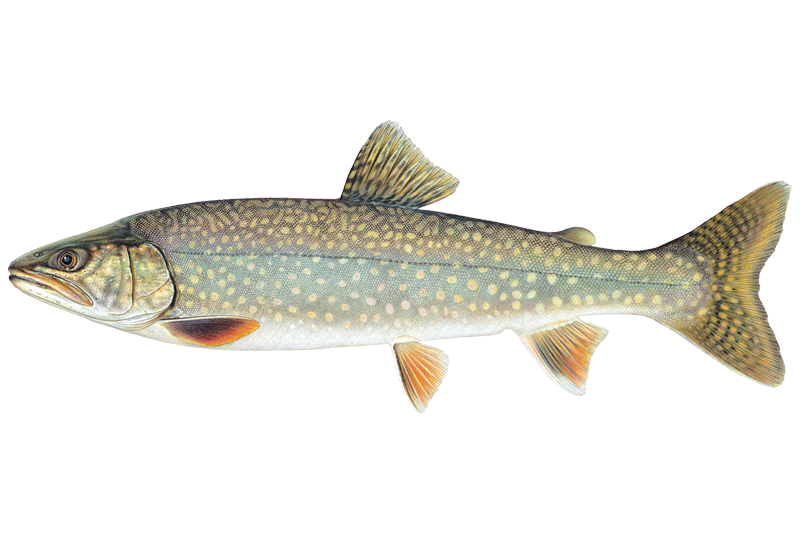
Splake are a hatchery hybrid — male brook trout crossed with female lake trout — stocked extensively across Ontario since the 1970s.
They've become a genuine target species in their own right, particularly in Northern Ontario lakes where they grow well beyond early expectations. Ice fishing and early open-water seasons are when most Ontario anglers connect with them.
Also known as Speckle, Specklake
- Body sits between brook trout and lake trout in shape — slightly deeper than a laker, with a tail that's only lightly forked rather than the laker's deep V.
- Light spots on a dark background, some red spots present but without the blue halos you'd see on a pure brook trout; tricoloured fins.
- Appearance varies fish to fish — some look nearly identical to brook trout, others lean toward lake trout; coloration can be dull or vivid.
- Typical catch runs 10–18 inches; fish over 20 inches are notable, and the Ontario record sits at 20.71 lbs.
What to know
Habitat Distribution
- Not native anywhere — splake are a hatchery hybrid stocked by the Ontario Ministry of Natural Resources across much of the province since the 1970s.
- Most stocking has occurred in Northern and Northeastern Ontario, with fish present in lakes around North Bay, Gogama, Nakina, the Lake Nipigon watershed, and Algonquin-area waters.
- Require cold, clear water year-round, but can handle slightly marginal trout habitat — including lower-pH lakes — better than pure lake trout.
- Behaviorally they track lake trout: deep, cold water in summer, shallower in spring and under ice in winter.
Key Locations
- Northeastern Ontario lakes south of Gogama — remote, snowmachine-access waters known for consistent winter catches of both splake and brook trout.
- Nakina area, Northwestern Ontario — Lucy Lake and surrounding waters regularly produce splake in the 2–5 lb range.
- Lake Nipigon watershed, Northwestern Ontario — hundreds of spring-fed lakes in this region hold splake alongside brook trout and lake trout.
- North Bay / Trout Creek area, Northern Ontario — stocked lakes within easy reach of town, with fall splake fishing drawing local anglers using float-fishing tactics.
- Bancroft-area lakes near Algonquin, Southern Ontario — stocked splake lakes accessible to anglers from further south, with fish taken trolling drop-offs.
Specific Spots
- Right after ice-out, splake move into the shallows — shoreline structure, rocky points, and shallow bays are worth covering before the water warms.
- As temperatures climb, fish push to 40–50 feet; drop-offs from shallow flats into deeper basins concentrate them in summer.
- Under ice, fish tend to suspend over deeper water — drilling along depth transitions and drop-offs near 20–30 feet produces well.
- Splake are easily spooked; approach quietly and work structure methodically rather than burning through spots.
Splake FAQ
Answers from onWater's species guide.
What are the best lures and bait for Splake?
Small flashy spoons (1/8–1/4 oz) and inline spinners are consistent producers at all seasons, they imitate the small baitfish splake key on. Small minnow-style plugs (think Rapala-style floaters and countdown models in the 2–3 inch range) work well cast along drop-offs or trolled at depth.
What flies work for Splake?
Streamers are the main event, Woolly Buggers and Clouser Minnows (both imitate small baitfish) in olive, white, or black cover most situations; size 6–10 works well. Leech patterns and small Muddler Minnows (which imitate both baitfish and sculpin) are worth carrying for deeper presentations on a sinking-tip line.
When is the best time to fish for Splake?
Ice fishing (January through late winter), one of the most reliable windows; fish feed actively under ice and concentrate over predictable structure. Ice-out through late spring, splake are in the shallows and at their most accessible for light-tackle and fly anglers before water temperatures rise.
How do you catch Splake?
Most Ontario anglers target splake through the ice in winter, jigging small spoons or minnow-tipped jigs over drop-offs in 20–30 feet of water.
What do Splake eat?
Minnows and small baitfish are the primary forage once splake reach any size, small minnow-imitating plugs, spoons, and spinners all work because they match this forage directly.
See it in the app
Most maps show you water.
onWater shows you Splake.



- 01 · Species map filter
Map every Splake water
Pick Splake and the map zeroes in on the waters they call home. No more guessing which lake holds them.
- 02 · Waterbody species
Tap any water. See what lives there.
Species, behavior and seasonal patterns for every lake, river and pond, before you leave the driveway.
- 03 · Angler Intelligence
Ask how to catch Splake
Tactics, gear and timing from onWater's AI fishing guide, tuned to the species and the water you're on.
Stop guessing where Splake are.
Open the map, filter by Splake, and head to water that holds them. Download onWater and plan your next trip in minutes.
- Species map filter
- Angler Intelligence
- Fishing journal
Explore other species
Trout, bass, salmon, panfish and everything in between. Each guide unpacks the behavior, seasons, and tactics that put fish in the net.
No species information available.
Smarter Fishing Starts in the App.
onWater Fish gives you everything you need to plan smarter, fish better, and own every trip from first cast to last.