Smallmouth Bass
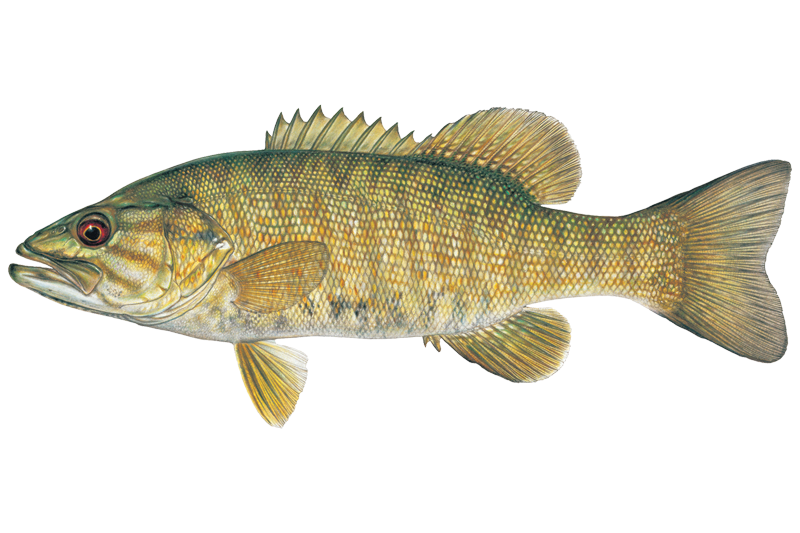
Smallmouth bass are the defining gamefish of the Canadian Shield. Native to the St.
Lawrence–Great Lakes system and Hudson Bay drainages, they thrive in the cold, clear, rocky lakes of Ontario and Quebec — and have been introduced across parts of British Columbia and Saskatchewan.
Anglers target them for their acrobatic fights and willingness to hit topwater, making them a favourite on remote fly-in lakes across northern Ontario.
Scientific Name: Micropterus dolomieu
Also known as Smallie, bronzeback, achigan à petite bouche
- Golden-olive to dark brown back fading to yellowish-white belly; vertical bars along the sides range from sharp and dark in clear water to faint in stained water.
- Upper jaw ends at or before the eye — the key distinction from largemouth bass, whose jaw extends past it. Eyes sometimes have a reddish tint.
- Dark bars radiate back from the eye; dorsal fins appear joined rather than clearly separated as on largemouth.
- Most Canadian fish run 12–18 inches; fish over 20 inches are notable, and the species tops out near 27 inches and 12 lbs.
What to know
Habitat Distribution
- Native to the St. Lawrence–Great Lakes basin, Hudson Bay drainage, and southern Quebec — the Canadian Shield is core habitat.
- Ontario holds the bulk of Canada's smallmouth fishery: Eagle Lake, Lake of the Woods, the English River system, and countless remote Canadian Shield lakes.
- Introduced and established in southern British Columbia, including Osoyoos Lake and other Okanagan Valley lakes, parts of the Columbia River system, and Vancouver Island. Also present in southeastern Saskatchewan.
- Favour clear, cool, rocky lakes and rivers — Canadian Shield water is ideal, with visible structure in six to ten feet common on the best lakes.
Key Locations
- Lake of the Woods, Ontario/Manitoba — vast rocky Shield lake with a well-established smallmouth population and long open-water season.
- Eagle Lake, Ontario — known for consistent numbers and size, with complex structure including broken rock, timber, and deep humps.
- English River system, Ontario — clear Shield water with good populations accessible from remote outpost camps.
- Remote fly-in lakes of northwestern Ontario — minimal pressure and rocky Canadian Shield habitat produce fish in the 4–5 lb range regularly.
- Osoyoos Lake, British Columbia — warmest smallmouth water in Canada; fish run large and hold deep in summer to escape surface heat.
Specific Spots
- During and just after the spawn, fish concentrate on shallow bays with mixed sand, rubble, and sparse weeds — pairs or groups hold tight to beds, making multiple fish from one spot realistic.
- In summer heat, smallmouth slide to the shady side of downed timber, broken rock, and mixed vegetation along shorelines, then push deeper to reefs and rocky humps at midday — 10 to 20 feet is a reliable summer depth.
- Rocky points, islands, and shoals are year-round magnets; bass use the edges where rock meets deeper water as feeding lanes.
- In fall, deep humps and underwater structure hold fish stacking up to feed heavily on minnows before ice-up.
Smallmouth Bass FAQ
Answers from onWater's species guide.
What are the best lures and bait for Smallmouth Bass?
Tube jigs in green pumpkin, smoke, or brown are the go-to for rocky Canadian Shield lakes, they imitate crayfish and can be crawled, hopped, or dragged along bottom structure.
What flies work for Smallmouth Bass?
Deer Hair Poppers and foam surface bugs imitate frogs or injured baitfish, the topwater bite on remote Shield lakes is one of the best reasons to bring a fly rod for smallmouth.
When is the best time to fish for Smallmouth Bass?
Spring (late May–June): Fish concentrate on shallow spawning bays and are most active near structure, Ontario regulations typically require catch-and-release during this period.
How do you catch Smallmouth Bass?
Most Canadian smallmouth fishing is done by boat, working rocky shorelines, points, and reefs with spinning or baitcasting gear. On remote fly-in lakes in Ontario, topwater presentations at dawn and dusk draw fish to the surface, while jigging tubes or crankbaits along structure covers the midday hours when fish push...
What do Smallmouth Bass eat?
Crayfish are the primary forage across most Canadian Shield lakes, match them with tube jigs in green pumpkin or brown, or soft-plastic crayfish imitations worked slowly along rocky bottom.
See it in the app
Most maps show you water.
onWater shows you Smallmouth Bass.



- 01 · Species map filter
Map every Smallmouth Bass water
Pick Smallmouth Bass and the map zeroes in on the waters they call home. No more guessing which lake holds them.
- 02 · Waterbody species
Tap any water. See what lives there.
Species, behavior and seasonal patterns for every lake, river and pond, before you leave the driveway.
- 03 · Angler Intelligence
Ask how to catch Smallmouth Bass
Tactics, gear and timing from onWater's AI fishing guide, tuned to the species and the water you're on.
Stop guessing where Smallmouth Bass are.
Open the map, filter by Smallmouth Bass, and head to water that holds them. Download onWater and plan your next trip in minutes.
- Species map filter
- Angler Intelligence
- Fishing journal
Explore other species
Trout, bass, salmon, panfish and everything in between. Each guide unpacks the behavior, seasons, and tactics that put fish in the net.
No species information available.
Smarter Fishing Starts in the App.
onWater Fish gives you everything you need to plan smarter, fish better, and own every trip from first cast to last.