Sauger
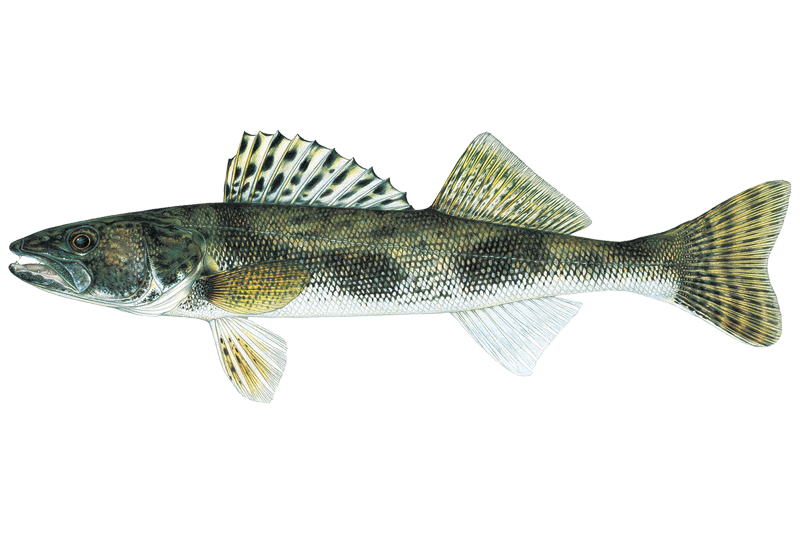
Sauger are native to Canada from Quebec west to Alberta, living in the same river systems as walleye but running deeper and murkier water.
They're smaller than walleye on average, but they bite when walleye won't — low-light, high-turbidity days that shut other fish down are prime sauger time. Table fare is excellent, and the deep-river puzzle of finding them keeps dedicated anglers coming back.
Scientific Name: Sander canadensis
Also known as Doré noir, sand pike, river pike
- Brown or brassy body with dark blotches and a white belly; generally darker overall than walleye, sometimes appearing almost grey in turbid water.
- Key ID mark: two or three rows of distinct black spots on the first (spiny) dorsal fin — walleye lack these spots entirely.
- No white tip on the lower tail lobe (walleye have one); rough, sandpapery skin over the gill covers is another reliable field check.
- Typical Canadian fish run 300–700 g; the Ontario record is just under 2 kg — a fish over 1 kg is a solid catch anywhere in their range.
What to know
Habitat Distribution
- Native across central and eastern Canada: the St. Lawrence River system and Great Lakes, the Ottawa River drainage, and westward through Ontario, Manitoba, Saskatchewan, and into Alberta.
- Strongly river-oriented — large, turbid, slow-to-moderate rivers with silt, sand, or clay bottoms are their core habitat, though they also use large, murky lakes connected to those systems.
- The most migratory member of the perch family in North America; they move long distances upstream to spawn, then drop back downstream — rivers like the Ottawa and the Saskatchewan system see these seasonal runs.
- Share water with walleye across much of their range, but consistently hold in deeper, faster, or more turbid stretches that walleye avoid.
Key Locations
- Ottawa River, Ontario/Quebec — the most accessible sauger fishery for anglers in eastern Canada, with fish present through much of the river's length.
- Lake Abitibi and the Abitibi River system, northern Ontario — known for dense sauger populations, though consumption advisories apply.
- Detroit River, Ontario — produced the Ontario record; a border-water fishery with strong sauger numbers in the deep, fast current.
- Saskatchewan River system, Saskatchewan/Manitoba — part of the species' western Canadian range; large turbid rivers here hold fish through the season.
- Kenora/Dryden area rivers, northwestern Ontario — consistently mentioned by Ontario anglers as reliable sauger water.
Specific Spots
- Deep holes and scoured pools in main river channels — sauger sit belly-to-bottom in 20–40 feet, especially smaller fish, while bigger ones push shallower at low light.
- The upstream (current-facing) edge of gravel bars, sandbars, and river points — sauger hold tighter to current than walleye do, using structure to break the flow while staying close to the feeding lane.
- Tailwaters below dams concentrate fish during migration and in winter; current seams where fast and slow water meet are reliable holding spots year-round.
- In large turbid lakes, look for them on sand or gravel flats near main-lake points, hugging the bottom in deeper water than walleye typically use.
Sauger FAQ
Answers from onWater's species guide.
What are the best lures and bait for Sauger?
Jigs are the foundation of sauger fishing everywhere in Canada, 1/8 to 3/8 oz lead-head jigs tipped with a live or dead minnow, soft-plastic minnow body, or twister tail. Bounce them along the bottom in current; the strike usually comes on the drop.
When is the best time to fish for Sauger?
Spring (March–May): upstream spawning migrations concentrate fish below dams and in river narrows, one of the most reliable times to intercept large numbers of fish. Summer (June–August): fish scatter into deeper holes and main-channel structure; low-light windows at dawn and dusk are the most productive periods.
How do you catch Sauger?
Most Canadian sauger fishing happens from a boat, drifting or anchoring in river current and working jigs vertically along the bottom. Shore fishing is productive at tailwaters below dams, especially during spring upstream migrations. Ice fishing over deep river holes and connected lakes produces fish through winter.
What do Sauger eat?
Sauger eat smaller fish, shiners, young perch, emerald shiners, and other baitfish, making jigs tipped with soft-plastic minnow bodies or live/dead minnows the go-to presentation across Canada. They also take aquatic invertebrates, including mayfly nymphs and crayfish, especially in rivers.
Where do Sauger live?
Native across central and eastern Canada: the St. Lawrence River system and Great Lakes, the Ottawa River drainage, and westward through Ontario, Manitoba, Saskatchewan, and into Alberta.
See it in the app
Most maps show you water.
onWater shows you Sauger.



- 01 · Species map filter
Map every Sauger water
Pick Sauger and the map zeroes in on the waters they call home. No more guessing which lake holds them.
- 02 · Waterbody species
Tap any water. See what lives there.
Species, behavior and seasonal patterns for every lake, river and pond, before you leave the driveway.
- 03 · Angler Intelligence
Ask how to catch Sauger
Tactics, gear and timing from onWater's AI fishing guide, tuned to the species and the water you're on.
Stop guessing where Sauger are.
Open the map, filter by Sauger, and head to water that holds them. Download onWater and plan your next trip in minutes.
- Species map filter
- Angler Intelligence
- Fishing journal
Explore other species
Trout, bass, salmon, panfish and everything in between. Each guide unpacks the behavior, seasons, and tactics that put fish in the net.
No species information available.
Smarter Fishing Starts in the App.
onWater Fish gives you everything you need to plan smarter, fish better, and own every trip from first cast to last.