Rock Bass
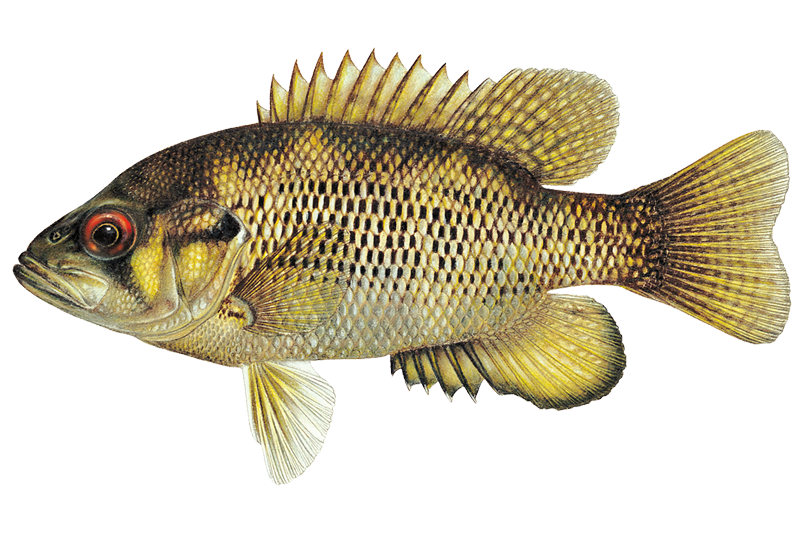
Rock bass are a native panfish found across southern and central Ontario and into the Great Lakes basin — scrappy, willing biters that punch above their weight on light tackle.
They're a genuine target in their own right, not just a bycatch, and their willingness to bite all day in summer makes them a reliable option when walleye and bass go quiet.
Scientific Name: Ambloplites rupestris
Also known as Redeye, goggle-eye, rock perch, black perch
- Bronze to olive-green body with rows of dark spots along the sides; back often shows darker saddle markings with golden or brassy flanks.
- The large, distinctly red or orange eye is the single best field mark — no other common Ontario panfish has it.
- Six spines in the anal fin (most sunfish have three) and 10–13 spines in the dorsal fin; deep, compressed body with a bass-sized mouth.
- Typical fish run 15–20 cm (6–8 in) and under half a pound; Ontario record is 1.4 kg (3.0 lb), but anything over 0.7 kg (1.5 lb) is a genuine trophy.
What to know
Habitat Distribution
- Native to Ontario — found throughout southern and central Ontario, the Great Lakes system, and portions of northwestern Ontario; range extends into Quebec and west toward Saskatchewan.
- Prefer clear, cool to moderately warm lakes and slow-moving rivers with hard, rocky bottoms — the Latin species name rupestris literally means "of the rocks."
- Regularly share water with smallmouth bass and other sunfish; where you find rocky shoals holding smallmouth, rock bass are usually nearby.
- Also turn up in Lake of the Woods and Whiteshell Lakes in Manitoba, and in tributaries of Lake Winnipeg.
Key Locations
- Lake of the Woods (Ontario/Manitoba border) — classic rocky-shoal habitat holds strong populations alongside smallmouth bass.
- Southern and central Ontario shield lakes — the Canadian Shield's rocky structure is near-ideal habitat; rock bass are widespread across this region.
- The Great Lakes nearshore — rocky points and rubble zones along Lake Ontario, Lake Erie, and Georgian Bay hold fish through the summer.
- Whiteshell Lakes and Falcon Lake, Manitoba — among the westernmost reliable rock bass waters in Canada.
Specific Spots
- Rocky points, shoals, and rubble-strewn reefs — rock bass tuck into crevices and hold tight to hard structure rather than roaming open water.
- In strong sunlight they move under docks, sunken logs, and overhanging woody debris; shade is a reliable locator on bright summer days.
- In rivers, look for sheltered pool edges behind boulders and along current breaks where they can hold without fighting heavy flow.
- Rock bass stay in a relatively small home range, so once you find a productive rock pile or dock, it tends to hold fish consistently through the season.
Rock Bass FAQ
Answers from onWater's species guide.
What are the best lures and bait for Rock Bass?
Small tube jigs (1/16–1/8 oz) in brown, green, or orange are the go-to for rocky structure, they sink into crevices and mimic crayfish naturally. Small inline spinners (size 1–2), shallow crankbaits, and small minnow plugs work well when rock bass are active along rock edges and points.
What flies work for Rock Bass?
Small poppers and foam bugs (size 8–10) draw surface strikes near docks and woody debris, one of the most entertaining ways to fish for them on a calm evening.
When is the best time to fish for Rock Bass?
Summer (June–August) is peak season, rock bass feed actively throughout the day in warm water and are easiest to locate on rocky structure. Spring (post-spawn, late May into June) sees fish concentrated in shallow rocky areas; they're accessible and willing near spawning habitat.
How do you catch Rock Bass?
Most anglers in Ontario fish rock bass from a boat or by wading, casting small jigs or spinners tight to rocky structure. They're a natural bonus species when smallmouth fishing, but dedicated sessions with ultralight gear on known rocky shoals or dock-lined bays produce consistent action all day in summer.
What do Rock Bass eat?
Crayfish are a primary forage, small tube jigs and soft-plastic creature baits in brown, orange, or green directly imitate them and are among the most consistent producers.
See it in the app
Most maps show you water.
onWater shows you Rock Bass.



- 01 · Species map filter
Map every Rock Bass water
Pick Rock Bass and the map zeroes in on the waters they call home. No more guessing which lake holds them.
- 02 · Waterbody species
Tap any water. See what lives there.
Species, behavior and seasonal patterns for every lake, river and pond, before you leave the driveway.
- 03 · Angler Intelligence
Ask how to catch Rock Bass
Tactics, gear and timing from onWater's AI fishing guide, tuned to the species and the water you're on.
Stop guessing where Rock Bass are.
Open the map, filter by Rock Bass, and head to water that holds them. Download onWater and plan your next trip in minutes.
- Species map filter
- Angler Intelligence
- Fishing journal
Explore other species
Trout, bass, salmon, panfish and everything in between. Each guide unpacks the behavior, seasons, and tactics that put fish in the net.
No species information available.
Smarter Fishing Starts in the App.
onWater Fish gives you everything you need to plan smarter, fish better, and own every trip from first cast to last.