River Redhorse
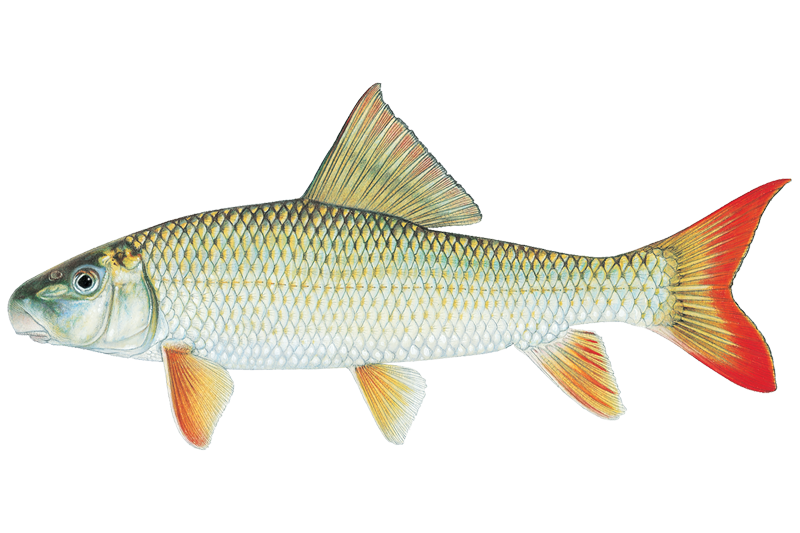
The river redhorse is a large, native sucker found in a handful of southern Ontario and Quebec river systems.
It's a species of special concern under Canada's Species at Risk Act, so most anglers who encounter one do so while targeting walleye or smallmouth bass.
A few dedicated anglers chase them deliberately — on crayfish, worms, or even fly tackle — for the sheer novelty of landing a 5-plus-pound bottom-feeder built like a brick.
Scientific Name: Moxostoma carinatum
Also known as Big-sawed sucker, river mullet, greater redhorse, redfin redhorse, redhorse sucker
- Large, thick-bodied sucker reaching up to 30 inches and over 10 lbs; brassy olive back, copper-yellow sides, white belly, and unmistakably bright red tail and anal fins in adults.
- Blunt, fleshy snout with deeply grooved, crumpled-looking lips — the most reliable field mark separating it from shorthead and greater redhorse.
- No barbels (whiskers) around the mouth, which distinguishes it immediately from common carp in the same water.
- Breeding males develop tubercles on the snout and head and a dark lateral stripe; these spawning colors fade quickly once the fish is handled.
What to know
Habitat Distribution
- Native to southeastern Canada only; Canadian populations are disjunct and limited to southern Ontario and Quebec, with documented fish in the Grand, Trent, Thames, Mississippi, Gatineau, Richelieu, and Ottawa rivers.
- Requires clear, medium to large rivers with moderate to strong current — intolerant of siltation, high turbidity, and pollution; disappeared from heavily agricultural watersheds like the Yamaska and Châteauguay.
- Most often found in deep rocky runs and pools, typically between 1 and 10 feet, over gravel and rubble substrate.
- Some fish move to deeper water or lakes to overwinter, returning to fast, shallow river sections to spawn in late spring.
Key Locations
- Ottawa River — recent surveys show a wider distribution than previously known, making it one of the more accessible Canadian locations.
- Grand River, Ontario — one of the documented southwestern Ontario populations in a river system managed for water quality improvement.
- Trent River system, Ontario — holds a known population in eastern Ontario.
- Richelieu River, Quebec — a documented Quebec population, though late-spring pesticide runoff is an ongoing concern for spawning fish here.
- Gatineau River, Quebec — another Quebec catchment with confirmed river redhorse presence.
Specific Spots
- Long, deep runs over clean gravel and rubble between riffles — this is where adults hold and feed, using current to deliver food to them.
- Tail-outs of pools where current picks back up; river redhorse position here to intercept dislodged invertebrates tumbling off the bottom.
- Rocky current breaks mid-river — boulders and ledges that break flow give fish a place to hold without fighting current while staying close to feeding lanes.
- Shallow gravel bars in late spring during spawning; fish concentrate in numbers and are visible in clear water, making sight-fishing possible.
River Redhorse FAQ
Answers from onWater's species guide.
What are the best lures and bait for River Redhorse?
Live or fresh crayfish on a slip-sinker rig is the top bait, match the size of local crayfish and fish it right on the bottom in rocky runs. Nightcrawlers and worms on a small hook with just enough weight to hold bottom; effective when crayfish aren't available and a good option for introducing kids to the species.
What flies work for River Redhorse?
Weighted stonefly and caddis larva nymphs (like a Pat's Rubber Legs or a beadhead Hare's Ear) dead-drifted, meaning carried naturally by the current with no added action, along the bottom through rocky runs; these imitate the aquatic insect larvae that make up part of the diet.
When is the best time to fish for River Redhorse?
Late spring through early summer is the most reliable window, fish are concentrated on spawning gravel and actively feeding before and after the spawn. Summer (July–August) fish hold in deeper rocky runs and pools; harder to locate but catchable on bottom presentations during cooler parts of the day.
How do you catch River Redhorse?
Most Canadian anglers encounter river redhorse incidentally while wading for smallmouth bass or walleye in clear rocky rivers. Deliberate pursuit means wading slowly in clear water, spotting fish visually, and presenting crayfish or worms on the bottom a foot or two upstream of a holding fish, then watching the nose...
What do River Redhorse eat?
Mussels, snails, and crayfish are the core of the adult diet, the large molariform (molar-like) teeth in the throat are built to crush hard-shelled prey. Crayfish imitations and live crayfish are the most reliable bait.
See it in the app
Most maps show you water.
onWater shows you River Redhorse.



- 01 · Species map filter
Map every River Redhorse water
Pick River Redhorse and the map zeroes in on the waters they call home. No more guessing which lake holds them.
- 02 · Waterbody species
Tap any water. See what lives there.
Species, behavior and seasonal patterns for every lake, river and pond, before you leave the driveway.
- 03 · Angler Intelligence
Ask how to catch River Redhorse
Tactics, gear and timing from onWater's AI fishing guide, tuned to the species and the water you're on.
Stop guessing where River Redhorse are.
Open the map, filter by River Redhorse, and head to water that holds them. Download onWater and plan your next trip in minutes.
- Species map filter
- Angler Intelligence
- Fishing journal
Explore other species
Trout, bass, salmon, panfish and everything in between. Each guide unpacks the behavior, seasons, and tactics that put fish in the net.
No species information available.

Smarter Fishing Starts in the App.
onWater Fish gives you everything you need to plan smarter, fish better, and own every trip from first cast to last.