Rainbow Trout
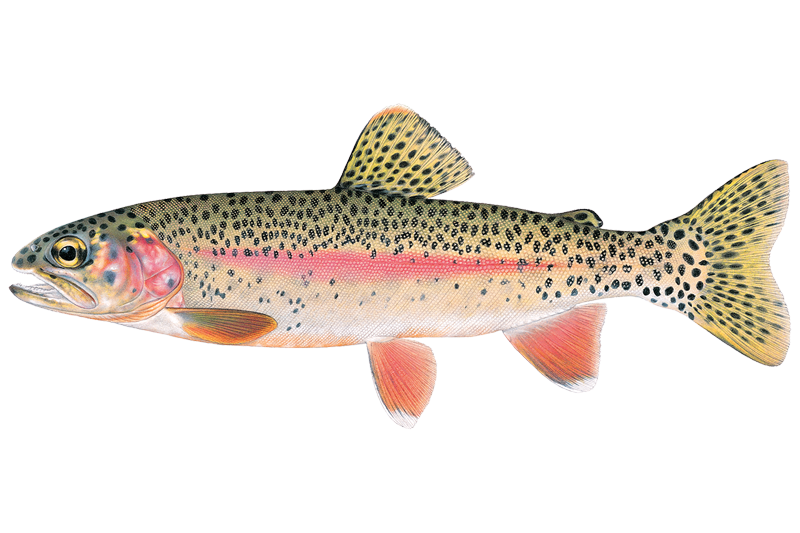
Rainbow trout are the backbone of freshwater sport fishing across much of Canada. Native to Pacific-draining rivers in British Columbia, they've been widely introduced elsewhere — from Alberta's Bow River to Ontario's Great Lakes tributaries.
Whether you're swinging streamers for wild fish in a remote BC valley or drifting eggs for steelhead on a southern Ontario river, rainbows show up in more water types and more regions than almost any other trout.
Scientific Name: Oncorhynchus mykiss
Also known as Steelhead, 'bows, Kamloops trout
- Silver to olive-green body with a vivid pink-to-red lateral stripe and dense black spotting on the back, sides, and fins — the stripe brightens dramatically on spawning fish.
- Steelhead (sea-run or lake-run form) are chrome-bright and can look almost like a different fish until the pink flush develops after time in freshwater.
- Stream residents typically run 1–5 lb; lake-run and anadromous steelhead commonly reach 8–15 lb, with large fish exceeding 20 lb in productive systems.
- Distinguished from brown trout by the lack of red spots and from cutthroat trout by the absence of red slash marks under the jaw.
What to know
Habitat Distribution
- Native to cold, Pacific-draining rivers and streams in British Columbia, including the headwaters of major salmon systems in the northwest and the interior plateau lakes (Kamloops country).
- Introduced and self-sustaining across Alberta (Bow, Oldman, and other eastern Rockies rivers), Saskatchewan (Lake Diefenbaker), and throughout Ontario's Great Lakes tributaries.
- Steelhead — the lake-run or sea-run form — run rivers emptying into Lake Ontario, Lake Erie, Georgian Bay, and Lake Superior, as well as coastal BC rivers.
- Occupy cold, well-oxygenated rivers, streams, and large lakes; interior BC stillwaters (Kamloops-area lakes) support some of the largest resident rainbows in the country.
Key Locations
- Bow River, Alberta — a Blue Ribbon tailwater running through Calgary, known for dense populations of large wild rainbows and browns in its lower float sections.
- Interior BC (Kamloops region) — the plateau lakes around Kamloops, including Kootenay and Thompson drainages, are the historic heart of large resident rainbow fishing in Canada.
- Spatsizi Plateau / Stikine headwaters, BC — remote fly-in water holding wild, unpressured rainbows alongside Arctic grayling and bull trout.
- Southern Ontario tributaries (Credit, Ganaraska, Saugeen, Nipigon, and others) — receive strong runs of lake-run steelhead from Lake Ontario, Erie, Georgian Bay, and Superior.
- Lake Diefenbaker, Saskatchewan — a large reservoir with stocked rainbows available to trollers and shore anglers across a long season.
Specific Spots
- In rivers, hold in current breaks — the seam where fast water meets slow, behind boulders, at the tail of pools, and along undercut banks — where they can intercept drifting food without burning energy.
- In large rivers like the Bow, focus on gravel runs and riffles during hatches; fish drop into deeper pools and slower water during midday heat or bright light.
- Steelhead stack in deep holding pools, especially below rapids or at tributary mouths, resting before pushing upstream to spawn.
- In lakes, cruise shallow shoals and drop-offs near inlet streams early and late in the day; mid-lake thermoclines pull fish deeper in summer.
Rainbow Trout FAQ
Answers from onWater's species guide.
What are the best lures and bait for Rainbow Trout?
Small inline spinners (Mepps, Blue Fox in sizes 2–4) and spoons are reliable across river and lake situations, the flash and vibration draw strikes when fish aren't actively surface feeding.
What flies work for Rainbow Trout?
Dry flies: Elk Hair Caddis (imitates adult caddisflies), Adams (general mayfly imitation), and Stimulator (imitates large stoneflies) cover most river hatch situations from BC to Ontario.
When is the best time to fish for Rainbow Trout?
Spring (April–June): prime time for spawning rainbows in rivers and the peak steelhead window on many Ontario tributaries as fish push upstream with warming flows.
How do you catch Rainbow Trout?
On rivers, most anglers wade and either nymph-fish with a dead-drift (letting the fly tumble naturally with the current) or swing wet flies and streamers through runs and pools. Steelhead on Ontario tributaries are heavily targeted by float fishers drifting eggs or beads from shore or by wading.
What do Rainbow Trout eat?
In rivers, mayflies, caddisflies, and stoneflies make up the core of the diet, match the hatch with a Pheasant Tail or Hare's Ear nymph (both imitate mayfly nymphs), an Elk Hair Caddis (imitates an adult caddisfly on the surface), or a Stimulator (imitates a large stonefly adult).
See it in the app
Most maps show you water.
onWater shows you Rainbow Trout.



- 01 · Species map filter
Map every Rainbow Trout water
Pick Rainbow Trout and the map zeroes in on the waters they call home. No more guessing which lake holds them.
- 02 · Waterbody species
Tap any water. See what lives there.
Species, behavior and seasonal patterns for every lake, river and pond, before you leave the driveway.
- 03 · Angler Intelligence
Ask how to catch Rainbow Trout
Tactics, gear and timing from onWater's AI fishing guide, tuned to the species and the water you're on.
Stop guessing where Rainbow Trout are.
Open the map, filter by Rainbow Trout, and head to water that holds them. Download onWater and plan your next trip in minutes.
- Species map filter
- Angler Intelligence
- Fishing journal
Explore other species
Trout, bass, salmon, panfish and everything in between. Each guide unpacks the behavior, seasons, and tactics that put fish in the net.
No species information available.

Smarter Fishing Starts in the App.
onWater Fish gives you everything you need to plan smarter, fish better, and own every trip from first cast to last.