Quillback
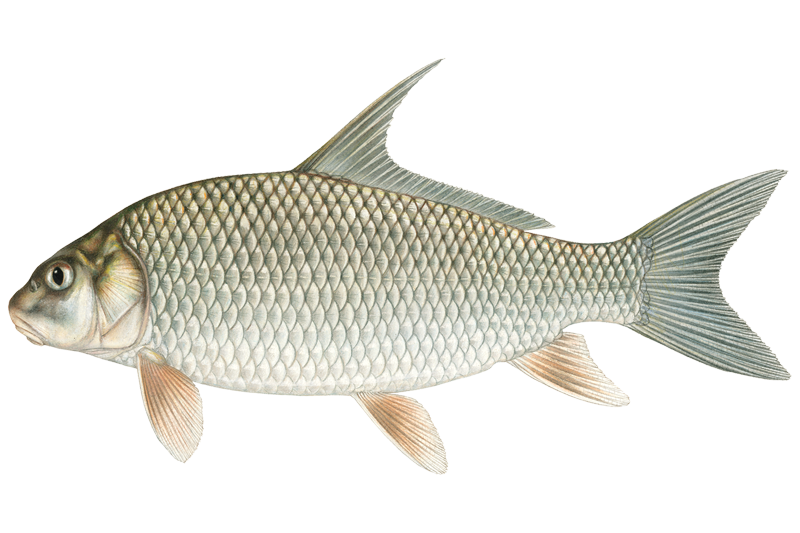
The quillback is a deep-bodied sucker found across much of southern Canada, from the Great Lakes–St. Lawrence drainage through the prairies.
It's not a target species for most anglers, but it turns up on light tackle and draws a dedicated following among rough-fish enthusiasts. Lake Manitoba holds the IGFA world record, which says something about what Canadian waters can produce.
Also known as Quillback sucker, quillback carpsucker
- Deep, slab-sided silver body with a distinctly humped back; golden-yellow tinge on the sides, white belly, and orange or yellow lower fins — easy to distinguish from common carp by the complete absence of barbels.
- The signature feature: the first rays of the dorsal fin extend into a long, stiff quill that sticks up well past the rest of the fin, even when the fin is folded flat.
- Subterminal mouth (positioned slightly under the snout) with no nipple-like projection on the lower lip — the key mark separating it from other carpsuckers.
- Typical adults run 15–20 inches and 1–4 lbs; large specimens can push 24 inches and the world record from Lake Manitoba weighed over 8 lbs.
What to know
Habitat Distribution
- Native to Canada; found across the Great Lakes–St. Lawrence basin, including Ontario's Thames River and other southern Ontario drainages, and extending west through Manitoba's lake and river systems.
- Prefers moderately clear to slightly turbid rivers, creeks, and lakes with sandy to silty bottoms and deep pools — less tolerant of heavy turbidity than some other suckers.
- Also occupies slow-moving backwaters, river impoundments, and natural lakes; adapts readily to a range of still and moving water as long as the bottom offers soft substrate for feeding.
Key Locations
- Lake Manitoba, Manitoba — produced the current IGFA world record; large, productive prairie lake with strong quillback populations.
- Thames River, Ontario — documented catch site in the London area; part of the broader Lake Erie drainage where quillbacks are present.
- Southern Ontario river systems draining into Lake Erie and Lake Ontario hold quillbacks wherever clean gravel runs and deep pools coexist.
Specific Spots
- Deep pools adjacent to gravel or rubble runs — quillbacks hold in the slower water but stage near current to feed on drifting invertebrates and bottom material.
- Tailwaters below dams, where fish congregate in numbers, especially during spring; the fast water concentrates them and makes snagging a traditional (if controversial) method.
- Sandy or silty flats in lakes and slow river bends, where they root through bottom sediment for insect larvae and organic matter.
Quillback FAQ
Answers from onWater's species guide.
What are the best lures and bait for Quillback?
Small worms and nightcrawler pieces are the most reliable bait, fished on the bottom with just enough weight to hold in current without dragging.
When is the best time to fish for Quillback?
Spring (roughly April–June depending on latitude) is the most productive window, when fish gather in shallow gravel runs to spawn and are most concentrated and catchable. Tailwater fishing below dams peaks during the same spring run, when quillbacks stage in fast water and numbers are highest.
How do you catch Quillback?
Most Canadian anglers encounter quillbacks incidentally while bottom-fishing for other species. Dedicated rough-fish anglers target them with ultralight spinning gear and small worm rigs, focusing on deep pools in rivers or tailwaters below dams in spring when fish stack up ahead of and during the spawn.
What do Quillback eat?
Bottom feeders by default, they vacuum up aquatic insect larvae (chironomid midges, mayfly nymphs), bottom ooze, and plant material using their subterminal mouth. Small jigs or worm rigs fished on or near the bottom imitate this feeding mode best.
Where do Quillback live?
Native to Canada; found across the Great Lakes–St. Lawrence basin, including Ontario's Thames River and other southern Ontario drainages, and extending west through Manitoba's lake and river systems.
See it in the app
Most maps show you water.
onWater shows you Quillback.



- 01 · Species map filter
Map every Quillback water
Pick Quillback and the map zeroes in on the waters they call home. No more guessing which lake holds them.
- 02 · Waterbody species
Tap any water. See what lives there.
Species, behavior and seasonal patterns for every lake, river and pond, before you leave the driveway.
- 03 · Angler Intelligence
Ask how to catch Quillback
Tactics, gear and timing from onWater's AI fishing guide, tuned to the species and the water you're on.
Stop guessing where Quillback are.
Open the map, filter by Quillback, and head to water that holds them. Download onWater and plan your next trip in minutes.
- Species map filter
- Angler Intelligence
- Fishing journal
Explore other species
Trout, bass, salmon, panfish and everything in between. Each guide unpacks the behavior, seasons, and tactics that put fish in the net.
No species information available.

Smarter Fishing Starts in the App.
onWater Fish gives you everything you need to plan smarter, fish better, and own every trip from first cast to last.