Pygmy Whitefish
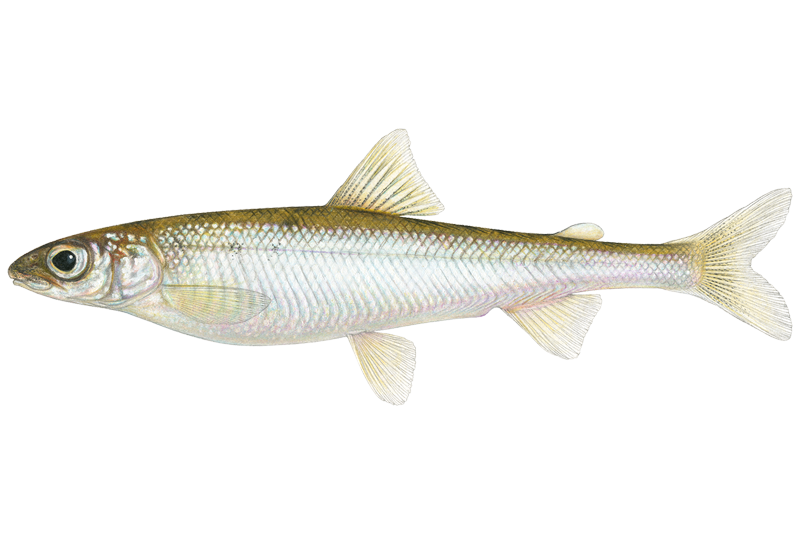
Pygmy Whitefish are Canada's smallest whitefish — a glacial relict species scattered across the country in disconnected pockets from the Yukon and Northwest Territories through BC, Alberta, Saskatchewan, and Ontario.
They rarely crack 15 cm, so they're not a target species for most anglers. Their real significance is ecological: they're forage for larger predators, and the Great Lakes–Upper St. Lawrence populations are under federal conservation review.
Scientific Name: Prosopium coulterii
- Silvery-white body with an olive-brown back; round in cross-section with relatively large scales along the lateral line.
- Overhanging snout, toothless jaw, and a notably large eye — the eye diameter roughly matches the snout length, a useful field ID mark.
- A single nasal flap between the nostrils (other whitefishes have two) and a distinct notch in the membrane around the eye distinguish it from Mountain Whitefish and Lake Whitefish.
- Typically 9–11 cm in Ontario populations; occasionally reaches 15–20 cm. Maximum known age is 9 years.
What to know
Habitat Distribution
- Native to Canada; found in disconnected populations across the Yukon, Northwest Territories, BC, Alberta, Saskatchewan, and Ontario — possibly the most fragmented range of any Canadian freshwater fish.
- In lakes, gravitates toward deep, cold, low-productivity water — often found at depths of 7–90+ m where oxygen and temperature suit it.
- Also inhabits cool streams and rivers with moderate to swift current; tolerates both silty and clear water.
- Great Lakes populations (Lake Superior) represent the easternmost range in Canada and are the focus of federal Species at Risk consultations.
Key Locations
- Lake Superior (Ontario) — easternmost Canadian population, currently under federal Threatened assessment.
- British Columbia interior lakes — historically documented populations in cold, deep mountain lakes.
- Alberta (Waterton Lake, Athabasca River drainage) — known western populations referenced in COSEWIC assessments.
- Yukon and Northwest Territories — northern range, with recent range extensions documented outside previously known boundaries.
Specific Spots
- In lakes, concentrate sampling or incidental encounters in deep, cold basins — this fish stays well below the thermocline through summer.
- During spawning runs, look for them moving into tributary streams or over coarse gravel shoals in lakes from late summer into early winter.
- Shallow, productive bays are less likely habitat; unproductive, clear, cold lakes with significant depth are the consistent pattern across BC and the western provinces.
Pygmy Whitefish FAQ
Answers from onWater's species guide.
How do you catch Pygmy Whitefish?
Pygmy Whitefish are not a directed sport fishery in Canada. They are most often encountered incidentally during deep-water sampling with fine-mesh gear.
What do Pygmy Whitefish eat?
Feeds on small crustaceans (zooplankton, amphipods), aquatic insect larvae and pupae, fish eggs, and small molluscs, a mix that shifts with what's available at depth.
Where do Pygmy Whitefish live?
Native to Canada; found in disconnected populations across the Yukon, Northwest Territories, BC, Alberta, Saskatchewan, and Ontario, possibly the most fragmented range of any Canadian freshwater fish.
See it in the app
Most maps show you water.
onWater shows you Pygmy Whitefish.



- 01 · Species map filter
Map every Pygmy Whitefish water
Pick Pygmy Whitefish and the map zeroes in on the waters they call home. No more guessing which lake holds them.
- 02 · Waterbody species
Tap any water. See what lives there.
Species, behavior and seasonal patterns for every lake, river and pond, before you leave the driveway.
- 03 · Angler Intelligence
Ask how to catch Pygmy Whitefish
Tactics, gear and timing from onWater's AI fishing guide, tuned to the species and the water you're on.
Stop guessing where Pygmy Whitefish are.
Open the map, filter by Pygmy Whitefish, and head to water that holds them. Download onWater and plan your next trip in minutes.
- Species map filter
- Angler Intelligence
- Fishing journal
Explore other species
Trout, bass, salmon, panfish and everything in between. Each guide unpacks the behavior, seasons, and tactics that put fish in the net.
No species information available.

Smarter Fishing Starts in the App.
onWater Fish gives you everything you need to plan smarter, fish better, and own every trip from first cast to last.