Pumpkinseed
Pumpkinseed are the only sunfish native to Canadian waters, and they punch well above their weight as a fishery. Found across southern Ontario, Quebec, and the Maritimes in their native range — and introduced to southern B. C.
— they're the fish most Canadians catch first, and plenty of experienced anglers return to them on purpose. Light tackle, a worm, and a weedy bay is all it takes.
Scientific Name: Lepomis gibbosus
Also known as Sun perch, pond perch, common sunfish, sunny, punkie, crapet-soleil
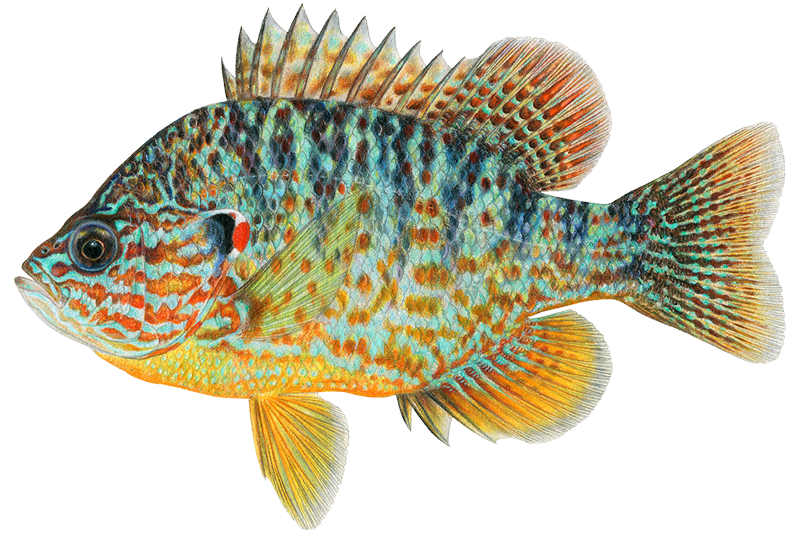
- Deep, disk-shaped body — almost perfectly round in profile — with orange-red breast and belly, and olive-brown back speckled with orange, yellow, blue, and emerald spots.
- The key ID mark: a black ear flap (opercular tab) tipped with a bright crimson or red-orange half-moon — absent on the similar bluegill, which has a plain black flap.
- Seven or eight faint, irregular dark vertical bars on the sides, plus narrow wavy stripes of orange-brown and light blue on the cheeks.
- Average catch runs 0.2–0.5 lb; a fish over 1 lb and 10 inches is a genuine trophy.
What to know
Habitat Distribution
- Native to eastern Canada — New Brunswick west through Quebec, Ontario, and into southeastern Manitoba — in the Atlantic Slope, Great Lakes, and Hudson Bay drainages.
- Introduced to southern B.C., where populations are established in the Columbia, Thompson, and Fraser River watersheds and on southern Vancouver Island; considered an invasive species there.
- Gravitates toward warm, shallow, weedy water: small ponds, lake bays, slow backwaters, and quiet stretches of streams with clear water and submerged vegetation.
- Often the most abundant fish in small, warm ponds — can make up the majority of the fish population in those systems.
Key Locations
- Lake of the Woods (Ontario/Manitoba border) — classic panfish water with abundant weedy bays holding large populations.
- Whiteshell and Falcon Lakes (Manitoba) — reliable pumpkinseed fisheries in the Canadian Shield's warmer southern lakes.
- Small ponds and weedy lakes throughout southern Ontario — the heart of the native range, where pumpkinseeds are often the most accessible fish from shore.
- Southern Vancouver Island and the Fraser Valley (B.C.) — introduced populations are well established; check local invasive species guidance before fishing.
Specific Spots
- Weedy, shallow bays with lily pads or bulrushes — pumpkinseeds hold tight to the edge of vegetation where they can dart in and out of cover.
- Dock pilings and submerged brush piles in 2–6 feet of water; the shade and structure concentrate fish, especially midday in summer.
- During the spawn, look for visible circular depressions (beds) in sandy or gravelly shallows — fish will be sitting right on them and are easy to spot in clear water.
- In winter, they school up in deeper holes near their summer haunts; slow presentations directly below the ice over those spots produce fish when nothing else will.
Pumpkinseed FAQ
Answers from onWater's species guide.
What are the best lures and bait for Pumpkinseed?
Small pieces of nightcrawler or waxworms under a slip float, the most consistent producer across all seasons and skill levels. 1/32–1/16 oz jig heads tipped with a small soft-plastic grub or a waxworm; work them slowly along the bottom near weed edges or structure.
What flies work for Pumpkinseed?
Small nymphs, Pheasant Tail and Hare's Ear in sizes 12–16, dead-drifted (drifted naturally with the current, or allowed to sink without movement) along the bottom near weed beds imitate the aquatic invertebrates pumpkinseeds feed on most of the time.
When is the best time to fish for Pumpkinseed?
Spring (April–May): fish move shallow as water warms; pre-spawn fish are active and easy to locate near weed edges and docks. Late spring–early summer (June): spawning season, fish are on visible beds in the shallows and will strike almost anything that comes near the nest.
How do you catch Pumpkinseed?
Shore fishing with a float and worm near docks, weed edges, or visible spawning beds accounts for the majority of pumpkinseeds caught in Canada. Canoe or kayak access opens up weedy bays that bank anglers can't reach, and a slow drift along a weed line with a small jig or fly covers water efficiently.
What do Pumpkinseed eat?
Snails and small mollusks are a staple, pumpkinseeds have hard, molar-like teeth in the throat specifically for crushing shells, which sets them apart from most other panfish. Small jigs or soft plastics tipped with a waxworm or maggot imitate the small invertebrates they root out from the bottom.
See it in the app
Most maps show you water.
onWater shows you Pumpkinseed.



- 01 · Species map filter
Map every Pumpkinseed water
Pick Pumpkinseed and the map zeroes in on the waters they call home. No more guessing which lake holds them.
- 02 · Waterbody species
Tap any water. See what lives there.
Species, behavior and seasonal patterns for every lake, river and pond, before you leave the driveway.
- 03 · Angler Intelligence
Ask how to catch Pumpkinseed
Tactics, gear and timing from onWater's AI fishing guide, tuned to the species and the water you're on.
Stop guessing where Pumpkinseed are.
Open the map, filter by Pumpkinseed, and head to water that holds them. Download onWater and plan your next trip in minutes.
- Species map filter
- Angler Intelligence
- Fishing journal
Explore other species
Trout, bass, salmon, panfish and everything in between. Each guide unpacks the behavior, seasons, and tactics that put fish in the net.
No species information available.

Smarter Fishing Starts in the App.
onWater Fish gives you everything you need to plan smarter, fish better, and own every trip from first cast to last.