Northern Pike
Northern pike are native across Canada — from Quebec and Ontario through the Prairie provinces, into British Columbia's northeast corner, and up through the Yukon, Nunavut, and Northwest Territories.
They're one of the country's most widely pursued freshwater fish, drawing anglers to remote fly-in lodges on Manitoba's North Seal, Saskatchewan's Reindeer Lake, Ontario's Lake of the Woods, and the Mackenzie River drainage in the NWT.
Big fish, accessible gear, and a long open-water season make pike a staple of Canadian freshwater fishing.
Scientific Name: Esox lucius
Also known as jackfish, jack, pike, northerns, water wolf, gator, snot rocket
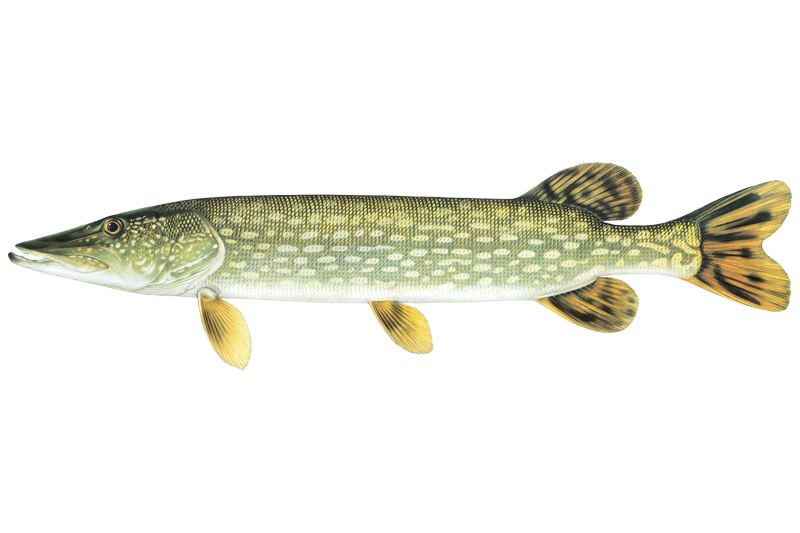
- Long, torpedo-shaped body with a broad, flattened snout and large mouth packed with sharp teeth — built for grabbing prey headfirst.
- Dark olive-green to brown back fading to cream or white on the belly, with distinctive rows of yellow to whitish bean-shaped spots along the sides.
- Dorsal and anal fins set far back near the tail — a key ID feature shared with muskellunge; tell them apart by the pike's pale spots and rounded tail lobes (muskie has pointed lobes and dark spots on a pale background).
- Typical Canadian fish run 25–36 inches; fish over 40 inches are common in top waters. Manitoba's record stands at 50 lbs / 70 inches.
What to know
Habitat Distribution
- Native across Canada: found in rivers and lakes throughout Quebec, Ontario, the Prairie provinces, the northeast corner of British Columbia, and in the Yukon, Nunavut, and Northwest Territories.
- Prefer clear to lightly stained lakes and rivers with abundant aquatic vegetation — cabbage beds, reeds, and submerged weed flats are core habitat.
- Also occupy quiet river backwaters, flooded marsh edges, and the weedy shallows of large reservoirs and shield lakes.
- Legally introduced for sport fishing in some areas; illegal introductions have occurred elsewhere, where pike can displace native trout and other game fish.
Key Locations
- Lake of the Woods, Ontario — dark, shallow Sabaskong Bay warms early after ice-out, concentrating pike in spring; consistently produces large fish through summer.
- Reindeer Lake, Saskatchewan — one of the largest pike lakes in the world at roughly 180 miles long, with thousands of island-created bays providing ideal structure.
- North Seal River area, Manitoba — remote fly-in waters with clear bays, river current, and extensive cabbage beds; produces consistent numbers of large fish.
- Munroe Lake, northern Manitoba — wilderness fly-in destination in untouched boreal country; cold, clear water supports dense pike populations.
- Mackenzie River / Great Slave Lake outflow, Northwest Territories — remote NWT waters north of the 60th parallel, known for producing very large pike in river current and lake margins.
Specific Spots
- Shallow weedy bays in spring and early summer — pike move into these areas right after ice-out to spawn, then stay as weed growth provides cover and concentrates prey.
- Cabbage and coontail weed edges: pike hold just inside or along the outer edge of thick beds, using the vegetation as a screen to intercept passing baitfish.
- Rocky points, sand bars, and reef edges in summer and fall — as weed beds thicken or water warms, fish push to these harder-bottom transition zones and deeper adjacent water.
- River mouths and current breaks where tributary flow meets a lake or larger river — pike stack here to intercept baitfish funneled by current, especially in spring and fall.
Northern Pike FAQ
Answers from onWater's species guide.
What are the best lures and bait for Northern Pike?
Spoons (size #2 and larger, in silver, gold, five-of-diamonds, and black-and-white) are a Canadian pike staple, the wobbling flash imitates a struggling baitfish and covers water fast. Shiny finishes on sunny days, brighter colors like chartreuse or orange on overcast days.
What flies work for Northern Pike?
Large streamers are the foundation of pike fly fishing, Clouser Minnows (which imitate baitfish with a jigging action) and Deceiver-style patterns in white, chartreuse, or perch colors cover most situations. Tie them on 2/0–4/0 hooks and strip them fast with irregular pauses.
When is the best time to fish for Northern Pike?
Ice-out (late April to mid-May in most of Canada), pike move into the shallowest, warmest bays immediately after ice breaks; this is the most accessible big-fish window of the year.
How do you catch Northern Pike?
Most Canadian pike fishing is done by boat, casting large lures or flies to weed edges, rocky points, and bay margins. Working weed lines with spoons or bucktails, casting parallel to the edge and retrieving just above the weed tops, is the standard approach in spring and early summer.
What do Northern Pike eat?
Primarily fish, perch, suckers, shiners, whitefish, and whatever baitfish dominate the local system. Match this with large spoons, swimbaits, or streamer flies that imitate a wounded or fleeing baitfish.
See it in the app
Most maps show you water.
onWater shows you Northern Pike.



- 01 · Species map filter
Map every Northern Pike water
Pick Northern Pike and the map zeroes in on the waters they call home. No more guessing which lake holds them.
- 02 · Waterbody species
Tap any water. See what lives there.
Species, behavior and seasonal patterns for every lake, river and pond, before you leave the driveway.
- 03 · Angler Intelligence
Ask how to catch Northern Pike
Tactics, gear and timing from onWater's AI fishing guide, tuned to the species and the water you're on.
Stop guessing where Northern Pike are.
Open the map, filter by Northern Pike, and head to water that holds them. Download onWater and plan your next trip in minutes.
- Species map filter
- Angler Intelligence
- Fishing journal
Explore other species
Trout, bass, salmon, panfish and everything in between. Each guide unpacks the behavior, seasons, and tactics that put fish in the net.
No species information available.
Smarter Fishing Starts in the App.
onWater Fish gives you everything you need to plan smarter, fish better, and own every trip from first cast to last.