Northern Hogsucker
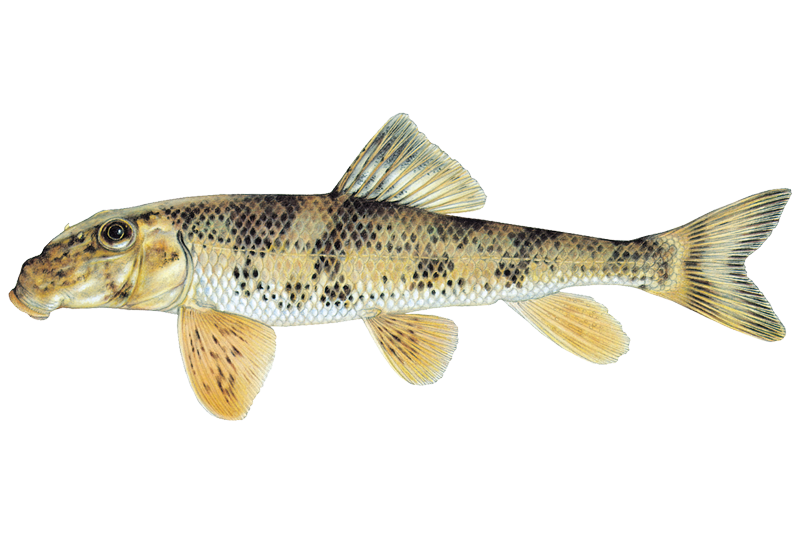
The northern hogsucker is a bottom-dwelling stream fish native to Ontario, found in the Great Lakes and Hudson Bay drainages.
It's not a conventional target species — most anglers encounter it incidentally while fishing for smallmouth bass or other stream fish.
Its real value is ecological: it flips rocks and stirs gravel, flushing invertebrates that bass, sunfish, and minnows follow and pick off.
Scientific Name: Hypentelium nigricans
Also known as hogsucker, hog sucker, meunier à tête carrée
- Large, boxy, square-sectioned head with a concave depression between the eyes — unmistakable compared to other suckers, which have rounder profiles.
- Body is wide up front and tapers sharply behind the dorsal fin; back is green, bronze, or reddish-brown with 3–6 dark saddle bars across the upper sides.
- Thick, bumpy (papillae-covered) lips on the underside of the snout; fan-like pectoral fins built for holding position in fast current.
- Typically 8–15 inches long; maximum around 17 inches. Females run larger than males.
What to know
Habitat Distribution
- Native to Canada; in Ontario, found in the Great Lakes basin and Hudson Bay drainage rivers and streams.
- Strictly a stream fish — lives in clear, permanent-flow creeks and small to medium rivers with gravel, cobble, or rubble bottoms. Rarely turns up in lakes or impoundments.
- Needs clean, well-oxygenated water; sedimentation, channelization, and pollution push it out quickly, making its presence a reliable sign of good water quality.
Key Locations
- Southern Ontario streams draining into Lake Erie, Lake Ontario, and Lake Huron — particularly clear, gravel-bottomed tributaries in these systems.
- Rivers within the Great Lakes basin in Ontario where water quality remains high and gravel riffles are intact.
Specific Spots
- Rocky riffles are the core habitat — the heavy head and enlarged pectoral fins let it hold bottom in fast, shallow current where most fish can't stay.
- Also uses the downstream tail-outs of pools where current picks back up over gravel, especially when foraging.
- Look for it where cobble and rubble mix — it actively flips small rocks to expose the invertebrates underneath, so areas with loose, moveable substrate hold more fish.
Northern Hogsucker FAQ
Answers from onWater's species guide.
What are the best lures and bait for Northern Hogsucker?
Small pieces of nightcrawler on a size 8–12 hook fished on a slip-sinker or split-shot rig right on the bottom of a riffle or pool tail-out. Keep the presentation dead on the substrate, that's where the fish feeds.
When is the best time to fish for Northern Hogsucker?
Spring (April–May): spawning activity concentrates fish in shallow gravel riffles, making them more visible and accessible. Summer: active feeding in riffles and pool tail-outs during warmer months; most incidental catches happen during smallmouth bass season.
How do you catch Northern Hogsucker?
Hogsuckers are rarely targeted deliberately in Canada, most encounters happen while wading and fishing for smallmouth bass in Ontario stream systems. When specifically sought, anglers wade to rocky riffles and fish a small worm hard on the bottom with light spinning gear.
What do Northern Hogsucker eat?
Feeds almost entirely on aquatic invertebrates, mayfly, stonefly, and caddisfly larvae, along with small snails and crustaceans, by rooting through the gravel and sucking up what it dislodges.
Where do Northern Hogsucker live?
Native to Canada; in Ontario, found in the Great Lakes basin and Hudson Bay drainage rivers and streams. Strictly a stream fish, lives in clear, permanent-flow creeks and small to medium rivers with gravel, cobble, or rubble bottoms. Rarely turns up in lakes or impoundments.
See it in the app
Most maps show you water.
onWater shows you Northern Hogsucker.



- 01 · Species map filter
Map every Northern Hogsucker water
Pick Northern Hogsucker and the map zeroes in on the waters they call home. No more guessing which lake holds them.
- 02 · Waterbody species
Tap any water. See what lives there.
Species, behavior and seasonal patterns for every lake, river and pond, before you leave the driveway.
- 03 · Angler Intelligence
Ask how to catch Northern Hogsucker
Tactics, gear and timing from onWater's AI fishing guide, tuned to the species and the water you're on.
Stop guessing where Northern Hogsucker are.
Open the map, filter by Northern Hogsucker, and head to water that holds them. Download onWater and plan your next trip in minutes.
- Species map filter
- Angler Intelligence
- Fishing journal
Explore other species
Trout, bass, salmon, panfish and everything in between. Each guide unpacks the behavior, seasons, and tactics that put fish in the net.
No species information available.

Smarter Fishing Starts in the App.
onWater Fish gives you everything you need to plan smarter, fish better, and own every trip from first cast to last.