Muskellunge
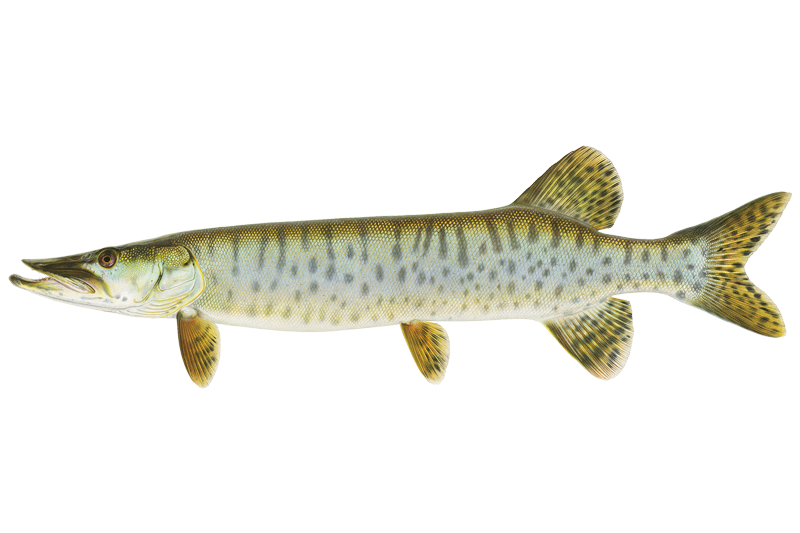
The muskellunge is the largest member of the pike family and the fish that defines big-water fishing across Ontario and into Manitoba. Native to the St.
Lawrence–Great Lakes system and the Hudson Bay drainage, Canada holds some of the most productive musky water on the continent. Northwestern Ontario in particular draws anglers from across North America chasing fish that regularly push past 50 inches.
The fishery runs on casting and trolling large artificials, and the musky's reputation for long stretches of silence broken by sudden, violent strikes is what keeps anglers coming back.
Scientific Name: Esox masquinongy
Also known as Muskie, musky, lunge, maskinongé, masquinongé, tiger muskie (hybrid with northern pike)
- Long, torpedo-shaped body with a flattened, duckbill snout packed with canine teeth; silver to olive-green flanks marked with dark spots, bars, or blotches depending on subspecies.
- Distinguished from northern pike by its pointed tail (pike tails are more rounded), 6–9 sensory pores on each side of the lower jaw (pike have 5 or fewer), and dark markings on a lighter background rather than light spots on dark.
- Average angled fish in Ontario runs around 37 inches; fish over 50 inches are caught regularly in top waters, and the Ontario record stands at 58 inches and 65 pounds.
- Tiger muskies — natural hybrids with northern pike — show bold dark vertical stripes on a lighter body and are also present in many Ontario lakes.
What to know
Habitat Distribution
- Native to Canada across the St. Lawrence–Great Lakes basin and the Hudson Bay drainage, with the core of the fishery in Ontario and extending into Manitoba.
- Northwestern Ontario — the region around Dryden, Kenora, and the Lake of the Woods — holds some of the densest natural populations on the continent; no stocking is required in these waters.
- Prefers large, clear to lightly stained lakes and connecting rivers with abundant weed growth, rocky structure, and sufficient depth; also present in the St. Lawrence River system in eastern Ontario.
- Three subspecies occur in Canada: the spotted Great Lakes form in the St. Lawrence and Great Lakes basin, the barred Chautauqua form in Lake Ontario and the St. Lawrence, and the clear or lightly marked form in northwestern Ontario and southeastern Manitoba.
Key Locations
- Lake of the Woods (Ontario/Manitoba border) — a massive, relatively shallow lake with thousands of islands and thriving weed-based musky habitat; consistent numbers and large fish.
- Eagle Lake (west of Dryden, Ontario) — 68,000 acres of mixed boulder, reef, and weed structure with a strong reputation for fish over 50 inches.
- Lac Seul (north of Dryden, Ontario) — tannin-stained water with flooded timber and a reputation for exceptionally large silver muskies; some of the biggest fish in the province come from here.
- St. Lawrence River (eastern Ontario) — holds the barred subspecies and draws dedicated musky anglers, particularly in the Thousand Islands region.
Specific Spots
- Shallow weed beds — cabbage, reeds, emergent vegetation — are the primary holding areas from late June through midsummer; muskies use the edge of the weed line as a hunting lane.
- Rocky points, island saddles, and reefs concentrate fish, especially where a hard bottom transitions to deeper water; these break-lines are key trolling and casting targets.
- Stump fields and flooded timber (common in tannin-stained lakes like Lac Seul) give muskies overhead cover and ambush angles — work the edges and openings rather than the thickest wood.
- When water temperatures climb in summer, fish move to deeper humps and underwater structure in the 20–40 foot range; sonar marks in that depth band are worth a heavy jig tipped with sucker or cisco.
Muskellunge FAQ
Answers from onWater's species guide.
What are the best lures and bait for Muskellunge?
Large bucktail spinners (8–12 inch blades) are a staple casting lure along weed edges and rocky points, retrieved fast enough to keep the blade turning; vary blade color (gold, silver, chartreuse) based on water clarity and light.
When is the best time to fish for Muskellunge?
Season opens mid-June in Ontario (closed until the third Saturday in June to protect spawning fish); late June and early July fish are found near spawning bays and adjacent rocky structure.
How do you catch Muskellunge?
Most Canadian musky fishing is done from a boat, either casting large artificials along weed edges, rocky points, and island structure, or trolling break-lines and deep humps on bigger water.
What do Muskellunge eat?
Suckers, cisco, and other large soft-rayed fish make up the bulk of an adult musky's diet, this is why big swimbaits, glide baits, and large soft-plastic paddle-tails in sucker or cisco colors are go-to presentations.
Where do Muskellunge live?
Native to Canada across the St. Lawrence–Great Lakes basin and the Hudson Bay drainage, with the core of the fishery in Ontario and extending into Manitoba.
See it in the app
Most maps show you water.
onWater shows you Muskellunge.



- 01 · Species map filter
Map every Muskellunge water
Pick Muskellunge and the map zeroes in on the waters they call home. No more guessing which lake holds them.
- 02 · Waterbody species
Tap any water. See what lives there.
Species, behavior and seasonal patterns for every lake, river and pond, before you leave the driveway.
- 03 · Angler Intelligence
Ask how to catch Muskellunge
Tactics, gear and timing from onWater's AI fishing guide, tuned to the species and the water you're on.
Stop guessing where Muskellunge are.
Open the map, filter by Muskellunge, and head to water that holds them. Download onWater and plan your next trip in minutes.
- Species map filter
- Angler Intelligence
- Fishing journal
Explore other species
Trout, bass, salmon, panfish and everything in between. Each guide unpacks the behavior, seasons, and tactics that put fish in the net.
No species information available.
Smarter Fishing Starts in the App.
onWater Fish gives you everything you need to plan smarter, fish better, and own every trip from first cast to last.