Mountain Whitefish
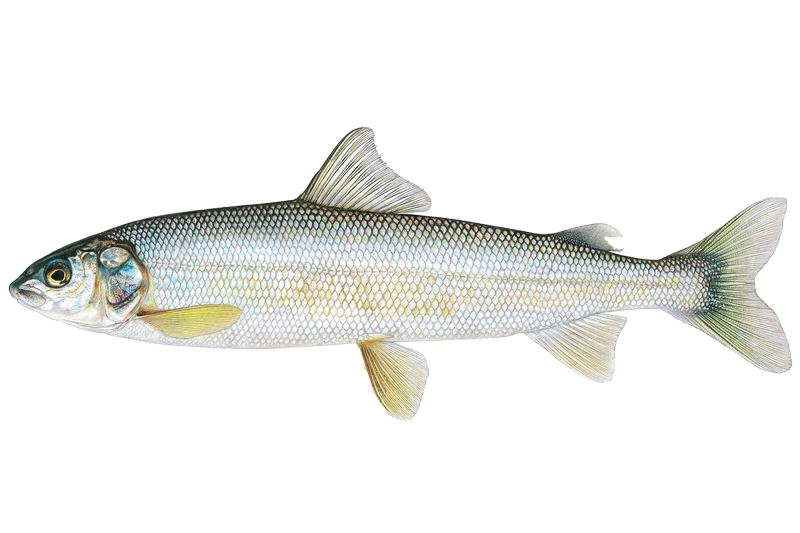
Mountain whitefish are a native salmonid found across cold, clear rivers and lakes of western Canada — from the Mackenzie River drainage in the Northwest Territories south through Alberta and British Columbia.
Locally called 'rockies,' they school in large numbers, feed actively even in winter, and give a scrappy account of themselves on light tackle. They're underrated table fare and a legitimate target when trout aren't cooperating.
Scientific Name: Prosopium williamsoni
Also known as Rocky Mountain whitefish, rockies, whities, mountain herring (historical)
- Slender, nearly cylindrical silver body with a dusky olive-green back; scales have darkened borders that give the flanks a subtle scaled pattern.
- Small, downward-pointing mouth under a blunt snout — the key ID feature that separates it from trout and grayling at a glance.
- Like all salmonids, carries an adipose fin; tail is forked. Most fish run 10–16 inches; the upper end reaches around 22 inches and close to 3 kg (6.4 lb).
What to know
Habitat Distribution
- Native to western Canada — present from the Mackenzie River drainage in the Northwest Territories south through Alberta and British Columbia in Pacific, Hudson Bay, and upper Missouri drainages.
- Primarily a river fish: cold, clear, fast-moving streams with gravel or cobble bottoms. Also found in alpine lakes and reservoirs connected to those drainages.
- A clean-water indicator — their presence in a river system signals cold, well-oxygenated, low-pollution conditions. The Bow River in Alberta and rivers around Canmore and Banff are well-known Canadian strongholds.
Key Locations
- Bow River, Alberta — flows through Canmore and Banff; one of the most accessible and productive whitefish rivers in Canada, with large resident populations year-round.
- Rivers of the Canadian Rockies around Banff and Jasper — cold, clear tributaries hold dense schools, particularly during fall spawning runs.
- Fraser River system, British Columbia — mountain whitefish are present throughout the upper Fraser drainage and have been studied as an indicator species for river health.
- Mackenzie River drainage, Northwest Territories — the northern edge of the species' Canadian range; fish are present but less commonly targeted by sport anglers.
Specific Spots
- Deep, slow pools and eddies adjacent to fast water — whitefish hold near the bottom here, especially in winter, where they pick invertebrates off the substrate.
- Large submerged boulders and cobble runs: whitefish school around this structure and feed by nosing into crevices, so get your presentation down to their level.
- Gravel bars and tributary mouths in fall — fish congregate here during spawning runs, making them easier to locate in numbers.
- The warmest part of a deep hole during cold months; in winter, midday sun warms the water slightly and triggers the most consistent feeding activity.
Mountain Whitefish FAQ
Answers from onWater's species guide.
What are the best lures and bait for Mountain Whitefish?
Small beadhead nymphs (size 10–14) fished under a bobber on spinning gear, the Prince Nymph and Copper John are go-to patterns across Alberta and BC rivers.
What flies work for Mountain Whitefish?
Small beadhead nymphs are the foundation: Prince Nymphs and Copper Johns (sizes 10–14) imitate stonefly and mayfly nymphs and account for the majority of fly-caught whitefish in Canadian rivers.
When is the best time to fish for Mountain Whitefish?
Winter (December–March), whitefish feed actively in cold water when many other species slow down; deep pools on open-water river sections fish well midday. Spring (April–May), fish spread out as flows rise; nymphing runs and eddies near structure produces consistent action.
How do you catch Mountain Whitefish?
Most Canadian anglers target mountain whitefish by wading rivers and dead-drifting small nymphs or bait rigs through deep pools and boulder runs, using a strike indicator to detect bottom-feeding takes.
What do Mountain Whitefish eat?
Aquatic invertebrates are the core of their diet, mayfly nymphs, caddisfly larvae, stonefly nymphs, and midges. Their small, downward-pointing mouth is built for rooting these off the bottom, not sipping drifting bugs off the surface.
See it in the app
Most maps show you water.
onWater shows you Mountain Whitefish.



- 01 · Species map filter
Map every Mountain Whitefish water
Pick Mountain Whitefish and the map zeroes in on the waters they call home. No more guessing which lake holds them.
- 02 · Waterbody species
Tap any water. See what lives there.
Species, behavior and seasonal patterns for every lake, river and pond, before you leave the driveway.
- 03 · Angler Intelligence
Ask how to catch Mountain Whitefish
Tactics, gear and timing from onWater's AI fishing guide, tuned to the species and the water you're on.
Stop guessing where Mountain Whitefish are.
Open the map, filter by Mountain Whitefish, and head to water that holds them. Download onWater and plan your next trip in minutes.
- Species map filter
- Angler Intelligence
- Fishing journal
Explore other species
Trout, bass, salmon, panfish and everything in between. Each guide unpacks the behavior, seasons, and tactics that put fish in the net.
No species information available.

Smarter Fishing Starts in the App.
onWater Fish gives you everything you need to plan smarter, fish better, and own every trip from first cast to last.