Longnose Gar
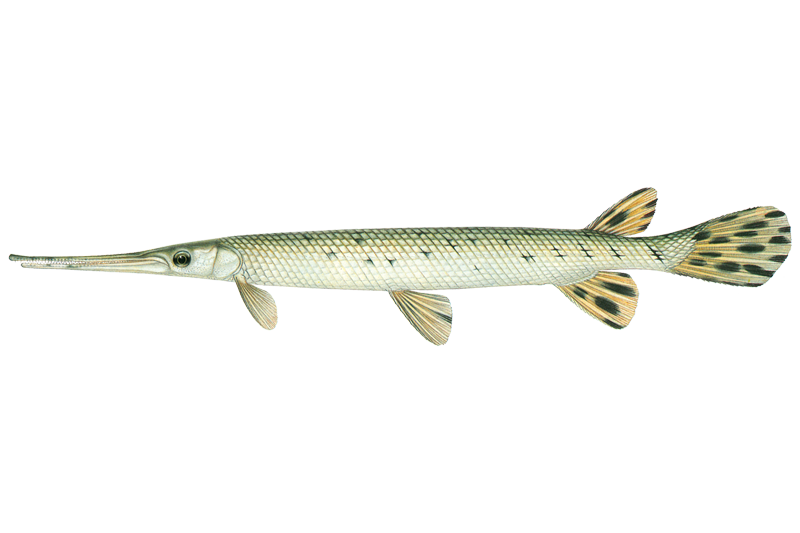
Longnose gar are native to Ontario's waters and represent one of Canada's most unusual sight-fishing targets. Found in the Ottawa River, St.
Lawrence, and the Great Lakes (except Superior), they draw a dedicated following of anglers who wade shallow bays and back eddies hunting fish that can push past 16 pounds.
The Ottawa River holds Canada's record-class fish, and the sight-fishing game here rivals anything on a saltwater flat.
Scientific Name: Lepisosteus osseus
Also known as Needle-nose gar, needlenose gar, garpike
- Long, cylindrical body covered in hard, diamond-shaped ganoid scales that interlock like armour — no other Ontario fish looks remotely like this.
- The snout is the key ID feature: extremely long and narrow, lined with sharp teeth, and up to twice the length of the rest of the skull — far longer than any other gar in Canada.
- Olive-brown to greenish on the back, fading to cream or white on the belly; dark spots often visible along the flanks and fins.
- Most Ottawa River fish run 3–4 feet; females grow larger than males, and fish over 50 inches and 16 lbs have been recorded from Canadian waters.
What to know
Habitat Distribution
- Native to eastern Canada — present in the Ottawa River, St. Lawrence River, Lake Ontario, Lake Erie, Lake Huron, and Lake Michigan; absent from Lake Superior.
- Healthy populations exist in Quebec along the St. Lawrence corridor and throughout much of southern Ontario.
- Prefer large rivers, connected backwaters, and the weedy shallows of lakes — slow to moderate current with abundant aquatic vegetation.
- Tolerant of low-oxygen conditions thanks to a modified swim bladder that lets them gulp air at the surface, which allows them to thrive in warm, weedy bays where other species struggle.
Key Locations
- Ottawa River (Eastern Ontario/Quebec border) — home to Canada's largest documented longnose gar, with multiple fish over 16 lbs recorded; the back bays and weedy shallows are prime sight-fishing water in late spring and summer.
- St. Lawrence River — healthy gar populations along the Quebec corridor and the upper river near the Ontario border.
- Lake Erie and Lake Huron shallows — weedy bays and connected backwaters hold fish through the warm months; less targeted here than on the Ottawa but present in good numbers.
- Lake Ontario nearshore bays — gar use the weedy, warmer shallows of the north shore, particularly in areas with slow-moving tributary mouths.
Specific Spots
- Shallow, sun-warmed bays with emergent or submerged weed growth — gar cruise these areas actively hunting baitfish schools and are visible from the surface.
- Back eddies and slow pools just downstream of current breaks in large rivers like the Ottawa; they hold in calmer water adjacent to flow rather than fighting the main current.
- Weedy shoreline margins in the Great Lakes bays, especially where reeds or lily pads meet open water — gar use the edge as a hunting lane.
- Surface-oriented fish: look up, not down. On calm, sunny days they're visible as dark shadows just below the surface, often motionless before moving.
Longnose Gar FAQ
Answers from onWater's species guide.
What are the best lures and bait for Longnose Gar?
Rope lures, short sections of nylon or polypropylene rope frayed at the end, are the most effective gar-specific tool; the fibres tangle in the teeth without requiring a traditional hook set, which is nearly impossible on a bony gar bill.
What flies work for Longnose Gar?
Large, slender streamers tied on long-shank hooks, think Deceiver-style patterns or pike flies scaled down slightly, imitate the baitfish that make up nearly all of the gar's diet; white, chartreuse, or olive work well in weedy, stained water.
When is the best time to fish for Longnose Gar?
Late spring (May–June), fish move into shallow, weedy bays as water warms; spawning activity concentrates large fish in accessible areas and this is when the Ottawa River's biggest fish are most consistently encountered.
How do you catch Longnose Gar?
Most Canadian gar fishing is done by sight, anglers wade or pole a boat through shallow, weedy bays in summer, spotting fish near the surface and casting ahead of them.
What do Longnose Gar eat?
Roughly 98% of the diet is small fish, bullhead catfish, bluegill, shiners, and other baitfish. Match this with slender, minnow-profile lures or streamers that mimic a struggling baitfish.
See it in the app
Most maps show you water.
onWater shows you Longnose Gar.



- 01 · Species map filter
Map every Longnose Gar water
Pick Longnose Gar and the map zeroes in on the waters they call home. No more guessing which lake holds them.
- 02 · Waterbody species
Tap any water. See what lives there.
Species, behavior and seasonal patterns for every lake, river and pond, before you leave the driveway.
- 03 · Angler Intelligence
Ask how to catch Longnose Gar
Tactics, gear and timing from onWater's AI fishing guide, tuned to the species and the water you're on.
Stop guessing where Longnose Gar are.
Open the map, filter by Longnose Gar, and head to water that holds them. Download onWater and plan your next trip in minutes.
- Species map filter
- Angler Intelligence
- Fishing journal
Explore other species
Trout, bass, salmon, panfish and everything in between. Each guide unpacks the behavior, seasons, and tactics that put fish in the net.
No species information available.

Smarter Fishing Starts in the App.
onWater Fish gives you everything you need to plan smarter, fish better, and own every trip from first cast to last.