Largemouth Bass
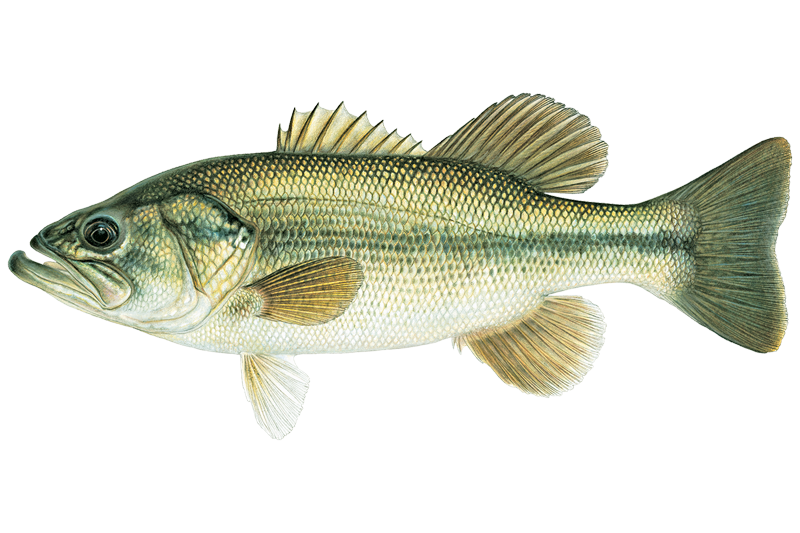
Largemouth bass are one of Canada's most pursued freshwater sport fish, concentrated in southern Ontario and the warm-water lakes of British Columbia's Okanagan Valley. Native to the Great Lakes and St.
Lawrence drainages, they've been introduced — sometimes invasively — into waters across southern BC. Ontario's cottage-country lakes, the French River system, and the St. Marys River area hold fish that regularly push 5 to 7 pounds.
Scientific Name: Micropterus salmoides
Also known as bucketmouth, bigmouth bass, largie, achigan à grande bouche
- Olive-green to brassy body with a dark, irregular lateral stripe running from gill to tail — most vivid in clear, weedy water; paler and washed-out in turbid conditions.
- The defining ID mark: the upper jaw extends well past the rear edge of the eye in adults — noticeably farther back than on a smallmouth bass.
- Two dorsal fins that appear nearly separated, with a deeper notch between them than on a smallmouth; body is deeper and less streamlined.
- Most Canadian fish run 1–4 lbs; fish over 5 lbs are legitimate trophies in Ontario, and the Okanagan's warm water grows some of the biggest bass in the country.
What to know
Habitat Distribution
- Native to the Great Lakes–St. Lawrence basin, including southern Ontario and parts of southern Quebec; introduced — and in some cases invasive — across southern British Columbia, including the Okanagan and Columbia River systems.
- Warm, shallow lakes and slow-moving rivers with abundant aquatic vegetation; they need warmer water than smallmouth and are largely absent from the cold, deep Canadian Shield lakes that dominate the north.
- In BC's Okanagan Valley, lakes like Osoyoos reach surface temperatures that rival anything in the southern US — ideal largemouth habitat, though the fish are considered invasive there.
- In Ontario, they concentrate in weedy bays, back-channel sloughs, and the warmer arms of larger river systems like the French River and St. Marys.
Key Locations
- Osoyoos Lake, BC — the warmest lake in Canada, producing some of the country's largest largemouth in the Okanagan desert climate.
- St. Marys River system and Sault Ste. Marie area, Ontario — an underrated largemouth fishery with consistent 5-pound-class fish in the back bays off the main channel.
- French River, Ontario — classic Shield-edge water where warm, weedy bays hold largemouth from ice-out through fall.
- Sunset Country lakes, northwestern Ontario — a smaller number of lakes than central Ontario, but fish regularly reach 7–8 lbs in the most productive waters.
Specific Spots
- Weed edges and lily pad mats — largemouth use dense vegetation as both shade and cover, positioning just inside the edge where they can intercept baitfish moving through.
- Shallow back bays off main channels, especially where soft-bottom meets submerged wood or dock pilings; these warm up fastest in spring and hold fish early in the season.
- Docks, fallen timber, and any hard structure in 2–8 feet of water — shade is the key variable, not just the structure itself.
- Weedline drop-offs where submerged vegetation gives way to open water; fish suspend along this edge, especially during midday heat.
Largemouth Bass FAQ
Answers from onWater's species guide.
What are the best lures and bait for Largemouth Bass?
Topwater lures, hollow-body frogs, poppers, and walk-the-dog style stickbaits, are the most effective presentation over weed mats and lily pads, especially at dawn and dusk.
What flies work for Largemouth Bass?
Deer-hair poppers and foam surface bugs fished near weed edges and docks imitate frogs and large insects, the most exciting largemouth fly fishing, especially in low light.
When is the best time to fish for Largemouth Bass?
Spring (ice-out to late May), fish move into the warmest, shallowest bays first; pre-spawn fish are actively feeding and accessible near docks and wood. Early summer (June), spawning period across most of Ontario; many zones require catch-and-release during this window.
How do you catch Largemouth Bass?
Most Canadian largemouth fishing happens from a boat, working shallow weedy bays and structure with topwater lures early and late in the day, then switching to soft plastics or crankbaits as the sun climbs.
What do Largemouth Bass eat?
Smaller fish, perch, shiners, and young panfish, make up the bulk of the diet in most Canadian lakes. Match this with swimbaits, crankbaits, or Clouser Minnows (a streamer fly that imitates a baitfish).
See it in the app
Most maps show you water.
onWater shows you Largemouth Bass.



- 01 · Species map filter
Map every Largemouth Bass water
Pick Largemouth Bass and the map zeroes in on the waters they call home. No more guessing which lake holds them.
- 02 · Waterbody species
Tap any water. See what lives there.
Species, behavior and seasonal patterns for every lake, river and pond, before you leave the driveway.
- 03 · Angler Intelligence
Ask how to catch Largemouth Bass
Tactics, gear and timing from onWater's AI fishing guide, tuned to the species and the water you're on.
Stop guessing where Largemouth Bass are.
Open the map, filter by Largemouth Bass, and head to water that holds them. Download onWater and plan your next trip in minutes.
- Species map filter
- Angler Intelligence
- Fishing journal
Explore other species
Trout, bass, salmon, panfish and everything in between. Each guide unpacks the behavior, seasons, and tactics that put fish in the net.
No species information available.

Smarter Fishing Starts in the App.
onWater Fish gives you everything you need to plan smarter, fish better, and own every trip from first cast to last.