Lake Trout
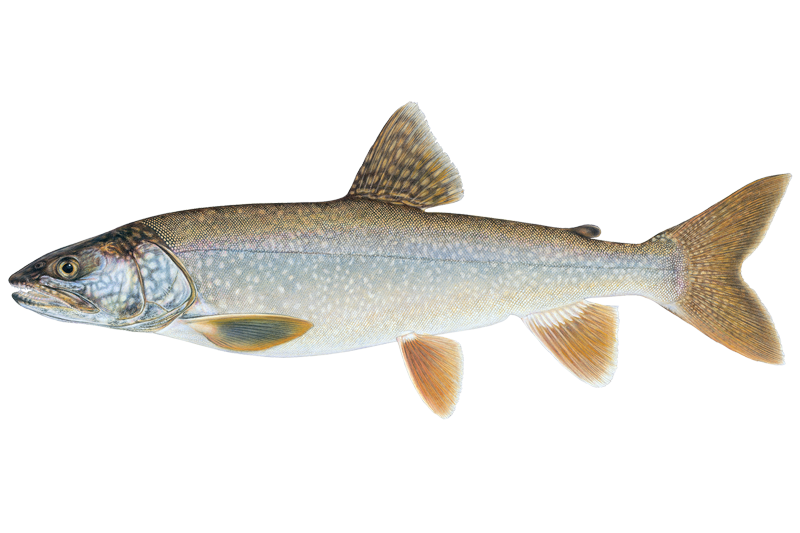
Lake trout are Canada's deep-water char — native across nearly every province and territory, from Ontario's Canadian Shield lakes to the Northwest Territories and the high Arctic.
They're the primary target at dozens of fly-in lodges and draw anglers chasing both numbers and size. Fish over 20 lbs are legitimate trophies; the far north produces fish pushing 50 lbs and beyond.
Scientific Name: Salvelinus namaycush
Also known as Laker, touladi, grey trout, lake char, namaycush, togue
- Deeply forked tail — the clearest field mark separating lake trout from brook trout, which have a square or only slightly forked tail.
- Dark olive to grey-green body covered in irregular cream or yellow spots; northern fish often show orange or orange-red on the lower fins.
- Massive head — roughly 25% of total body length — with a wide, toothy mouth built for eating large prey.
- Typical catch runs 2–10 lbs; fish over 20 lbs are genuine trophies, and remote northern lakes like Great Slave and Munroe Lake have produced fish exceeding 50 lbs.
What to know
Habitat Distribution
- Native across nearly all of Canada — from the Great Lakes and Ontario's Shield country north through Manitoba, Saskatchewan, and the territories to the Arctic islands at 72°N latitude.
- Require cold, deep, well-oxygenated lakes; most commonly found at 18–53 metres once summer sets in, though they've been recorded as deep as 467 m.
- In northern Canada — the NWT, Nunavut, and northern Manitoba — they also use rivers and shallower lake sections year-round, since water temperatures stay cold enough to keep them near the surface longer.
- Absent from the warmer, shallower lakes of the southern prairies, where water temperatures exceed their comfort range through summer.
Key Locations
- Great Slave Lake, NWT — one of the largest and most productive lake trout fisheries in the world, with documented fish over 50 lbs.
- Reindeer Lake, Saskatchewan/Manitoba border — remote fly-in destination known for very large lakers in a wilderness setting.
- Munroe Lake, northern Manitoba — near the Manitoba/Nunavut border; extremely lightly fished with fish of exceptional size.
- Coppermine River headwater lakes, NWT/Nunavut — gin-clear Arctic systems where big lakers feed on cisco and whitefish in the shallows early season.
- Ontario's Sunset Country (northwestern Ontario) — thousands of Canadian Shield lakes supporting strong lake trout populations, accessible by road and floatplane.
Specific Spots
- Rocky shorelines and boulder fields in spring and fall — lakers spawn over large rubble at 1–12 m, and they feed aggressively in these same areas before and after ice-out.
- Drop-offs and points adjacent to shallow flats: lakers use these edges as highways between deep cold water and shallower feeding zones, especially at low light.
- The thermocline in summer — the invisible temperature boundary where cold, oxygenated water meets warmer surface water. Mark it on sonar and work lures at that depth.
- River narrows and current breaks in northern systems, where moving water concentrates baitfish like cisco and whitefish and lakers stack up to feed.
Lake Trout FAQ
Answers from onWater's species guide.
What are the best lures and bait for Lake Trout?
Spoons, Swedish Pimples, Williams Wabler, and similar flutter spoons, are the classic lake trout lure across Canada, effective both trolled and jigged vertically through the water column.
What flies work for Lake Trout?
Large articulated streamers, 4–8 inches, in white, olive, or silver imitate cisco and whitefish, the main forage in most Canadian lake trout waters. Patterns like big Deceiver-style flies or articulated bunny-strip streamers work well; the size filters out smaller fish.
When is the best time to fish for Lake Trout?
Ice-out to early summer (typically May–June in most of Canada): the most accessible fishing of the year, lakers are shallow, aggressive, and catchable on light gear near shore.
How do you catch Lake Trout?
Most Canadian lake trout fishing happens from boats, trolling spoons or crankbaits to cover water and find fish, then switching to vertical jigging once a school is located on sonar. In spring, within a few weeks of ice-out, fish move into the shallows and can be reached by casting from shore or a kayak.
What do Lake Trout eat?
Cisco (also called tullibee) and whitefish are the primary forage in most Canadian lakes, big lakers gorge on these in spring when schools are shallow. Match them with large spoons, swimbaits, or long streamer flies in silver or white.
See it in the app
Most maps show you water.
onWater shows you Lake Trout.



- 01 · Species map filter
Map every Lake Trout water
Pick Lake Trout and the map zeroes in on the waters they call home. No more guessing which lake holds them.
- 02 · Waterbody species
Tap any water. See what lives there.
Species, behavior and seasonal patterns for every lake, river and pond, before you leave the driveway.
- 03 · Angler Intelligence
Ask how to catch Lake Trout
Tactics, gear and timing from onWater's AI fishing guide, tuned to the species and the water you're on.
Stop guessing where Lake Trout are.
Open the map, filter by Lake Trout, and head to water that holds them. Download onWater and plan your next trip in minutes.
- Species map filter
- Angler Intelligence
- Fishing journal
Explore other species
Trout, bass, salmon, panfish and everything in between. Each guide unpacks the behavior, seasons, and tactics that put fish in the net.
No species information available.
Smarter Fishing Starts in the App.
onWater Fish gives you everything you need to plan smarter, fish better, and own every trip from first cast to last.