Grass Pickerel
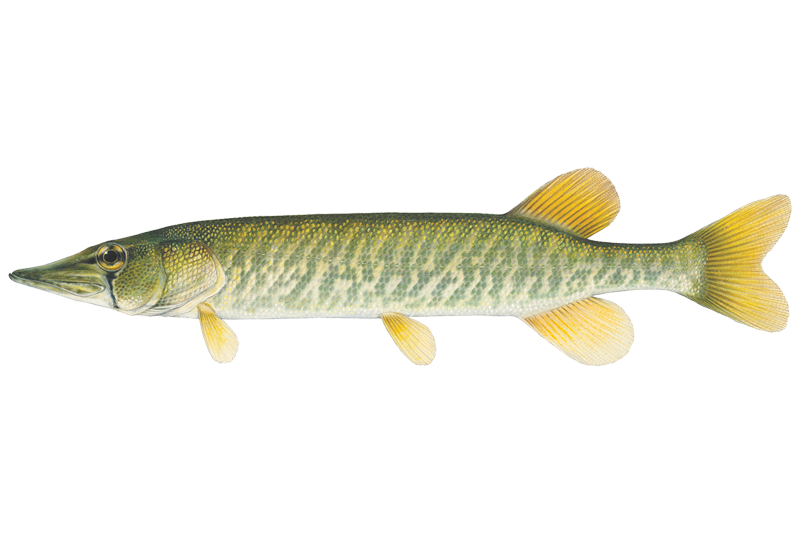
Grass Pickerel are a small, native member of the pike family found in a narrow band of southern Ontario and a handful of southwestern Quebec sites.
They rarely top 30 cm, so they're not a target species in the traditional sense — most encounters happen while trout or bass fishing in weedy shallows. Their conservation status makes them worth knowing on sight.
Scientific Name: Esox americanus
Also known as American pickerel, brochet d'Amérique
- Long, tube-shaped body with a distinctly flattened, duck-billed snout — classic pike family silhouette, but miniature; adults usually under 30 cm.
- Pale to dark green base color with dark, wavy vertical bars along the sides; a vertical dark bar runs below each eye in adults — the clearest field mark.
- Fins are yellow-green to amber with dark leading edges — no orange or red tint (that's the redfin pickerel subspecies).
- Females run slightly larger than males; record-class fish approach 2 lbs (under 1 kg), but most Canadian fish are well under that.
What to know
Habitat Distribution
- Native to Canada; range is limited to southern Ontario (Great Lakes tributaries, Bay of Quinte, Upper St. Lawrence) and a few scattered sites in southwestern Quebec.
- Restricted to warm, slow-moving or still water — shallow stream backwaters, quiet lake embayments, weedy ponds and marshy creek margins.
- Dense submergent and emergent aquatic vegetation is a hard requirement; without it, grass pickerel simply aren't present.
- A colder northern climate limits their spread; they don't push into the Canadian Shield or northern Ontario watersheds.
Key Locations
- Upper St. Lawrence River (Brockville to Gananoque area) — one of the more consistently documented Ontario populations.
- Bay of Quinte, eastern Lake Ontario — shallow, weedy embayments here provide suitable habitat.
- North shore tributaries of Lake Erie and Lake Huron — scattered populations in slow, vegetated stream reaches.
- Southwestern Quebec — a handful of known sites represent the eastern edge of the Canadian range.
Specific Spots
- Thick weed beds in shallow embayments — grass pickerel hold tight to vegetation edges where they can stalk prey without being exposed.
- Slow backwater pools in small streams, especially where overhanging bank vegetation or submerged roots add overhead cover.
- Flooded marsh margins in spring, where rising water pushes them into temporarily inundated vegetation to spawn.
Grass Pickerel FAQ
Answers from onWater's species guide.
What are the best lures and bait for Grass Pickerel?
Small inline spinners (size 0–1) and 2–3 inch soft-plastic minnow baits on light jig heads work well, slow retrieves through or along weed edges draw the most strikes. Tiny spoons and small crankbaits in natural minnow colors are worth trying; keep presentations small to match the fish's modest mouth size.
What flies work for Grass Pickerel?
Small streamers, Woolly Buggers or Clouser Minnows (both imitate small baitfish) in sizes 6–10, stripped slowly through weed openings are the most reliable approach.
When is the best time to fish for Grass Pickerel?
Spring, fish move into flooded marsh edges and shallow vegetation to spawn as water warms; this is when they're most concentrated and accessible near shore. Summer, retreat deeper into weed beds during the warmest periods; early morning and evening fishing along weed edges produces best.
How do you catch Grass Pickerel?
Grass pickerel are rarely targeted deliberately in Canada, most encounters are incidental while fishing weedy shallows for bass or trout with light tackle.
What do Grass Pickerel eat?
Juveniles eat aquatic insects and invertebrates, the same forage that draws trout, which is why grass pickerel often show up as bycatch on small nymphs and wet flies.
See it in the app
Most maps show you water.
onWater shows you Grass Pickerel.



- 01 · Species map filter
Map every Grass Pickerel water
Pick Grass Pickerel and the map zeroes in on the waters they call home. No more guessing which lake holds them.
- 02 · Waterbody species
Tap any water. See what lives there.
Species, behavior and seasonal patterns for every lake, river and pond, before you leave the driveway.
- 03 · Angler Intelligence
Ask how to catch Grass Pickerel
Tactics, gear and timing from onWater's AI fishing guide, tuned to the species and the water you're on.
Stop guessing where Grass Pickerel are.
Open the map, filter by Grass Pickerel, and head to water that holds them. Download onWater and plan your next trip in minutes.
- Species map filter
- Angler Intelligence
- Fishing journal
Explore other species
Trout, bass, salmon, panfish and everything in between. Each guide unpacks the behavior, seasons, and tactics that put fish in the net.
No species information available.

Smarter Fishing Starts in the App.
onWater Fish gives you everything you need to plan smarter, fish better, and own every trip from first cast to last.