Fallfish
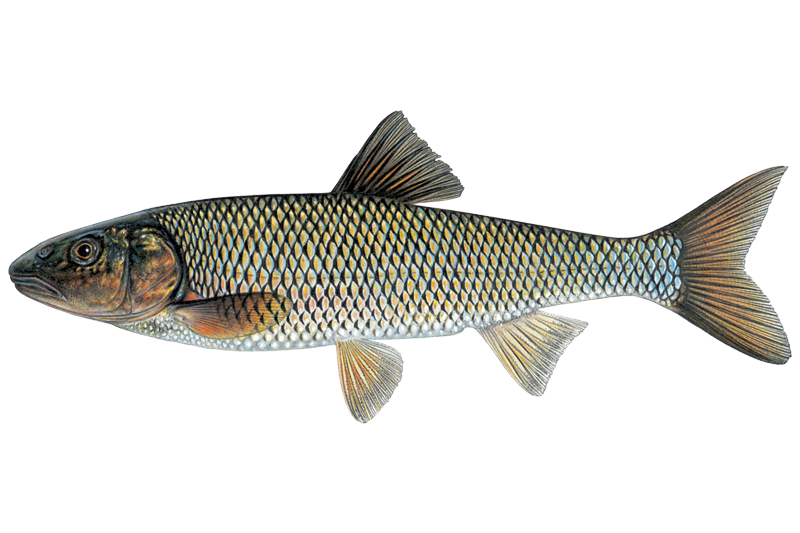
Fallfish are the largest minnow native to eastern North America, and in Canada they're a genuine sleeper species.
Found across Quebec, Ontario, and into New Brunswick, they share water with trout and are usually dismissed as bycatch — but on light tackle or a fly rod they're a legitimate target, especially when summer heat pushes trout off the bite.
Scientific Name: Semotilus corporalis
Also known as Chub, American chub
- Large, silvery body with a slightly compressed profile; scales on the back and upper sides are darkly outlined, giving a scaled-armor look distinct from creek chub.
- Bright silver sides, sometimes with a purple or blue sheen; juveniles carry a bold dark stripe down the centerline that fades with age.
- Breeding males develop a rosy-red face and a dark bar along the back of the gill cover — easy to spot in clear water during spawn.
- Typical fish run 7–10 inches; mature fish commonly reach 12–15 inches and up to 3 lbs, with rare specimens pushing past 19 inches.
What to know
Habitat Distribution
- Native to eastern Canada — present in Quebec and Ontario drainages feeding Hudson Bay and Lake Ontario, and in Atlantic Slope rivers from New Brunswick southward.
- In northern parts of their range, including Canada, fallfish use both rivers and lakes; southern populations stick mainly to moving water.
- Prefer clear, low-gradient streams with forest cover along the banks, typically at moderate elevations; water clarity matters — turbid or heavily silted systems hold far fewer fish.
- Young fish hold in faster riffles; adults gravitate to slower pools, often in water 30–50 cm deep.
Key Locations
- Quebec's Atlantic Slope rivers — fallfish are native here and present throughout the province's southern river systems.
- Ontario drainages feeding Lake Ontario and Hudson Bay hold fallfish across a broad area of the province.
- New Brunswick rivers along the Atlantic Slope, where fallfish reach the northern edge of their native range.
Specific Spots
- Deep pools below riffles are the most reliable holding water — adults stack where current slows and depth gives them a buffer from predators above.
- Shallow, open gravel flats during the spawn; males build visible stone nests (redds) that can be spotted from the bank in clear water.
- Unlike most stream species, fallfish don't depend heavily on woody cover — you'll find them in wide-open mid-stream water, which makes sight-fishing a real option on bright days.
- In lakes, look along drop-offs and near tributary mouths where current concentrates food.
Fallfish FAQ
Answers from onWater's species guide.
What are the best lures and bait for Fallfish?
Small spinners (size 0–2 inline spinners like a Mepps or Rooster Tail) are the go-to, the flash and vibration draw strikes from fish holding in open pools.
What flies work for Fallfish?
Nymphs, Pheasant Tail and Hare's Ear patterns imitate the mayfly nymphs and caddis larvae that make up the bulk of the diet in most Canadian streams; dead-drift (letting the fly drift naturally with the current, no added movement) under an indicator or tight-line style.
When is the best time to fish for Fallfish?
Spring, fish become active as water warms above 10°C; pre-spawn fish in pools are catchable before they move to gravel to build nests. Summer, the prime window in Canada, particularly July and August when trout streams are too warm for salmonids but fallfish feed actively through the heat.
How do you catch Fallfish?
Most Canadian anglers encounter fallfish while wading streams for trout, but deliberately targeting them means working pools with small spinners or swinging wet flies through likely holding water.
What do Fallfish eat?
Smaller fish eat aquatic insects, chironomid midges, mayfly nymphs, and caddis larvae, making standard trout nymphs like a Pheasant Tail or Hare's Ear a natural first choice.
See it in the app
Most maps show you water.
onWater shows you Fallfish.



- 01 · Species map filter
Map every Fallfish water
Pick Fallfish and the map zeroes in on the waters they call home. No more guessing which lake holds them.
- 02 · Waterbody species
Tap any water. See what lives there.
Species, behavior and seasonal patterns for every lake, river and pond, before you leave the driveway.
- 03 · Angler Intelligence
Ask how to catch Fallfish
Tactics, gear and timing from onWater's AI fishing guide, tuned to the species and the water you're on.
Stop guessing where Fallfish are.
Open the map, filter by Fallfish, and head to water that holds them. Download onWater and plan your next trip in minutes.
- Species map filter
- Angler Intelligence
- Fishing journal
Explore other species
Trout, bass, salmon, panfish and everything in between. Each guide unpacks the behavior, seasons, and tactics that put fish in the net.
No species information available.
Smarter Fishing Starts in the App.
onWater Fish gives you everything you need to plan smarter, fish better, and own every trip from first cast to last.