Dolly Varden
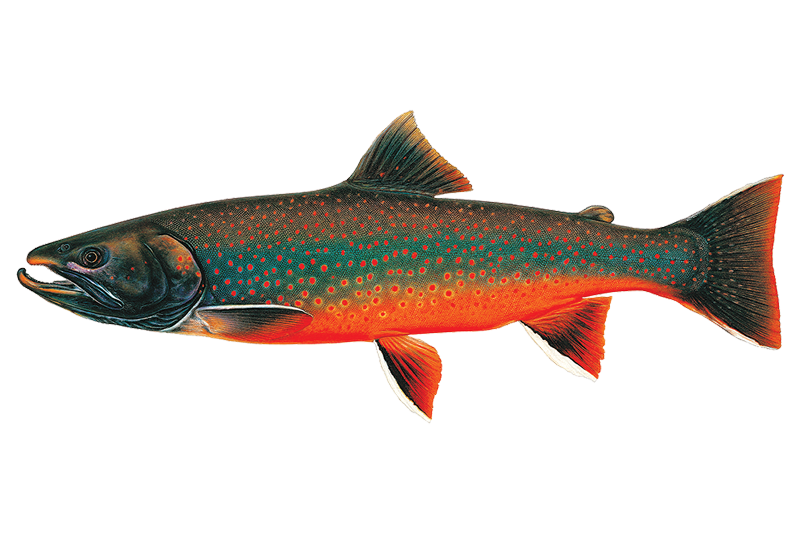
Dolly Varden are native char found across British Columbia, Yukon, the Northwest Territories, and into the Canadian Arctic — including the Mackenzie River drainage and, as recent research confirms, rivers east of it like the Coppermine and Tree.
Both sea-run and freshwater-resident fish exist. Anglers target them for their willingness to eat flies and lures, and for the vivid spawning colors the males display.
Scientific Name: Salvelinus malma
Also known as Dolly, Dolly Varden trout, DV
- A char, not a trout — key ID feature: light-colored spots (yellow, orange, or red) on a dark olive-green or blue-gray body, the reverse of trout patterning.
- Anadromous adults run dark blue-backed with silver sides at sea; freshwater fish are olive to brown with red or orange flanks, especially vivid on spawning males.
- Breeding males develop a pronounced kype (hooked lower jaw) and deepen dramatically in color; females stay comparatively muted.
- Most adults run 16–22 inches; northern-form fish from large river systems can exceed 30 inches and push toward 20 pounds.
What to know
Habitat Distribution
- Native to cold Pacific and Arctic drainages in Canada — coastal BC, Yukon, and the Northwest Territories, with confirmed populations in the Mackenzie River system and rivers east of it including the Coppermine and Tree rivers in Nunavut.
- Two subspecies occur in Canada: the southern form (S. m. lordi) along the BC coast, and the northern form (S. m. malma) from the Alaska border east through the western Canadian Arctic.
- Sea-run populations move between tidal estuaries and freshwater rivers; freshwater-resident fish stay in cold lakes, headwater streams, and larger river systems year-round.
- In small, steep headwater streams, a dwarf freshwater form is common — fish that mature at just 3–6 inches and retain juvenile parr marks their whole lives.
Key Locations
- Skeena and Stikine river systems, BC — major coastal drainages supporting sea-run Dolly Varden alongside steelhead and salmon.
- Yukon River tributaries — large river system with both northern-form anadromous and freshwater-resident populations.
- Mackenzie River drainage, NWT — the long-established eastern boundary of the northern form, with fish present throughout the system.
- Coppermine and Tree rivers, Nunavut — recently confirmed Dolly Varden populations east of the Mackenzie, used by subsistence fishers in the Kugluktuk area.
Specific Spots
- Sea-run fish stage near river mouths and in tidal water during their inshore period — concentrate at current seams where fresh and salt water mix.
- In rivers, look for Dollies holding in deep pools and behind large boulders, especially below spawning salmon redds where they feed on drifting eggs.
- During summer, cold tributary confluences draw fish seeking thermal refuge when mainstem temperatures climb.
- In lakes, fish cruise shallow gravel shoals during spawning season and drop to deeper, cooler water in midsummer.
Dolly Varden FAQ
Answers from onWater's species guide.
What are the best lures and bait for Dolly Varden?
Inline spinners and small spoons in silver, gold, or orange are reliable across all water types, the flash and vibration draw strikes from both river and lake fish. Egg-imitation beads or soft-plastic egg clusters fished under a float are extremely effective below salmon spawning areas in fall.
What flies work for Dolly Varden?
Egg patterns, Glo Bugs, yarn eggs, or single beads pegged above the hook, are the go-to during and after salmon spawning season; dead-drifted (allowed to float naturally with the current) through pools below redds.
When is the best time to fish for Dolly Varden?
Summer (July–August): Sea-run fish are in rivers or near tidal mouths; freshwater fish are active but may seek cold tributaries during warm spells. Fall (September–October): Peak season on most rivers, fish are staging near or below salmon redds, feeding heavily on eggs, and males are in full spawning color.
How do you catch Dolly Varden?
River anglers in BC and Yukon most often fish from the bank or wade, working pools and current seams with spinners, spoons, or fly gear. During salmon runs, positioning below active redds and drifting egg patterns is the most consistent approach.
What do Dolly Varden eat?
Salmon and trout eggs are a primary fall food source, when salmon are spawning, Dollies stack below redds to intercept drifting eggs, making egg-pattern flies like Glo Bugs or beads the most direct imitation.
See it in the app
Most maps show you water.
onWater shows you Dolly Varden.



- 01 · Species map filter
Map every Dolly Varden water
Pick Dolly Varden and the map zeroes in on the waters they call home. No more guessing which lake holds them.
- 02 · Waterbody species
Tap any water. See what lives there.
Species, behavior and seasonal patterns for every lake, river and pond, before you leave the driveway.
- 03 · Angler Intelligence
Ask how to catch Dolly Varden
Tactics, gear and timing from onWater's AI fishing guide, tuned to the species and the water you're on.
Stop guessing where Dolly Varden are.
Open the map, filter by Dolly Varden, and head to water that holds them. Download onWater and plan your next trip in minutes.
- Species map filter
- Angler Intelligence
- Fishing journal
Explore other species
Trout, bass, salmon, panfish and everything in between. Each guide unpacks the behavior, seasons, and tactics that put fish in the net.
No species information available.

Smarter Fishing Starts in the App.
onWater Fish gives you everything you need to plan smarter, fish better, and own every trip from first cast to last.