Cutthroat Trout
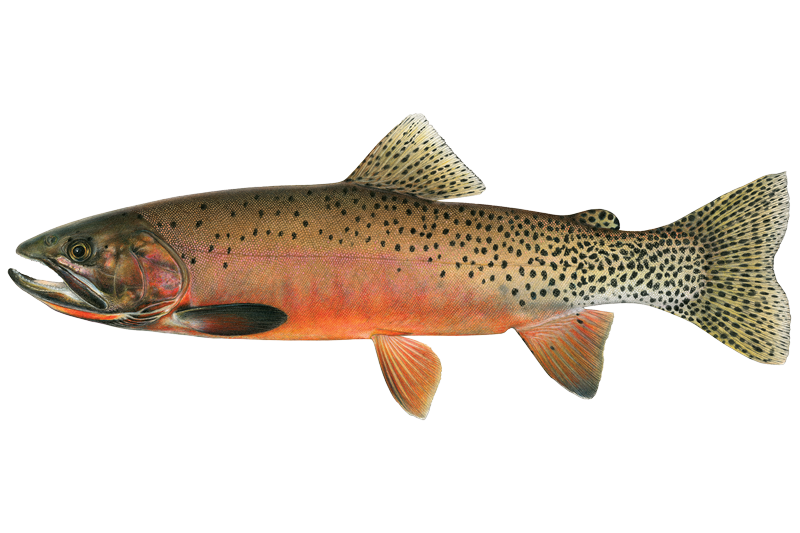
Cutthroat trout are the native trout of Canada's mountain west — the fish that belongs in those cold, clear streams before anything else did. Two subspecies live here: the westslope cutthroat, found throughout the B. C.
Interior and along Alberta's eastern Rocky Mountain slopes, and the coastal cutthroat, which runs the Pacific drainages of B. C. and can be anadromous.
Fly anglers in particular chase them hard, and for good reason — cutthroats rise to dry flies more readily than almost any other trout.
Scientific Name: Oncorhynchus clarkii
Also known as Cutty, cutties, westslope cutthroat, coastal cutthroat, Pacific cutthroat
- Named for the vivid red or orange slash marks on the underside of the jaw — the clearest field ID mark, present on all subspecies.
- Body coloration varies by subspecies and water: westslope fish tend toward olive-gold with heavy black spotting concentrated toward the tail; coastal fish are more silvery when sea-run.
- Typical mountain-stream fish run 25–40 cm; lake-dwelling fish can reach 50+ cm, and sea-run coastal cutthroat grow larger still.
- Distinguished from rainbow trout by the jaw slashes and the absence of a pink lateral band; distinguished from bull trout by the presence of black spots (bull trout have none).
What to know
Habitat Distribution
- Native to B.C. and Alberta — the only trout truly native to Canada's high country; found in nearly every cold mountain stream and high-elevation lake in their range.
- Westslope cutthroat occupy the B.C. Interior and Alberta's eastern Rocky Mountain slopes, including the upper Columbia, Kootenay, and Oldman drainages.
- Coastal cutthroat live in Pacific-draining streams and estuaries along B.C.'s coast; some populations are anadromous, moving between freshwater and saltwater.
- Pure-strain populations are increasingly confined to the upper reaches of mountain streams and isolated high-elevation lakes, where hybridization with introduced rainbow trout is less of a pressure.
Key Locations
- Elk River, B.C. (near Fernie) — one of the most recognized cutthroat fisheries in Canada, known for reliable hatches and strong dry-fly fishing.
- Kootenay region, B.C. — numerous rivers and lakes hold westslope cutthroat; the upper Columbia and Kootenay drainages are core habitat.
- Alberta's eastern Rocky Mountain slopes — the Oldman River system and its tributaries hold native westslope cutthroat in the upper reaches.
- High-elevation lakes in both B.C. and Alberta — backcountry lakes accessible by trail often hold pure-strain cutthroat with minimal fishing pressure.
Specific Spots
- Pool heads and tail-outs in mountain streams — cutthroats hold where current slows enough to conserve energy but fast enough to deliver food.
- Undercut banks and root wads provide overhead cover; cutthroats use these as feeding lies, darting out to take surface insects or drifting nymphs.
- In high-elevation lakes, fish the shallows and inlet streams early and late in the day when cutthroats move up to feed; drop-offs near inlet channels concentrate fish.
- Riffles and pocket water between boulders hold fish in summer — the broken surface gives them cover and the current concentrates insects.
Cutthroat Trout FAQ
Answers from onWater's species guide.
What are the best lures and bait for Cutthroat Trout?
Small inline spinners (sizes 0–2) in gold or silver are reliable across both stream and lake fishing, the flash and vibration draw strikes even in fast pocket water. Small spoons like a Kastmaster or Little Cleo work well in lakes and larger pools; vary the retrieve speed until you find what's working on a given day.
What flies work for Cutthroat Trout?
Dry flies are the signature approach: an Elk Hair Caddis (imitates an adult caddisfly), Parachute Adams (general mayfly imitation), or a large foam hopper pattern fished near the bank in summer will produce surface strikes throughout the day.
When is the best time to fish for Cutthroat Trout?
Summer (July–September) is the prime window for high-elevation lakes and backcountry streams, ice-out opens access, and terrestrial insects are on the water through August. Late spring through early summer brings the best hatch activity on lower-elevation streams once runoff settles and water clears.
How do you catch Cutthroat Trout?
Most cutthroat fishing in Canada is done by wading mountain streams or hiking into high-elevation lakes. Fly fishing with dry flies is the dominant method, and cutthroats are willing enough risers that it's productive even for beginners. Drift-boat fishing is an option on larger rivers like the Elk.
What do Cutthroat Trout eat?
Aquatic insects are the core of the diet in mountain streams, mayflies, caddisflies, and stoneflies at various life stages. Match the hatch with a Pheasant Tail or Hare's Ear nymph (both imitate mayfly nymphs), an Elk Hair Caddis (imitates an adult caddisfly on the surface), or a large Stimulator (imitates a stonefly...
See it in the app
Most maps show you water.
onWater shows you Cutthroat Trout.



- 01 · Species map filter
Map every Cutthroat Trout water
Pick Cutthroat Trout and the map zeroes in on the waters they call home. No more guessing which lake holds them.
- 02 · Waterbody species
Tap any water. See what lives there.
Species, behavior and seasonal patterns for every lake, river and pond, before you leave the driveway.
- 03 · Angler Intelligence
Ask how to catch Cutthroat Trout
Tactics, gear and timing from onWater's AI fishing guide, tuned to the species and the water you're on.
Stop guessing where Cutthroat Trout are.
Open the map, filter by Cutthroat Trout, and head to water that holds them. Download onWater and plan your next trip in minutes.
- Species map filter
- Angler Intelligence
- Fishing journal
Explore other species
Trout, bass, salmon, panfish and everything in between. Each guide unpacks the behavior, seasons, and tactics that put fish in the net.
No species information available.

Smarter Fishing Starts in the App.
onWater Fish gives you everything you need to plan smarter, fish better, and own every trip from first cast to last.