Common Carp
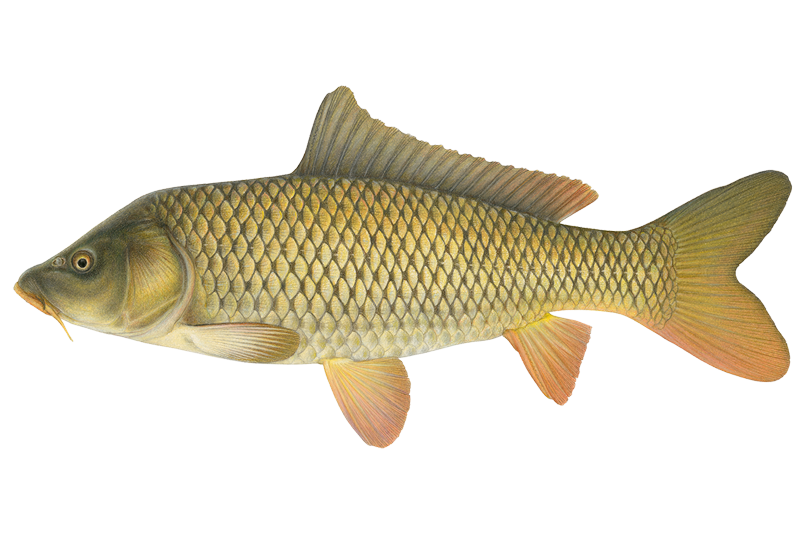
Common carp are an introduced species that have become one of Canada's most accessible large-fish targets, particularly across southern Ontario, Manitoba, and Quebec.
Dismissed for decades as rough fish, they've earned serious respect from anglers who've actually tangled with them — they're big, smart, and will test your tackle. The carp scene in Canada draws heavily from European methods, and the fishery keeps growing.
Scientific Name: Cyprinus carpio
Also known as carpe, carpe commune, European carp, mirror carp, leather carp
- Deep, heavy body; olive-brown to golden-bronze on the back, fading to yellow on the sides, with a yellowish belly and orange-red lower fins.
- Large, well-defined scales cover most of the body — mirror carp have fewer, irregular scales; leather carp are nearly scaleless.
- Two pairs of barbels (short whiskers) at the corners of the mouth — the clearest way to tell carp from Asian carp species, which lack barbels.
- Most Canadian fish run 5–15 lb; 30 lb-plus fish are caught regularly on waters like Lake Erie and the St. Lawrence, with occasional fish pushing 40 lb.
What to know
Habitat Distribution
- Introduced — not native to Canada. First stocked in Manitoba in the late 1800s; now naturalized across southern Ontario, Manitoba, Quebec, and parts of Saskatchewan.
- Heaviest concentrations in the Great Lakes basin (Erie, Ontario, St. Clair), the St. Lawrence River system, and Manitoba's Red River and Lake Winnipeg.
- Prefer warm, shallow, weedy lakes, slow river backwaters, and flooded sloughs — anywhere with soft bottom and abundant aquatic vegetation.
- Tolerant of turbid water and low oxygen levels, which lets them thrive in conditions that exclude most other large fish.
Key Locations
- Lake Erie (ON/national border) — some of the largest carp in Canada, with consistent access from shore and boat along the north shore.
- St. Lawrence River (ON/QC) — a major corridor with strong populations from Kingston through Montreal; Lac Saint-François and Lac Saint-Louis are well-known stretches.
- Red River and Lake Winnipeg (MB) — the heart of Manitoba's carp fishery, where the species has been naturalized for over a century.
- Grand River (ON) — a productive southern Ontario river with accessible carp fishing through Brantford and Cambridge.
- Lake Simcoe and Lake St. Clair (ON) — both hold strong populations and draw dedicated carp anglers, particularly in the warmer months.
Specific Spots
- Shallow, weedy bays in spring and early summer — carp move into the warmest water first after ice-out, and vegetation holds the food they're rooting for.
- Soft-bottom flats adjacent to deeper water; look for muddy, clouded patches where fish are actively rooting (called 'mudding') — that's a feeding carp.
- Current seams and backwater eddies in rivers, where slower water lets carp feed without fighting current — inside bends and slack water behind islands are reliable.
- Shoals (shallow humps surrounded by deeper water) are staging areas, especially in early spring when carp bask and concentrate before spawning.
Common Carp FAQ
Answers from onWater's species guide.
What are the best lures and bait for Common Carp?
Boilies (round, flavoured dough balls in sweet, fishmeal, or spice profiles) are the go-to bait across Canada's carp scene, hair-rigged on a size 4–8 carp hook so the bait sits just off the hook, which is the standard European presentation.
What flies work for Common Carp?
Crayfish patterns and lightly weighted nymphs fished on the bottom to actively feeding fish, cast ahead of a tailing or mudding carp and let the fly settle, then twitch it once as the fish approaches.
When is the best time to fish for Common Carp?
Spring (April–June): Post ice-out through pre-spawn is prime time, fish are concentrated, actively feeding, and often visible in the shallows. The biggest fish of the year are frequently caught in this window.
How do you catch Common Carp?
Most Canadian carp anglers fish from shore or a stationary boat, using pre-baited spots and static rigs, dropping free offerings (corn, pellets, or chopped boilies) in the days before fishing to concentrate fish.
What do Common Carp eat?
Bottom feeders by nature, they root through soft sediment for aquatic insect larvae (bloodworms, chironomid midges), crustaceans, and worms. Corn, boilies, and dough baits work because they mimic the soft, starchy, or protein-rich items carp naturally encounter on the bottom.
See it in the app
Most maps show you water.
onWater shows you Common Carp.



- 01 · Species map filter
Map every Common Carp water
Pick Common Carp and the map zeroes in on the waters they call home. No more guessing which lake holds them.
- 02 · Waterbody species
Tap any water. See what lives there.
Species, behavior and seasonal patterns for every lake, river and pond, before you leave the driveway.
- 03 · Angler Intelligence
Ask how to catch Common Carp
Tactics, gear and timing from onWater's AI fishing guide, tuned to the species and the water you're on.
Stop guessing where Common Carp are.
Open the map, filter by Common Carp, and head to water that holds them. Download onWater and plan your next trip in minutes.
- Species map filter
- Angler Intelligence
- Fishing journal
Explore other species
Trout, bass, salmon, panfish and everything in between. Each guide unpacks the behavior, seasons, and tactics that put fish in the net.
No species information available.
Smarter Fishing Starts in the App.
onWater Fish gives you everything you need to plan smarter, fish better, and own every trip from first cast to last.