Coho Salmon
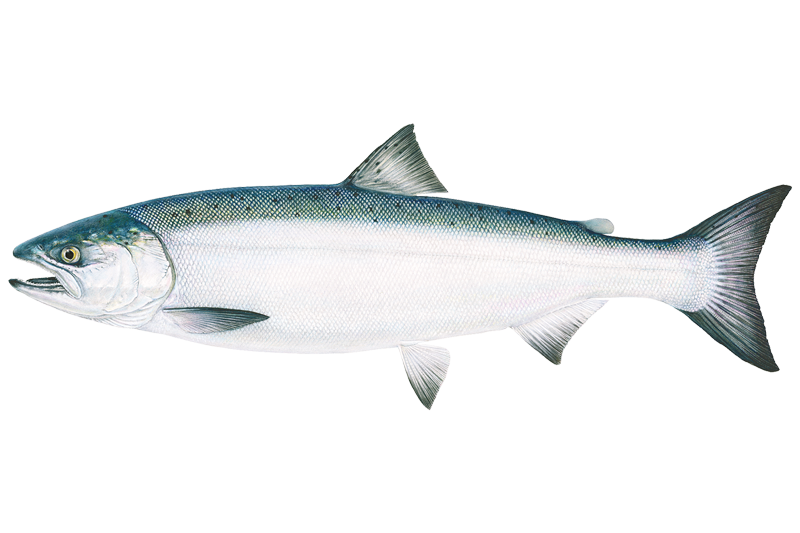
Coho salmon are native to British Columbia's coast and have been introduced to the Great Lakes, giving Canadian anglers two very different fisheries for the same fish. On the BC coast, silvers run hundreds of short coastal streams in fall.
In Ontario and the Great Lakes, introduced populations have built self-sustaining runs. Coho are known for chasing lures with reckless energy and spending as much time in the air as in the water when hooked.
Scientific Name: Oncorhynchus kisutch
Also known as Silver salmon, silvers, bluebacks
- In saltwater: bright silver sides, dark blue-green back, small black spots on the back and upper tail lobe only — no spots on the lower tail lobe, which separates them from Chinook.
- Lower jaw gumline is pale gray to white at the base of the teeth — a reliable field ID mark against Chinook, which have black gums.
- In freshwater: sides turn deep red-maroon, head and back go dark green; spawning males develop a hooked jaw and slightly humped back.
- Average adults run 7–11 lbs and 20–28 inches; fish to 20 lbs are possible, and the Great Lakes have produced specimens pushing 30 lbs.
What to know
Habitat Distribution
- Native to the BC coast from Vancouver Island north through Haida Gwaii and into Alaska; they use roughly 800 short coastal streams and rivers to spawn.
- Introduced to the Great Lakes in the late 1960s; self-sustaining populations now run tributaries in Ontario, giving freshwater anglers a fall run fishery far from the Pacific.
- At sea, coho forage in shallow coastal waters and along the continental shelf edge — areas like Haida Gwaii and Kyuquot Sound on northern Vancouver Island concentrate fish reliably.
- Juveniles spend 12–24 months in their natal streams before migrating to salt, making small coastal creeks and their riparian buffers critical habitat.
Key Locations
- Haida Gwaii, BC — remote archipelago on the edge of the continental shelf; consistent saltwater coho fishing through the summer and fall season.
- Kyuquot Sound, northern Vancouver Island, BC — reliable Chinook and coho fishing from July through late August, closer to shore than Haida Gwaii.
- Skeena River system, BC — major north-coast river system with coho runs accessible by fly and conventional gear in fall.
- Ontario Great Lakes tributaries — rivers flowing into Lake Ontario and Lake Huron see fall coho runs, giving inland anglers a Pacific-style salmon fishery.
Specific Spots
- In tidal saltwater, coho stack along kelp lines, current rips, and the edges of baitfish schools — follow the birds and the bait.
- In rivers, fresh-run fish hold in the deeper slots and tailouts of pools, resting out of the main current before pushing upstream.
- In the Great Lakes, tributaries concentrate fish at the river mouth and in the first deep pools above it once water temperatures drop in fall.
- On the BC coast, coho move into estuaries and tidal reaches before committing to the freshwater push — these transition zones fish well on an incoming tide.
Coho Salmon FAQ
Answers from onWater's species guide.
What are the best lures and bait for Coho Salmon?
In saltwater, hoochies (squid-skirt lures) trolled behind a flasher, spoons like the Gibbs Croc or Krippled K, and cut-plug herring are the standard BC coho setup, the flasher adds attraction and mimics a school of bait.
What flies work for Coho Salmon?
Egg patterns, single egg flies and egg-cluster imitations, are the most consistent producers on spawning-run coho in both BC streams and Great Lakes tributaries, imitating loose salmon eggs drifting in the current.
When is the best time to fish for Coho Salmon?
Summer (July–August): saltwater coho are actively feeding along the BC coast and around Haida Gwaii and Vancouver Island; prime time for trolling before the river push. Fall (September–November): coho enter BC coastal rivers and Great Lakes tributaries; fresh-run fish are the most responsive to lures and flies.
How do you catch Coho Salmon?
On the BC coast, most anglers troll saltwater with hoochies or spoons behind a flasher, targeting fish staging near baitfish schools before they enter rivers.
What do Coho Salmon eat?
Ocean-phase coho eat baitfish, herring, sand lance, and anchovies, which is why spoons, hoochies (squid-skirt lures), and cut-plug herring are the backbone of BC saltwater coho fishing.
See it in the app
Most maps show you water.
onWater shows you Coho Salmon.



- 01 · Species map filter
Map every Coho Salmon water
Pick Coho Salmon and the map zeroes in on the waters they call home. No more guessing which lake holds them.
- 02 · Waterbody species
Tap any water. See what lives there.
Species, behavior and seasonal patterns for every lake, river and pond, before you leave the driveway.
- 03 · Angler Intelligence
Ask how to catch Coho Salmon
Tactics, gear and timing from onWater's AI fishing guide, tuned to the species and the water you're on.
Stop guessing where Coho Salmon are.
Open the map, filter by Coho Salmon, and head to water that holds them. Download onWater and plan your next trip in minutes.
- Species map filter
- Angler Intelligence
- Fishing journal
Explore other species
Trout, bass, salmon, panfish and everything in between. Each guide unpacks the behavior, seasons, and tactics that put fish in the net.
No species information available.

Smarter Fishing Starts in the App.
onWater Fish gives you everything you need to plan smarter, fish better, and own every trip from first cast to last.