Chum Salmon
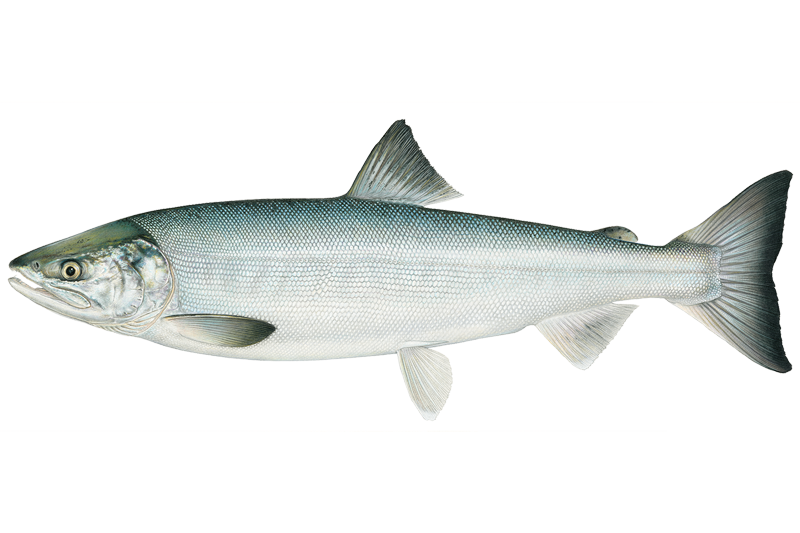
Chum salmon are native to British Columbia's coastal rivers and run as far inland as the Yukon River drainage, where some stocks make one of the longest freshwater migrations of any Pacific salmon.
They're an underrated sport fish — more abundant than Chinook or coho in many BC streams, willing to bite once they enter the river, and tough enough on tackle that they've earned the nickname 'water buffalo' among guides.
Scientific Name: Oncorhynchus keta
Also known as Dog salmon, keta salmon, keta, chum
- Ocean-bright fish are metallic greenish-blue on the back with fine black speckles; once in fresh water, both sexes develop bold red-and-black tiger stripes across the flanks.
- Males grow large canine-like fangs as they near spawning — the most distinctive ID feature; females are less colorful and lack the fangs.
- Second-largest Pacific salmon after Chinook; typical returning adults run 8–15 lbs, with fish over 20 lbs not uncommon and the record exceeding 40 lbs.
- Distinguished from coho by the tiger-stripe pattern in fresh water and from sockeye by larger body size and the absence of a red spawning color on sockeye's back.
What to know
Habitat Distribution
- Native to coastal rivers and streams throughout British Columbia, from small tidal creeks to large systems like the Fraser River — one of the most broadly distributed Pacific salmon in the province.
- Also native to the Yukon River drainage in Yukon Territory, where fall-run chum undertake migrations exceeding 2,700 km — among the longest anadromous runs in the world.
- Range extends along the Arctic coast to the Mackenzie River in the Northwest Territories, where range-expanding individuals have been documented in recent years.
- Anadromous: spawn in fresh water, then juveniles move quickly to estuaries and the open Pacific, returning as adults after 3–5 years at sea.
Key Locations
- Fraser River system, BC — one of the most productive chum rivers in the province, with fish accessible from tidewater through the lower tributaries.
- Vancouver Island coastal streams — numerous short coastal rivers on the island see strong chum runs, often the most abundant salmon species in smaller systems.
- Yukon River drainage, Yukon Territory — fall chum here undertake extraordinary upstream migrations; the Canadian portion holds some of the largest fall-run fish.
- BC's Sunshine Coast and central coast rivers — smaller systems with good public access and strong chum returns in fall.
Specific Spots
- Deep runs with moderate current — water deeper than 4 feet where chum can hold without fighting heavy flow; target the seam between fast and slow water.
- Deep pools with little current are prime holding water, especially mid-river; fish stage here before pushing to spawning gravel.
- Tidal reaches and lower river sections hold the freshest, most aggressive fish — from tidewater upstream is where you'll find chrome-bright chum most willing to bite.
- Avoid actively spawning fish on shallow gravel redds; concentrate on traveling fish in deeper transitional water between the estuary and spawning grounds.
Chum Salmon FAQ
Answers from onWater's species guide.
What are the best lures and bait for Chum Salmon?
Marabou or rabbit-fur jigs in 1/4–3/8 oz, fished under a float or twitched through pools, are the go-to river presentation; pink, chartreuse, and purple are proven colors. Tipping the jig with a small piece of raw prawn increases strikes.
What flies work for Chum Salmon?
Weighted Clouser Minnows (which imitate baitfish) in pink, chartreuse, or purple are a standard chum fly, the weight gets the fly into the strike zone in deeper holding water, and the color triggers reaction strikes.
When is the best time to fish for Chum Salmon?
Fall is the primary season across most of BC, with chum entering coastal rivers and moving through lower reaches before spawning, timing varies by system but generally runs from late summer through early winter.
How do you catch Chum Salmon?
Most anglers in BC target chum from the bank or by wading, working floats and jigs through deep runs from tidewater upstream. Boat anglers on larger rivers back-troll plugs through holding water. Fly anglers swing or strip streamers through the same seams, covering water methodically until they find traveling pods.
What do Chum Salmon eat?
Juveniles feed on zooplankton and aquatic insects in fresh water before quickly moving to estuaries, where they shift to small crustaceans and baitfish as they grow.
See it in the app
Most maps show you water.
onWater shows you Chum Salmon.



- 01 · Species map filter
Map every Chum Salmon water
Pick Chum Salmon and the map zeroes in on the waters they call home. No more guessing which lake holds them.
- 02 · Waterbody species
Tap any water. See what lives there.
Species, behavior and seasonal patterns for every lake, river and pond, before you leave the driveway.
- 03 · Angler Intelligence
Ask how to catch Chum Salmon
Tactics, gear and timing from onWater's AI fishing guide, tuned to the species and the water you're on.
Stop guessing where Chum Salmon are.
Open the map, filter by Chum Salmon, and head to water that holds them. Download onWater and plan your next trip in minutes.
- Species map filter
- Angler Intelligence
- Fishing journal
Explore other species
Trout, bass, salmon, panfish and everything in between. Each guide unpacks the behavior, seasons, and tactics that put fish in the net.
No species information available.
Smarter Fishing Starts in the App.
onWater Fish gives you everything you need to plan smarter, fish better, and own every trip from first cast to last.