Chinook Salmon
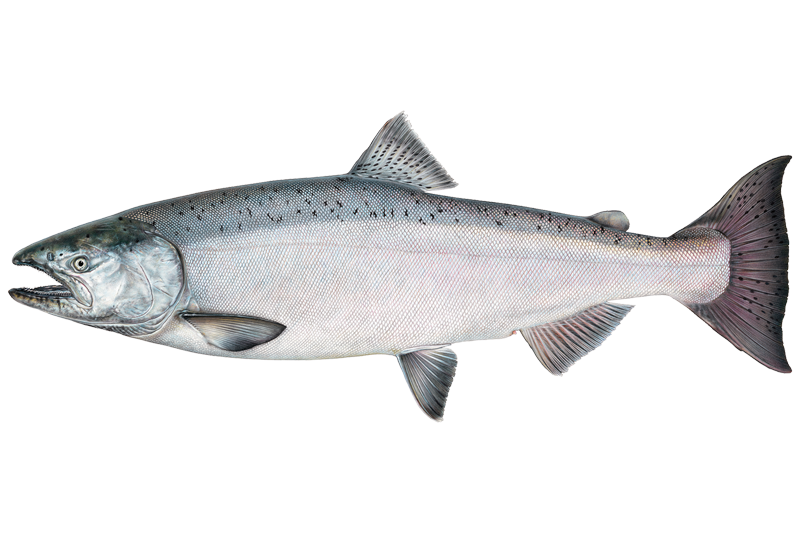
Chinook — called Kings or Springs by most BC anglers — are the largest Pacific salmon and the centerpiece of British Columbia's saltwater and river fisheries.
They run BC's coastal waters and major river systems from the Fraser to the Skeena, drawing anglers from February through September. No other Canadian salmon combines raw size with the depth of both ocean and freshwater opportunity that Kings do.
Scientific Name: Oncorhynchus tshawytscha
Also known as King salmon, Spring salmon, Springs, Tyee, Blackmouth, Quinnat salmon
- Blue-green back with silver sides and white belly in the ocean; body darkens to olive-brown, red, or purple as spawning approaches — males show the most dramatic color shift.
- Black gums are the clearest field mark separating Chinook from other Pacific salmon — check the gum line when you're not sure what you've got.
- Black spots cover the upper body and both lobes of the tail fin; spawning males develop a pronounced hooked upper jaw.
- Largest of the Pacific salmon — typical fish run 10–30 lb, with fish over 40 lb caught regularly in BC waters; the all-time record exceeded 100 lb.
What to know
Habitat Distribution
- Native to BC's Pacific coast and river systems; range spans from Vancouver Island and Haida Gwaii north through the Skeena and into the Yukon River drainage.
- Anadromous — hatch in freshwater rivers and streams, migrate to the ocean to feed and grow for two to six years, then return to their natal rivers to spawn and die.
- In the ocean, they roam open coastal waters and concentrate along the continental shelf edge, particularly around Haida Gwaii and the west coast of Vancouver Island.
- In freshwater, they hold in deep pools, behind large boulders, and in the slower water adjacent to main current seams in rivers like the Fraser, Stamp, and Skeena.
Key Locations
- Haida Gwaii — remote archipelago on the edge of the continental shelf; consistent Chinook fishing through the full season with access to both ocean and nearshore structure.
- Ucluelet / Barkley Sound, Vancouver Island — over 200,000 Chinook returned to the Stamp River system in 2023; one of the most productive and accessible ocean Chinook fisheries on the BC coast.
- Fraser River, BC — the province's largest river system and a major Chinook corridor; multiple runs move through from spring into fall, with both tidal and upper-river fisheries.
- Skeena River system, northern BC — a major wild Chinook river drawing fly anglers specifically for its large, chrome fish in a remote setting.
- Yukon River, Yukon — the longest freshwater migration route for Chinook in the world, at over 3,000 km; fish here are lean and powerful from the journey.
Specific Spots
- In tidal saltwater, Chinook stack along underwater structure — reefs, banks, and depth changes — and tend to face incoming tide flows, so work those edges with the tide rather than against it.
- Overcast days push fish shallower and make them more active; on bright days, drop presentations deeper along the same structure.
- In rivers, target the deep, slower water on the inside of bends and the calm pockets behind large boulders — fish rest in these spots after fighting current on their upstream migration.
- Near shore at night, Chinook move into calmer water close to the bank; first light on those same shoreline edges is a reliable window before fish push back to deeper holding water.
Chinook Salmon FAQ
Answers from onWater's species guide.
What are the best lures and bait for Chinook Salmon?
In saltwater, cut-plug herring fished on a mooching rig or trolled behind a flasher is the most consistent BC presentation; whole anchovies and herring-imitating spoons like the Krippled K or Coyote spoon are close seconds.
What flies work for Chinook Salmon?
Large, heavily weighted streamers in chartreuse, pink, orange, or purple, patterns like the Intruder or large Bunny Leech imitate nothing specific but trigger the aggression response of a fish that has stopped actively feeding.
When is the best time to fish for Chinook Salmon?
Early season (February–April): first Chinook of the year appear in coastal BC waters and some river systems; lower fishing pressure, cooler water, and fish that are still ocean-bright.
How do you catch Chinook Salmon?
Most BC anglers pursue Chinook from boats, either trolling or mooching with herring in saltwater, or back-trolling plugs and drifting roe in rivers. Shore-based river fishing with float rigs or spinners is productive where bank access exists on systems like the Fraser and Stamp.
What do Chinook Salmon eat?
Juveniles in freshwater feed on aquatic insects and small crustaceans; once at sea, they shift almost entirely to baitfish, herring, anchovies, and sand lance make up the bulk of their ocean diet, which is why cut-plug herring and herring-imitating spoons and plugs are the go-to ocean presentations.
See it in the app
Most maps show you water.
onWater shows you Chinook Salmon.



- 01 · Species map filter
Map every Chinook Salmon water
Pick Chinook Salmon and the map zeroes in on the waters they call home. No more guessing which lake holds them.
- 02 · Waterbody species
Tap any water. See what lives there.
Species, behavior and seasonal patterns for every lake, river and pond, before you leave the driveway.
- 03 · Angler Intelligence
Ask how to catch Chinook Salmon
Tactics, gear and timing from onWater's AI fishing guide, tuned to the species and the water you're on.
Stop guessing where Chinook Salmon are.
Open the map, filter by Chinook Salmon, and head to water that holds them. Download onWater and plan your next trip in minutes.
- Species map filter
- Angler Intelligence
- Fishing journal
Explore other species
Trout, bass, salmon, panfish and everything in between. Each guide unpacks the behavior, seasons, and tactics that put fish in the net.
No species information available.

Smarter Fishing Starts in the App.
onWater Fish gives you everything you need to plan smarter, fish better, and own every trip from first cast to last.