Channel Catfish
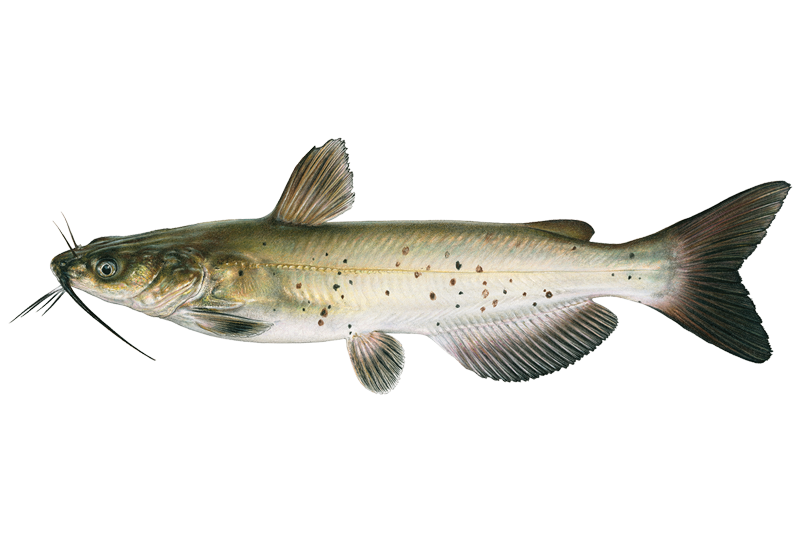
Channel catfish are native to Manitoba's Red River drainage and the Hudson Bay basin, and have been stocked across prairie rivers and lakes in Saskatchewan and Ontario. The stretch of Red River below St.
Andrews Dam north of Winnipeg is Canada's most celebrated catfish water — fish migrating up from Lake Winnipeg stack in that 22-mile run, and 20-pound cats are genuinely common there.
Scientific Name: Ictalurus punctatus
Also known as Channel cat, channel
- Scaleless, smooth skin ranging from grey-silver to olive-bronze; younger fish show scattered dark spots along the sides that fade with age.
- Deeply forked tail distinguishes channel cats from flatheads and bullheads, which have squared or only slightly notched tails.
- Eight barbels (whiskers) around the mouth — four beneath the jaw, two on top, one at each corner — covered in taste receptors used to locate food on the bottom.
- Typical fish run 2–5 lb; Manitoba's Red River regularly produces fish over 20 lb, and anything pushing 30 inches is a genuine trophy in Canadian waters.
What to know
Habitat Distribution
- Native to the Hudson Bay drainage — including the Red River and Assiniboine River systems in Manitoba — and the St. Lawrence–Great Lakes basin into southern Quebec and Ontario.
- Stocked into prairie reservoirs and rivers in Saskatchewan, including Lake Diefenbaker and the Qu'Appelle River system, expanding their fishable range well beyond native waters.
- Prefer large, warm rivers and reservoirs with sand or mud bottoms; also found in the slower arms of lakes where bottom temperatures stay warm through summer.
- In rivers, they concentrate in deep holes, below dams, along current seams, and in log jams — anywhere current slows and food collects.
Key Locations
- Red River below St. Andrews Dam, Manitoba — the 22-mile run to Lake Winnipeg holds the highest concentration of large channel cats in Canada, with 20-pound fish genuinely common.
- Lake Winnipeg, Manitoba — the source population that migrates into the Red River each spring; fish stage near the river mouth before moving upstream.
- Assiniboine River, Manitoba — a tributary of the Red that holds channel cats through the warmer months.
- Lake Diefenbaker and the Qu'Appelle River, Saskatchewan — the primary Saskatchewan fishery, with the provincial record coming from the Qu'Appelle system.
- Lake of the Woods, Ontario — the westernmost Ontario population, accessible from shore and by boat along the lake's many bays and river inflows.
Specific Spots
- Below dams and lock structures — the tailwater below St. Andrews Dam on the Red River is the textbook example — where current concentrates baitfish and migrating cats stack up.
- Deep river holes with soft bottoms, especially where a faster current seam drops into slack water; cats hold in the slow water and intercept food washing through.
- Logjams, submerged timber, and undercut banks provide cover during daylight hours; fish move out onto adjacent flats and current edges after dark to feed.
- In reservoirs like Lake Diefenbaker, focus on channel edges, points where tributaries enter, and any hard-bottom structure near deeper water.
Channel Catfish FAQ
Answers from onWater's species guide.
What are the best lures and bait for Channel Catfish?
Cut bait from local forage, sucker, goldeye, or shad, is the top producer on Manitoba's Red River; fresh-cut chunks fished on the bottom with a slip-sinker rig outperform almost everything else for big fish.
When is the best time to fish for Channel Catfish?
Late spring through early summer (May–June): fish move up from Lake Winnipeg into the Red River as water warms; this is when the Manitoba fishery opens and big fish are most concentrated below St. Andrews Dam.
How do you catch Channel Catfish?
Most Canadian channel cat fishing is done from shore or anchored boats, soaking cut bait or nightcrawlers on a slip-sinker rig on the bottom. On the Red River, guides run clients to deep holes and dam tailwaters where migrating fish concentrate; evening and overnight sessions produce the most consistent action.
What do Channel Catfish eat?
Channel cats eat a wide range of bottom-available food, cut baitfish (sucker, goldeye), crayfish, nightcrawlers, and clams. Their entire body is covered in taste buds, so scent-heavy baits like cut sucker or chicken liver draw fish from a distance in low-visibility or night conditions.
Where do Channel Catfish live?
Native to the Hudson Bay drainage, including the Red River and Assiniboine River systems in Manitoba, and the St. Lawrence–Great Lakes basin into southern Quebec and Ontario.
See it in the app
Most maps show you water.
onWater shows you Channel Catfish.



- 01 · Species map filter
Map every Channel Catfish water
Pick Channel Catfish and the map zeroes in on the waters they call home. No more guessing which lake holds them.
- 02 · Waterbody species
Tap any water. See what lives there.
Species, behavior and seasonal patterns for every lake, river and pond, before you leave the driveway.
- 03 · Angler Intelligence
Ask how to catch Channel Catfish
Tactics, gear and timing from onWater's AI fishing guide, tuned to the species and the water you're on.
Stop guessing where Channel Catfish are.
Open the map, filter by Channel Catfish, and head to water that holds them. Download onWater and plan your next trip in minutes.
- Species map filter
- Angler Intelligence
- Fishing journal
Explore other species
Trout, bass, salmon, panfish and everything in between. Each guide unpacks the behavior, seasons, and tactics that put fish in the net.
No species information available.
Smarter Fishing Starts in the App.
onWater Fish gives you everything you need to plan smarter, fish better, and own every trip from first cast to last.