Chain Pickerel
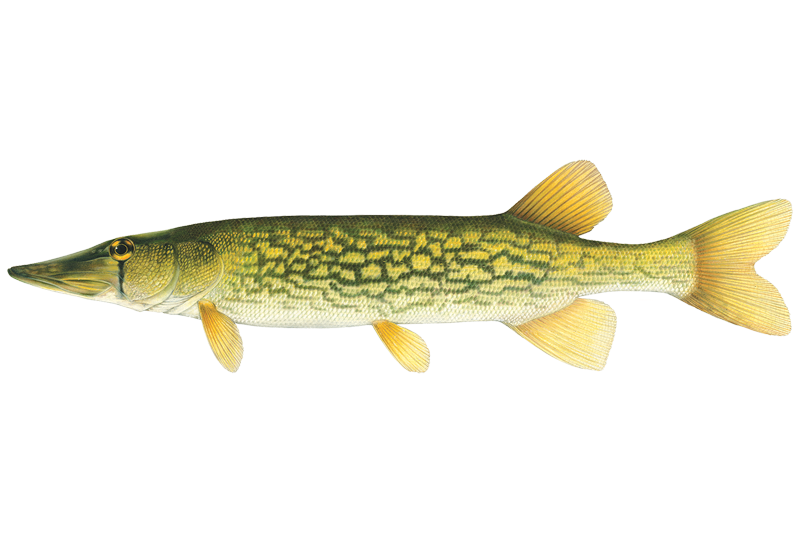
Chain pickerel are a small but scrappy member of the pike family found in eastern Canada. In Nova Scotia they were introduced in 1945 and have since spread widely; in Ontario they're a newer arrival, turning up in the eastern Lake Ontario and upper St.
Lawrence corridor. Neither population is native, and both are managed as invasive species — which means no size limits, no bag limits, and a mandatory-retention rule in Nova Scotia.
Scientific Name: Esox niger
Also known as Jackfish, Grass Pike, Southern Pike, Jack, Lake Snake
- Greenish sides covered in a dark, interlocking chain-link pattern — the clearest field mark separating this species from northern pike and walleye.
- A vertical black bar runs straight down through the eye; on the closely related grass pickerel, that bar curves backward — useful when you have both in hand.
- Cheeks and gill covers are fully scaled, unlike northern pike, which have scales only on the cheek.
- Average catch runs 40–55 cm and under 1 kg; fish pushing 65–70 cm exist but are uncommon in Canadian waters.
What to know
Habitat Distribution
- Not native to Canada — introduced to Nova Scotia in 1945 and now established across much of the province; appearing in eastern Lake Ontario and the upper St. Lawrence River in Ontario since 2008, likely spreading from New York waters.
- Considered an aquatic invasive species in both Nova Scotia and Ontario, where they compete with native fish communities.
- Prefer shallow, weedy lakes, ponds, slow-moving rivers, and backwater sloughs — anywhere dense aquatic vegetation gives them cover to hunt from.
- Tolerant of slightly brackish conditions and low-clarity water, which helps them colonize a wide range of habitats once introduced.
Key Locations
- Nova Scotia lakes and river systems province-wide, where the species has spread significantly since its 1945 introduction.
- Eastern Lake Ontario and the upper St. Lawrence River in Ontario, where the species has been documented since 2008 and appears to be expanding from New York waters.
- Micmac Lake, Nova Scotia — documented catch location noted by local anglers.
Specific Spots
- Thick weed edges — lily pad margins, milfoil beds, and emergent rushes — are the core holding water; pickerel use vegetation as cover to ambush passing baitfish.
- Shallow bays with dark, soft bottoms warm fastest in spring and draw pickerel in early season when the rest of the lake is still cold.
- Fallen timber, dock pilings, and any hard structure inside or adjacent to weeds concentrate fish, especially on bright midday sun when they push tighter to shade.
- In winter, look just above the weed tops in 1–3 m of water; pickerel stay active under ice and are a reliable target for tip-up anglers.
Chain Pickerel FAQ
Answers from onWater's species guide.
What are the best lures and bait for Chain Pickerel?
Inline spinners (Rooster Tail, Mepps) in yellow, chartreuse, or perch patterns are a go-to, the flash and vibration trigger reaction strikes even in cold water.
What flies work for Chain Pickerel?
Deceiver-style streamers and Clouser Minnows (both imitate baitfish) in white, chartreuse, or yellow-perch colours are the most reliable producers, strip them along weed edges with short, sharp pulls.
When is the best time to fish for Chain Pickerel?
Early spring (ice-out through May), fish move into the shallowest, warmest bays to spawn and feed aggressively; one of the most active windows of the year. Summer, consistent action along weed edges during early morning and evening; midday fish push tighter to shade and structure.
How do you catch Chain Pickerel?
In Nova Scotia, most anglers encounter chain pickerel while fishing for other species in weedy lakes and ponds; targeting them deliberately means working weed edges and shallow bays with spinners or jerkbaits. Shore fishing is practical given how shallow they hold.
What do Chain Pickerel eat?
Primarily small fish, perch, shiners, and juvenile bass, which is why long, slender lures like inline spinners, small jerkbaits, and spoons draw consistent strikes. A Rooster Tail or small Rapala in yellow-perch colours is a reliable starting point.
See it in the app
Most maps show you water.
onWater shows you Chain Pickerel.



- 01 · Species map filter
Map every Chain Pickerel water
Pick Chain Pickerel and the map zeroes in on the waters they call home. No more guessing which lake holds them.
- 02 · Waterbody species
Tap any water. See what lives there.
Species, behavior and seasonal patterns for every lake, river and pond, before you leave the driveway.
- 03 · Angler Intelligence
Ask how to catch Chain Pickerel
Tactics, gear and timing from onWater's AI fishing guide, tuned to the species and the water you're on.
Stop guessing where Chain Pickerel are.
Open the map, filter by Chain Pickerel, and head to water that holds them. Download onWater and plan your next trip in minutes.
- Species map filter
- Angler Intelligence
- Fishing journal
Explore other species
Trout, bass, salmon, panfish and everything in between. Each guide unpacks the behavior, seasons, and tactics that put fish in the net.
No species information available.

Smarter Fishing Starts in the App.
onWater Fish gives you everything you need to plan smarter, fish better, and own every trip from first cast to last.