Burbot
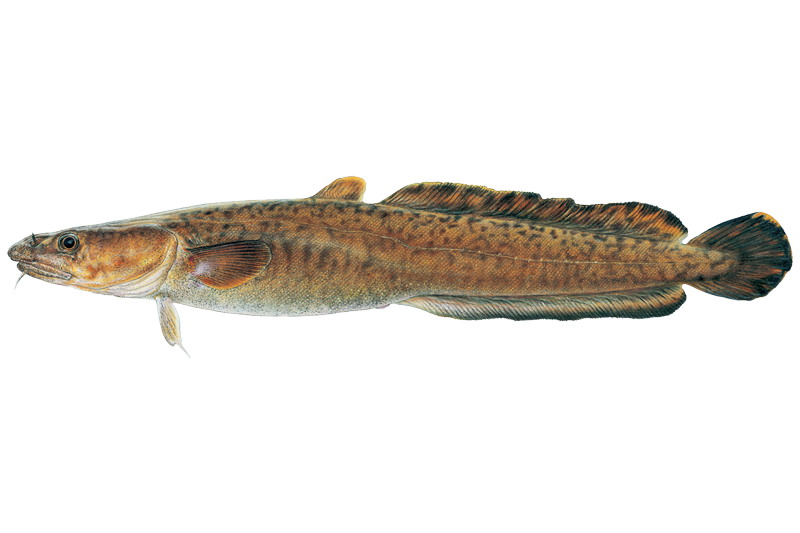
Burbot are Canada's only freshwater cod, native to cold lakes and rivers from New Brunswick to the Yukon — everywhere except Nova Scotia and the Atlantic islands.
They live deep, spawn under the ice in late winter, and bite hardest when most anglers are home by the fire. That timing, combined with genuinely excellent table fare, makes them a cult favourite among ice anglers who know what they're doing.
Scientific Name: Lota lota
Also known as Ling, Loche, Lawyer, Eelpout, Freshwater Cod, Freshwater Ling, Cusk, Snake, Mariah
- Long, eel-like body with mottled yellow-brown patterning — often described as leopard print — that can shade toward olive, grey, or near-black depending on the water.
- A single soft chin barbel (the "goatee"), a wide mouth lined with fine sandpaper-like teeth, and elongated dorsal and anal fins that run almost to the rounded tail.
- Skin appears smooth and slimy but carries tiny, nearly microscopic scales — easy to mistake for a catfish or eel at first glance.
- Typical Canadian fish run 40–60 cm; larger individuals push past 80 cm and several kilograms in deep, cold lakes.
What to know
Habitat Distribution
- Native across nearly all of Canada — from New Brunswick and Quebec west through Ontario, the Prairies, and into British Columbia, the Yukon, and Northwest Territories — absent only from Nova Scotia and the Atlantic islands.
- Primarily a deep, cold-lake species; in Lake Superior they're regularly found below 100 m and have been recorded past 300 m.
- Also live in large, cold river systems — the Mackenzie, Peace, and other northern drainages hold strong populations.
- Require cold, well-oxygenated water year-round; they retreat to the deepest available habitat during warm months and move shallow only to spawn in late winter.
Key Locations
- Lake Superior — deep, cold water and a documented population; Parks Canada has actively promoted burbot angling in the National Marine Conservation Area.
- Great Slave Lake and the Mackenzie River system, NWT — large, cold, and lightly fished; holds some of the biggest burbot in the country.
- Manitoba's large northern lakes, including Lake Winnipeg and Heming Lake — historically studied populations and accessible ice fishing.
- The Peace and Athabasca river systems in Alberta and BC — cold, deep rivers with strong burbot numbers and limited fishing pressure.
Specific Spots
- During winter and the pre-spawn period, burbot move onto flats and shoals adjacent to deep water — look for the transition zone where a hard bottom meets the drop-off.
- Rocky points, submerged reefs, and gravel shoals in 3–10 m of water draw spawning fish; these same areas hold feeding fish in the weeks before and after the spawn.
- In rivers, target deep holes, undercut banks, and slow eddies behind large boulders — burbot hug the bottom and avoid strong current.
- During summer, they push to the deepest, coldest water available; vertical jigging over deep structure or suspended above bottom in 20–40 m is the only reliable approach.
Burbot FAQ
Answers from onWater's species guide.
What are the best lures and bait for Burbot?
Cut bait, chunks of cisco, sucker, perch, or smelt, fished on bottom is the most reliable presentation, especially through the ice; fresh or slightly aged bait both work, and burbot find it by scent as much as sight.
When is the best time to fish for Burbot?
Late winter (February–March), the prime window; fish move shallow to spawn and feed heavily in the weeks leading up to it, making this the most productive and accessible season. Early ice (December–January), burbot are active and catchable on deep structure before the spawn push begins.
How do you catch Burbot?
The vast majority of Canadian burbot fishing happens through the ice during the late-winter pre-spawn and spawn period, working shoals and drop-offs after dark with cut bait or tipped jigs fished on or just above bottom.
What do Burbot eat?
Burbot eat smaller fish, perch, cisco, smelt, sculpin, and juvenile walleye, which is why jigging spoons, tube jigs, and swimbaits that mimic a struggling baitfish are the go-to presentations.
Where do Burbot live?
Native across nearly all of Canada, from New Brunswick and Quebec west through Ontario, the Prairies, and into British Columbia, the Yukon, and Northwest Territories, absent only from Nova Scotia and the Atlantic islands.
See it in the app
Most maps show you water.
onWater shows you Burbot.



- 01 · Species map filter
Map every Burbot water
Pick Burbot and the map zeroes in on the waters they call home. No more guessing which lake holds them.
- 02 · Waterbody species
Tap any water. See what lives there.
Species, behavior and seasonal patterns for every lake, river and pond, before you leave the driveway.
- 03 · Angler Intelligence
Ask how to catch Burbot
Tactics, gear and timing from onWater's AI fishing guide, tuned to the species and the water you're on.
Stop guessing where Burbot are.
Open the map, filter by Burbot, and head to water that holds them. Download onWater and plan your next trip in minutes.
- Species map filter
- Angler Intelligence
- Fishing journal
Explore other species
Trout, bass, salmon, panfish and everything in between. Each guide unpacks the behavior, seasons, and tactics that put fish in the net.
No species information available.
Smarter Fishing Starts in the App.
onWater Fish gives you everything you need to plan smarter, fish better, and own every trip from first cast to last.