Bull Trout
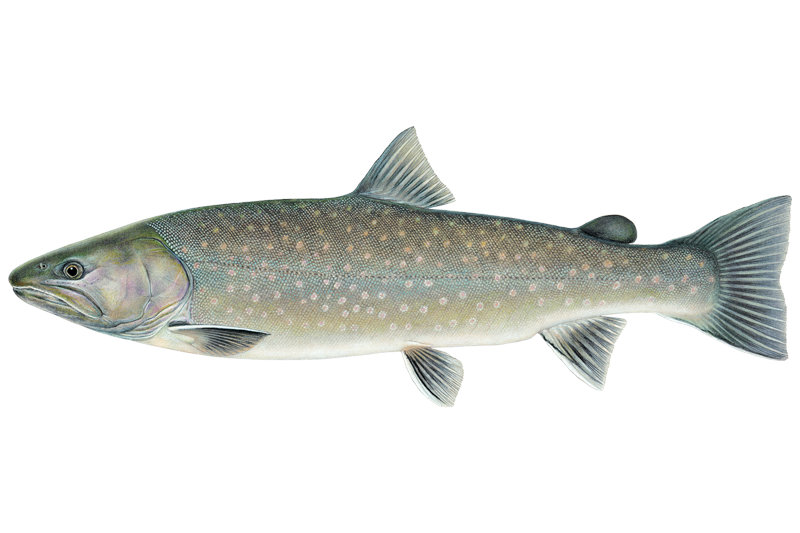
Bull trout are native char — not true trout — found across British Columbia, Alberta, and parts of the Yukon. In Canada they represent one of the last intact cold-water char fisheries in North America.
Anglers target them primarily on fly gear, throwing big streamers into deep pools on remote mountain rivers. Their size, selectivity about water quality, and the wild country they live in make them a serious pursuit.
Scientific Name: Salvelinus confluentus
Also known as Bull char, Dolly Varden (historical misidentification)
- Olive to drab-grey body with pale yellow, orange, or salmon-colored round spots along the sides — no red spots with blue halos like brook trout, and no worm-like markings on the back.
- Unusually large head and jaw for a salmonid — the feature that gives the fish its name and makes it unmistakable beside a rainbow or cutthroat.
- White leading edges on all lower fins; tail is only slightly forked, distinguishing it from lake trout's deeply forked tail.
- Migratory fish commonly reach 24–30 inches; resident stream fish rarely top 4–5 lbs, while large lake-run or river-run fish can exceed 20 lbs.
What to know
Habitat Distribution
- Native to British Columbia, Alberta, and portions of the Yukon — one of the few salmonids whose entire core range sits largely within Canada.
- Require cold, clean, complex, and connected water: glacially fed rivers, deep cold lakes, and high-elevation headwater streams where summer temperatures stay below about 55°F.
- In BC, found throughout the Northern Rockies, Cariboo Mountains, and coastal drainages; in Alberta, concentrated in the eastern slopes of the Rockies and foothills river systems.
- A rare anadromous form exists in some BC coastal rivers, where fish move to saltwater and return to spawn — similar in lifestyle to steelhead.
Key Locations
- Elk River, BC — one of the most well-known bull trout rivers in Canada, with a healthy population of large fish in a classic Rocky Mountain setting.
- Northern Rockies and Cariboo Mountains, BC — remote heli-access drainages around Crescent Spur hold bull trout and wild rainbows with minimal fishing pressure.
- Eastern Slopes of the Alberta Rockies — foothills rivers draining into the North and South Saskatchewan systems hold bull trout, though many are under conservation restrictions.
- Fraser River watershed, BC — the broad Rocky Mountain Trench section and its tributaries provide both river and lake habitat for migratory bull trout.
Specific Spots
- Deep pools with complex cover — undercut banks, large woody debris, and boulders — are the core holding lies; bulls use the depth and structure to stay cool and conserve energy.
- Current seams at the tail of a pool or below a log jam concentrate fish that are actively feeding, especially during low-light periods.
- In lakes, focus on drop-offs near tributary mouths in late summer and fall, when fish stage before moving into spawning streams.
- In spring, when snowmelt is still running off, fish stack in the deepest available pools — slow, dark water where they can hold without fighting heavy current.
Bull Trout FAQ
Answers from onWater's species guide.
What are the best lures and bait for Bull Trout?
Large spoons and heavy spinners in silver, gold, or chartreuse, retrieved slowly through deep pools, are a proven approach. The flash and vibration trigger the same predatory response as a fleeing baitfish.
What flies work for Bull Trout?
Large articulated streamers, patterns like Circus Peanuts, Sculpzillas, or Double Bunnies, imitate baitfish and are the primary tool. Fish them on a sink-tip with a slow, erratic strip through deep pools and along current seams.
When is the best time to fish for Bull Trout?
Spring (June–July in most of BC and Alberta, once rivers open): fish are stacked in deep wintering pools and respond well to large flies fished slow and deep. Summer (July–August): fish spread out as water warms; focus on the coldest, deepest pools and fish early morning or evening when temperatures are lowest.
How do you catch Bull Trout?
Most Canadian anglers pursue bull trout by wading or floating cold mountain rivers and swinging or stripping large streamers through deep pools. Boat access opens up longer stretches of BC's bigger rivers, while heli-access trips reach the most remote and least-pressured water.
What do Bull Trout eat?
Primarily fish-eaters: sculpins, whitefish, juvenile salmonids, and whatever baitfish are available. This is why large streamer patterns, flies that imitate a swimming baitfish, are the go-to approach. Articulated streamers, Sculpzillas, and Circus Peanuts all fall into this category.
See it in the app
Most maps show you water.
onWater shows you Bull Trout.



- 01 · Species map filter
Map every Bull Trout water
Pick Bull Trout and the map zeroes in on the waters they call home. No more guessing which lake holds them.
- 02 · Waterbody species
Tap any water. See what lives there.
Species, behavior and seasonal patterns for every lake, river and pond, before you leave the driveway.
- 03 · Angler Intelligence
Ask how to catch Bull Trout
Tactics, gear and timing from onWater's AI fishing guide, tuned to the species and the water you're on.
Stop guessing where Bull Trout are.
Open the map, filter by Bull Trout, and head to water that holds them. Download onWater and plan your next trip in minutes.
- Species map filter
- Angler Intelligence
- Fishing journal
Explore other species
Trout, bass, salmon, panfish and everything in between. Each guide unpacks the behavior, seasons, and tactics that put fish in the net.
No species information available.
Smarter Fishing Starts in the App.
onWater Fish gives you everything you need to plan smarter, fish better, and own every trip from first cast to last.