Brown Trout
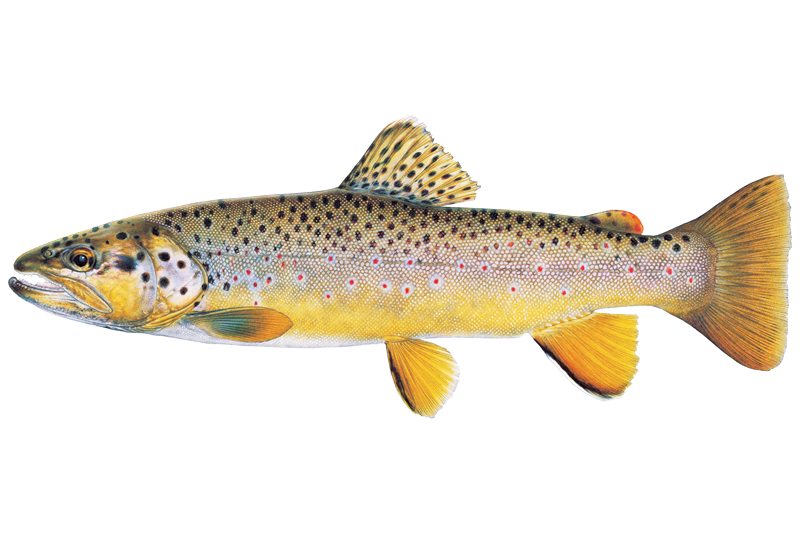
Brown trout were introduced to Canada from European stock — Ontario's Lake Ontario tributaries received fish as early as 1913, New Brunswick in 1921, Nova Scotia in 1925 — and have since naturalized across much of the country.
They grow larger than brook trout, feed selectively, and move mostly in low light, which makes them a genuine challenge. Alberta's Bow River, Ontario's Credit and Grand rivers, and Nova Scotia's Margaree all hold fish worth planning a trip around.
Scientific Name: Salmo trutta
Also known as Browns, football browns, seeforellen, German brown trout, von Behr trout
- Golden-brown to olive body with black spots on the upper sides and red or orange spots scattered lower — that mix of black and red spots is the clearest separation from brook trout (red spots with blue halos) and rainbow trout (no red spots).
- Square tail and a large mouth that extends well past the eye on bigger fish; belly is yellowish. Sea-run fish from Maritime coastal rivers are noticeably more silvery overall.
- Average river fish run 8–10 inches and 1–3 lb; fish over 20 inches are achievable on good water, and the seeforellen strain in Lake Ontario can reach 30 lb.
What to know
Habitat Distribution
- Introduced, not native to Canada — established in Ontario, Alberta, Nova Scotia, New Brunswick, Manitoba, and Prince Edward Island (where they colonized naturally without stocking).
- In Ontario, self-sustaining river populations exist across most southern watersheds; Lake Ontario holds a large naturalized population of the seeforellen strain that runs tributaries to spawn.
- Alberta populations occupy freestone rivers like the Bow, Waterton, Red Deer, and North Saskatchewan, plus smaller tributary creeks in the foothills and Cypress Hills area.
- In the Maritimes, browns have spread through coastal tributaries and inland lakes in Nova Scotia and New Brunswick; they tend toward sea-run behavior wherever they have access to tidal water.
Key Locations
- Bow River, AB — one of Canada's best-known brown trout rivers, with self-sustaining populations through Calgary and downstream; technical fishing on a large tailwater system.
- Lake Ontario tributaries, ON — numerous rivers along the north shore draw fall-run fish from the lake, including large seeforellen-strain browns that can exceed 10 lb.
- Credit River and Grand River, ON — southern Ontario rivers with established brown trout populations accessible to a large angling population.
- Margaree River, NS — a noted Maritime river where sea-run browns share water with Atlantic salmon; fish are accessible from shore and by wading.
- Cypress Hills area, AB — underrated and lightly pressured small streams holding browns that reward anglers willing to explore on foot.
Specific Spots
- Undercut banks and overhanging cover are the first places to check — big browns hold tight to the bank where they can dart out and retreat quickly.
- Deep pools at the tail of a riffle or below a log jam give browns the depth and overhead cover they prefer during daylight hours; they move to the shallower edges to feed at dusk and dawn.
- On Lake Ontario tributaries, fish concentrate in the deeper holding water of pools during the day and push into shallower runs and riffles once light drops — especially in fall when pre-spawn fish are staging.
- On freestone rivers like the Bow, current breaks behind large boulders and the seam between fast and slow water are reliable holding lies; browns use the slower water to conserve energy while watching the current for food.
Brown Trout FAQ
Answers from onWater's species guide.
What are the best lures and bait for Brown Trout?
Minnow-style hard baits like Rapalas and similar jointed or floating/diving plugs are reliable producers, especially for lake fish and in larger rivers, match the size to local baitfish.
What flies work for Brown Trout?
Nymphs fished dead-drift, meaning the fly drifts at the same speed as the current with no drag, are the workhorses: Pheasant Tails and Hare's Ears imitate mayfly nymphs; Caddis Larvae patterns cover the other major food group.
When is the best time to fish for Brown Trout?
Fall (September–November), the peak season on Lake Ontario tributaries as pre-spawn fish move in from the lake; fish are at their largest and most concentrated.
How do you catch Brown Trout?
On Ontario rivers, float fishing with a centerpin or long noodle rod, drifting bait or soft plastics through pools at current speed, is the most widely used method. Fly anglers wade and nymph or swing streamers, particularly during fall tributary runs on Lake Ontario.
What do Brown Trout eat?
Aquatic insects, mayflies, caddisflies, and stoneflies, make up the bulk of the diet in river fish. On Alberta's spring creeks and tailwaters, browns key on specific hatches and will refuse a fly that doesn't match closely; on freestone rivers they're less picky.
See it in the app
Most maps show you water.
onWater shows you Brown Trout.



- 01 · Species map filter
Map every Brown Trout water
Pick Brown Trout and the map zeroes in on the waters they call home. No more guessing which lake holds them.
- 02 · Waterbody species
Tap any water. See what lives there.
Species, behavior and seasonal patterns for every lake, river and pond, before you leave the driveway.
- 03 · Angler Intelligence
Ask how to catch Brown Trout
Tactics, gear and timing from onWater's AI fishing guide, tuned to the species and the water you're on.
Stop guessing where Brown Trout are.
Open the map, filter by Brown Trout, and head to water that holds them. Download onWater and plan your next trip in minutes.
- Species map filter
- Angler Intelligence
- Fishing journal
Explore other species
Trout, bass, salmon, panfish and everything in between. Each guide unpacks the behavior, seasons, and tactics that put fish in the net.
No species information available.

Smarter Fishing Starts in the App.
onWater Fish gives you everything you need to plan smarter, fish better, and own every trip from first cast to last.