Brook Trout
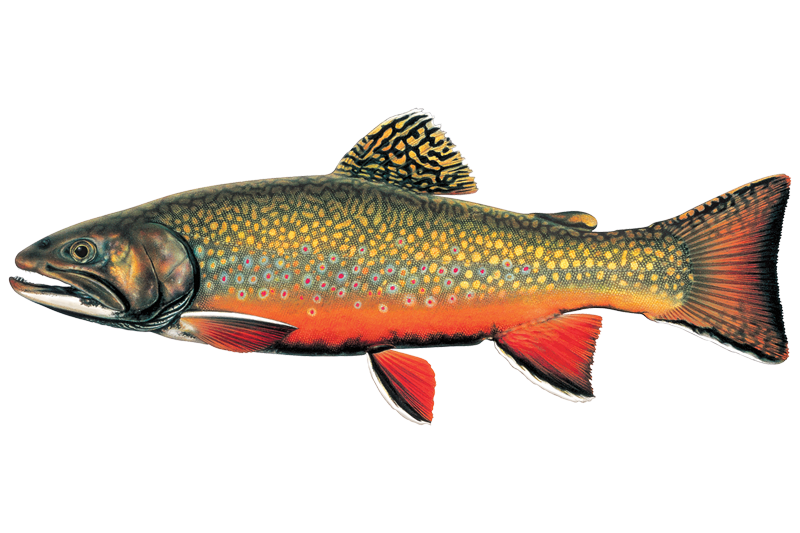
Brook trout — called speckled trout or 'specks' across most of Canada — are native to eastern Canada from Newfoundland and Labrador west to Hudson Bay.
They're the fish that draws anglers into remote northern Ontario rivers, Labrador wilderness camps, and Algoma backcountry streams.
Where pressure is low and water stays cold and clean, brookies grow to sizes that redefine what most anglers think is possible for the species.
Scientific Name: Salvelinus fontinalis
Also known as Speckled trout, specks, brookie, brook char, squaretail, coaster (lake-run form), salter (sea-run form)
- Olive-green back with worm-like yellowish markings (vermiculations); sides scattered with yellow spots and smaller red spots ringed in blue — one of the most distinctive color patterns of any freshwater fish.
- Lower fins are orange with a sharp white leading edge followed by a black stripe — this fin pattern alone separates brookies from brown trout and rainbow trout at a glance.
- In most pressured waters, a 12-inch fish is a good one; in remote northern Ontario and Labrador, 3–5 lb fish are realistic, and fish over 7–8 lb are caught in Labrador.
- Coaster brook trout (lake-run fish in Lake Superior) can exceed 2 feet and reach weights over 6 kg — a dramatically larger form than typical stream fish.
What to know
Habitat Distribution
- Native across eastern Canada: Newfoundland, Labrador, Quebec, Ontario, and the Maritime provinces — one of the few truly native salmonids in these watersheds.
- Cold, clear, well-oxygenated streams, spring-fed ponds, and river systems draining into Hudson Bay, James Bay, and Lake Superior are core habitat.
- The Nipigon River and Lake Nipigon system in northern Ontario, the Albany River drainage, and the Sutton and Winisk rivers flowing to Hudson Bay hold some of the largest wild brook trout populations remaining anywhere.
- Anadromous 'salter' populations use coastal rivers from the Maritimes to Hudson Bay; coaster brook trout move between Lake Superior and its tributary rivers seasonally.
Key Locations
- Nipigon River and Lake Nipigon, Ontario — home of the all-tackle world record (1915); still produces some of the largest brook trout in the world.
- Nipigon Bay and Lake Superior's north shore, Ontario — core habitat for coaster brook trout, with hotspots near Terrace Bay, Rossport, and Pukaskwa Park.
- Albany River system and Dusey River, northern Ontario — remote fly-in rivers producing consistently large wild brook trout with minimal fishing pressure.
- Winisk River, northern Ontario — a 700 km river running to Hudson Bay with wild brook trout up to 6 lb in its whitewater rapids.
- Newfoundland and Labrador — routinely produces 2–5 lb fish, with Labrador rivers holding fish over 7–8 lb; considered among the best brook trout destinations in the world.
Specific Spots
- Rapids and pocket water — brookies hold in the cushion of water just ahead of or behind boulders, using the break in current to rest while watching for food washing through.
- The heads and tails of pools in cold-water streams, especially where a riffle dumps into deeper, slower water — this transition zone concentrates feeding fish.
- Spring seeps and groundwater-fed tributaries in summer, where water temperatures stay coldest; brook trout will stack in these thermal refuges when main-river temps climb.
- In lakes, rocky shorelines, submerged structure, and the mouths of cold inlet streams — coasters on Lake Superior concentrate around Nipigon Bay and the outer islands near tributary mouths.
Brook Trout FAQ
Answers from onWater's species guide.
What are the best lures and bait for Brook Trout?
Small inline spinners (sizes 0–2) like Mepps or Blue Fox are a go-to across Canadian brook trout water, the flash and vibration trigger strikes even from fish that aren't actively feeding.
What flies work for Brook Trout?
Dry flies: Elk Hair Caddis (imitates adult caddisflies), Adams (general mayfly imitation), and small BWO (Blue-Winged Olive) patterns cover most surface-feeding situations; brook trout in remote Canadian waters will often rise freely to a well-presented dry.
When is the best time to fish for Brook Trout?
Ice-out through early summer (roughly April–June in southern Ontario, later farther north), fish are active and shallow after winter, and dry-fly fishing picks up as water warms.
How do you catch Brook Trout?
Most Canadian brook trout fishing happens from shore or by wading streams, with canoe access opening up backcountry lakes and rivers in Ontario and Quebec.
What do Brook Trout eat?
Aquatic insects are the foundation of the brook trout diet, mayflies, caddisflies, and stoneflies in all life stages. During a hatch, fish rise freely to dry flies like Elk Hair Caddis (imitates adult caddis) or Blue-Winged Olive (BWO) dries (imitating small mayflies).
See it in the app
Most maps show you water.
onWater shows you Brook Trout.



- 01 · Species map filter
Map every Brook Trout water
Pick Brook Trout and the map zeroes in on the waters they call home. No more guessing which lake holds them.
- 02 · Waterbody species
Tap any water. See what lives there.
Species, behavior and seasonal patterns for every lake, river and pond, before you leave the driveway.
- 03 · Angler Intelligence
Ask how to catch Brook Trout
Tactics, gear and timing from onWater's AI fishing guide, tuned to the species and the water you're on.
Stop guessing where Brook Trout are.
Open the map, filter by Brook Trout, and head to water that holds them. Download onWater and plan your next trip in minutes.
- Species map filter
- Angler Intelligence
- Fishing journal
Explore other species
Trout, bass, salmon, panfish and everything in between. Each guide unpacks the behavior, seasons, and tactics that put fish in the net.
No species information available.
Smarter Fishing Starts in the App.
onWater Fish gives you everything you need to plan smarter, fish better, and own every trip from first cast to last.