Black Redhorse
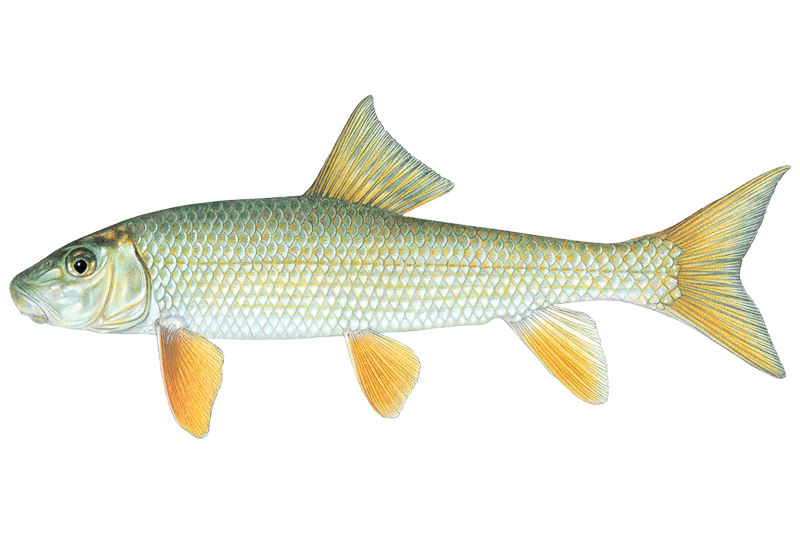
The black redhorse is a small-to-medium sucker native to southwestern Ontario — the only place it exists in Canada. It lives in clean, fast-moving rivers and streams, and its presence is a reliable sign of good water quality.
Because it's listed as Threatened under both Ontario's Endangered Species Act and federally under SARA, it's a fish most anglers encounter by surprise rather than by design.
Scientific Name: Moxostoma duquesnei
Also known as Chevalier noir
- Silvery-blue sides with a grey, brassy, or olive-brown back; belly silver to milky white; fins typically slate grey, sometimes pale orange on the lower fins.
- Long, rounded snout overhangs a downward-facing sucker mouth with a thick lower lip — no transverse grooves on the lips, which separates it from similar redhorse species.
- Tail and dorsal fin are slate grey, not red — the key visual difference from other redhorse suckers in Ontario.
- Grows to roughly 50 cm and around 1 kg; breeding males develop dark lateral stripes and orange or pink flanks, plus small tubercles on the tail fin.
What to know
Habitat Distribution
- Native to Canada and found only in southwestern Ontario — one of the most restricted ranges of any freshwater fish in the country.
- Canadian populations exist in the Lake Huron drainage (Ausable, Bayfield, Maitland, Saugeen, and Sauble rivers), the Lake St. Clair drainage (Thames River), and the Lake Erie drainage (Grand River and Spencer Creek).
- Prefers cool, clear, moderate-to-fast-flowing streams and rivers, typically less than two metres deep, with sandy or gravel bottoms and minimal aquatic vegetation.
- Disappears quickly from silty or polluted water — its presence in a watershed is a strong indicator of clean, well-oxygenated conditions.
Key Locations
- Thames River and its tributaries (including Fish Creek) — one of the healthiest remaining Canadian populations, actively monitored by the Upper Thames River Conservation Authority.
- Grand River watershed (Lake Erie drainage) — historically one of the strongest Ontario populations alongside the Thames.
- Maitland and Ausable rivers (Lake Huron drainage) — confirmed presence in recent surveys; part of the core southwestern Ontario range.
- Bayfield, Saugeen, and Sauble rivers (Lake Huron drainage) — additional confirmed locations within the species' restricted Canadian footprint.
Specific Spots
- Riffle areas with gravel or cobble substrate are prime feeding zones — the fish roots invertebrates directly out of the streambed.
- Deep pools adjacent to riffles serve as holding water, especially in winter when fish move off the shallows.
- Current breaks behind larger rocks or woody debris concentrate fish in moderate flows where they can feed without fighting heavy current.
- In spring, look for fish staging in faster gravel runs — this is spawning habitat, and fish congregate in numbers before moving onto the redds.
Black Redhorse FAQ
Answers from onWater's species guide.
What are the best lures and bait for Black Redhorse?
Small live or wriggling worms and maggots fished on a light bottom rig are the most reliable conventional baits, dead bait won't draw strikes. Small jigs (1/32–1/16 oz) tipped with a soft plastic or worm, bounced slowly along gravel runs, can produce incidental catches.
What flies work for Black Redhorse?
Small nymphs dead-drifted along the bottom are the most effective fly approach, Pheasant Tail Nymphs (imitate mayfly nymphs) and Hare's Ear Nymphs (imitate a broad range of aquatic larvae) in sizes 12–16 are good starting points.
When is the best time to fish for Black Redhorse?
Spring (April–June): fish move into shallow gravel riffles to spawn as water warms; most incidental catches occur during and just after this period. Summer: fish hold in deeper pools and feed in riffles during cooler parts of the day. Winter: largely inactive in deep pools; not realistically encountered by anglers.
How do you catch Black Redhorse?
Because the black redhorse is listed as Threatened under Ontario's Endangered Species Act and assessed under SARA, deliberately targeting it is not appropriate and may be restricted. Most encounters happen incidentally while fishing for other species in southwestern Ontario rivers.
What do Black Redhorse eat?
Adults feed mainly on aquatic insects (mayfly and caddisfly larvae) and small crustaceans rooted from gravel and cobble, unlike trout, which wait for food to drift past, redhorse actively dig it out of the substrate. Young fish feed on plankton; as they grow, they shift to bottom invertebrates.
See it in the app
Most maps show you water.
onWater shows you Black Redhorse.



- 01 · Species map filter
Map every Black Redhorse water
Pick Black Redhorse and the map zeroes in on the waters they call home. No more guessing which lake holds them.
- 02 · Waterbody species
Tap any water. See what lives there.
Species, behavior and seasonal patterns for every lake, river and pond, before you leave the driveway.
- 03 · Angler Intelligence
Ask how to catch Black Redhorse
Tactics, gear and timing from onWater's AI fishing guide, tuned to the species and the water you're on.
Stop guessing where Black Redhorse are.
Open the map, filter by Black Redhorse, and head to water that holds them. Download onWater and plan your next trip in minutes.
- Species map filter
- Angler Intelligence
- Fishing journal
Explore other species
Trout, bass, salmon, panfish and everything in between. Each guide unpacks the behavior, seasons, and tactics that put fish in the net.
No species information available.

Smarter Fishing Starts in the App.
onWater Fish gives you everything you need to plan smarter, fish better, and own every trip from first cast to last.