Black Crappie
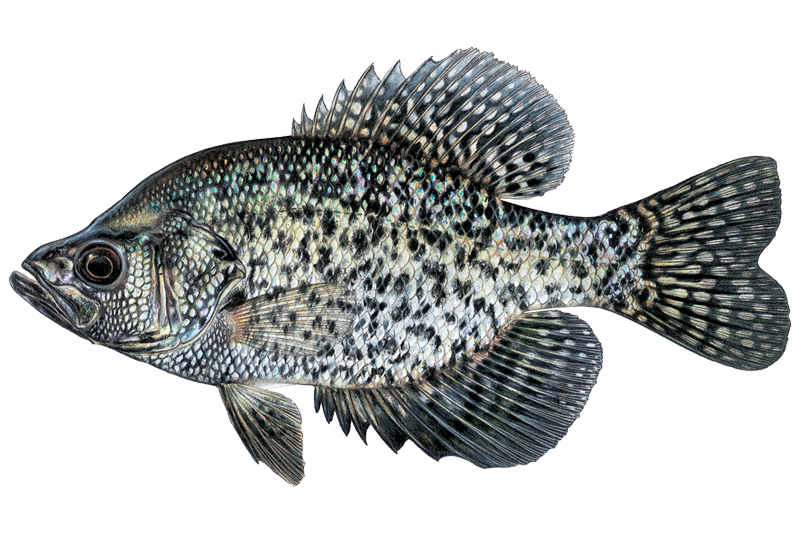
Black crappie are the most pursued panfish in Ontario and Quebec, with strong populations in Northwestern Ontario's Rainy Lake and Lake of the Woods, and in Quebec's Outaouais region.
They school reliably, eat readily, and taste excellent — reasons enough that dedicated crappie anglers in Canada quietly fill coolers while everyone else chases walleye. The fishery is genuinely underrated north of the border.
Scientific Name: Pomoxis nigromaculatus
Also known as Crappie, Calico Bass, White Perch, Marigane noire (Quebec French), Slab
- Deep, laterally compressed body; silvery-green with irregular black blotches and speckles — no distinct vertical bars, which separates it from white crappie.
- Seven or eight spines in the dorsal fin — count them to confirm: white crappie have only six.
- Common catch runs 8–12 inches; a 3-pound fish from Ontario's Sunset Country qualifies as a genuine slab.
- Eyes sit high on the head, angled upward — a detail that matters when you're deciding where to position your bait relative to the fish.
What to know
Habitat Distribution
- Native to the St. Lawrence–Great Lakes and Hudson Bay (Red River) drainages from Quebec to Manitoba; Canadian populations sit at the northern edge of the species' range.
- Found in lakes, ponds, backwater bays, and slow-moving sloughs — water that's warm, relatively clear, and has aquatic vegetation or woody cover.
- Northwestern Ontario (Rainy Lake, Lake of the Woods) and Manitoba's Whiteshell Provincial Park (Caddy Lake chain) hold well-established populations; Quebec's Outaouais region also has fishable numbers.
- Prefer sandy to muddy bottoms with nearby weed cover; pH range of roughly 6.0–7.5 suits them well, and they do especially well in slightly acidic, clear water.
Key Locations
- Rainy Lake, Northwestern Ontario — well-known crappie fishery with fish accessible from spring ice-out through winter.
- Lake of the Woods, Ontario — abundant populations; local guides specialize in crappie year-round.
- Caddy Lake chain (Caddy, South Cross, North Cross), Whiteshell Provincial Park, Manitoba — a go-to destination for Manitoba crappie anglers, especially in summer.
- Outaouais region, Quebec — fishable crappie numbers in a province where the species remains largely under the radar, leaving pressure low.
Specific Spots
- In spring, shallow bays with wood, docks, or weed cover draw fish moving inshore to feed and spawn — man-made boat cuts and canals concentrate them.
- Rock piles in and around shallow bays are consistent producers, particularly in Northern Ontario where natural structure is abundant.
- Summer fish suspend higher in the water column around main-lake structure: rockpiles, reefs, sunken islands, fallen trees, and beaver houses.
- Along deep weedlines in summer and fall — crappie hold at the edge where vegetation meets open water, especially during low-light periods.
Black Crappie FAQ
Answers from onWater's species guide.
What are the best lures and bait for Black Crappie?
Small jigs between 1/48 and 1/8 oz are the go-to, tube jigs, curly-tail grubs, and soft-plastic minnow bodies in white, chartreuse, or black all produce. Tip with a live minnow when fish are finicky.
What flies work for Black Crappie?
Small streamers, Woolly Buggers and Clouser Minnows (both imitate small baitfish) in sizes 8–12, work well when crappie are feeding on minnows near cover or along weedlines.
When is the best time to fish for Black Crappie?
Spring (April–June): fish move into shallow bays as ice clears; some of the most accessible fishing of the year as crappie feed actively before and during the spawn.
How do you catch Black Crappie?
Most Canadian crappie fishing happens from a boat, working shallow bays and cover in spring, then moving to deeper structure and suspended fish through summer.
What do Black Crappie eat?
Insects and crustaceans make up a large share of the diet, more so than in white crappie. Small jigs, panfish-sized soft plastics, and streamer flies all imitate these prey items effectively. Larger fish shift toward eating smaller fish, minnows, shiners, young perch.
See it in the app
Most maps show you water.
onWater shows you Black Crappie.



- 01 · Species map filter
Map every Black Crappie water
Pick Black Crappie and the map zeroes in on the waters they call home. No more guessing which lake holds them.
- 02 · Waterbody species
Tap any water. See what lives there.
Species, behavior and seasonal patterns for every lake, river and pond, before you leave the driveway.
- 03 · Angler Intelligence
Ask how to catch Black Crappie
Tactics, gear and timing from onWater's AI fishing guide, tuned to the species and the water you're on.
Stop guessing where Black Crappie are.
Open the map, filter by Black Crappie, and head to water that holds them. Download onWater and plan your next trip in minutes.
- Species map filter
- Angler Intelligence
- Fishing journal
Explore other species
Trout, bass, salmon, panfish and everything in between. Each guide unpacks the behavior, seasons, and tactics that put fish in the net.
No species information available.
Smarter Fishing Starts in the App.
onWater Fish gives you everything you need to plan smarter, fish better, and own every trip from first cast to last.