Bigmouth Buffalo
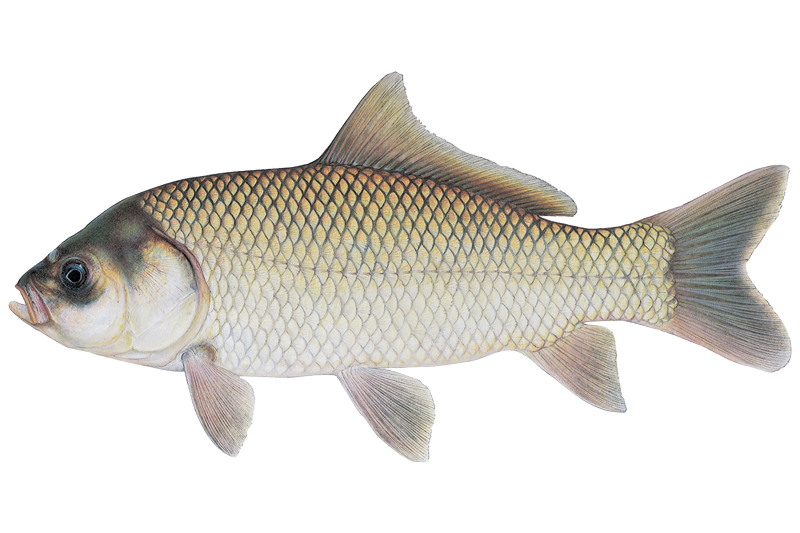
Bigmouth buffalo are the largest member of the sucker family in North America, native to prairie river systems and lakes across Manitoba and Saskatchewan.
In Canada, they're a genuine sleeper species — most are caught incidentally, but a dedicated following targets them in Lake Winnipeg and the Red River system.
Their extraordinary longevity (some individuals exceed 100 years) and size make every encounter worth noting.
Scientific Name: Ictiobus cyprinellus
Also known as Buffalofish, buffalo à grande bouche, redmouth buffalo, roundhead, gourdhead
- Deep-bodied, laterally compressed fish with dark olive-brown to grey sides, a coppery sheen, and a whitish or yellowish belly; fins are dusky.
- The key ID feature: a large, forward-facing (terminal) mouth with thin lips — unlike every other sucker in Canada, which has a downward-pointing mouth. No barbels, no spines.
- Long dorsal fin runs most of the back; tail is moderately forked with pointed tips. Easily confused with common carp, but bigmouth buffalo lack the carp's single serrated dorsal spine.
- Average fish run 5–15 lb in Canadian waters; fish over 30 lb are genuine trophies, and the species can exceed 36 kg (80 lb) at its largest.
What to know
Habitat Distribution
- Native to Canada in the Saskatchewan-Nelson River drainages (Manitoba, Saskatchewan) and the Great Lakes-Upper St. Lawrence system (Ontario); not introduced.
- Core Canadian range centers on Manitoba — Lake Winnipeg, Lake Manitoba, the Red River, and the Assiniboine River — with populations extending into Saskatchewan river systems.
- Prefers warm, turbid, slow-moving or still water: large prairie lakes, reservoirs, and the deeper pools and backwaters of medium to large rivers with soft mud bottoms.
- Uncommon in Ontario; the Saskatchewan-Nelson River populations are listed as Special Concern under Canada's Species at Risk Act.
Key Locations
- Lake Winnipeg (MB) — the most productive Canadian water for bigmouth buffalo, with master angler-class fish registered regularly.
- Red River (MB) — a key river corridor connecting Lake Winnipeg to the U.S. border; buffalo use it for seasonal movement and feeding.
- Assiniboine River (MB) — tributary system where buffalo are caught incidentally and by targeted bottom-fishing.
- Lake Manitoba (MB) — shallow, turbid prairie lake that provides ideal habitat; fish show up in the Delta Marsh area seasonally.
Specific Spots
- In lakes, work muddy flats and shallow vegetated bays — buffalo move into these areas to feed and, in spring, to spawn.
- In rivers, target deeper pools and backwater eddies off the main channel where current slows and fine sediment settles; this is where plankton and invertebrates concentrate.
- During warmer months, buffalo suspend in the water column of open lake areas, filter-feeding on plankton — look for them where turbid water meets calmer structure like points or submerged weed edges.
- Near dam tailwaters and river confluences, buffalo stage in slower water adjacent to current breaks, especially during spring movement.
Bigmouth Buffalo FAQ
Answers from onWater's species guide.
What are the best lures and bait for Bigmouth Buffalo?
Worms (nightcrawlers or pieces) on a bottom rig are the most reliable bait across Canadian waters; fish them stationary on muddy flats or in backwater pools.
When is the best time to fish for Bigmouth Buffalo?
Spring (May–June): fish move into shallow vegetated areas to spawn as water warms; the most accessible period for shore anglers targeting them deliberately. Summer (July–August): buffalo spread across lake flats and deeper river pools; bottom-fishing muddy bays and backwaters in the evening produces best results.
How do you catch Bigmouth Buffalo?
Most Canadian anglers fish bigmouth buffalo from shore or anchored boats on the bottom, using worms, corn, or dough bait on a slip-sinker rig cast to muddy flats and backwater areas. Spring, when fish school in shallow vegetated areas around spawning time, is the most reliable window for deliberate targeting.
What do Bigmouth Buffalo eat?
Primarily plankton and small crustaceans filtered from the water column, the only catostomid in Canada that feeds this way rather than rooting the bottom. This makes them genuinely difficult to match with conventional lures.
Where do Bigmouth Buffalo live?
Native to Canada in the Saskatchewan-Nelson River drainages (Manitoba, Saskatchewan) and the Great Lakes-Upper St. Lawrence system (Ontario); not introduced.
See it in the app
Most maps show you water.
onWater shows you Bigmouth Buffalo.



- 01 · Species map filter
Map every Bigmouth Buffalo water
Pick Bigmouth Buffalo and the map zeroes in on the waters they call home. No more guessing which lake holds them.
- 02 · Waterbody species
Tap any water. See what lives there.
Species, behavior and seasonal patterns for every lake, river and pond, before you leave the driveway.
- 03 · Angler Intelligence
Ask how to catch Bigmouth Buffalo
Tactics, gear and timing from onWater's AI fishing guide, tuned to the species and the water you're on.
Stop guessing where Bigmouth Buffalo are.
Open the map, filter by Bigmouth Buffalo, and head to water that holds them. Download onWater and plan your next trip in minutes.
- Species map filter
- Angler Intelligence
- Fishing journal
Explore other species
Trout, bass, salmon, panfish and everything in between. Each guide unpacks the behavior, seasons, and tactics that put fish in the net.
No species information available.

Smarter Fishing Starts in the App.
onWater Fish gives you everything you need to plan smarter, fish better, and own every trip from first cast to last.