Atlantic Salmon
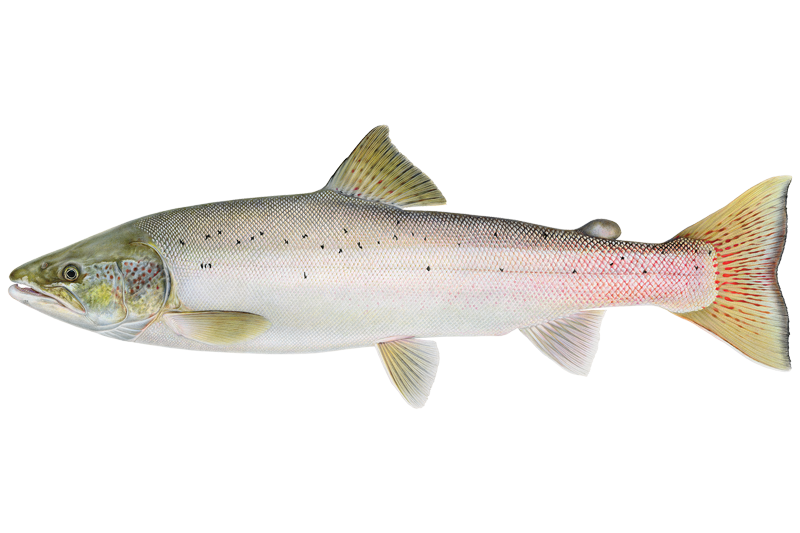
Atlantic salmon are the defining fish of eastern Canada's rivers.
Sea-run fish push into rivers from Labrador south through Quebec, New Brunswick, Nova Scotia, and Newfoundland — provinces that hold more than half of North America's best wild Atlantic salmon rivers.
Anglers come from around the world to wade these rivers, almost exclusively on fly tackle, chasing fish that can push 30 pounds or more.
Scientific Name: Salmo salar
Also known as Ouananiche (landlocked form), lake salmon, Atlantic, sea-run salmon
- Silvery flanks with black X-shaped spots above the lateral line; sea-run fish are bright chrome, darkening to bronze-red as they hold in fresh water through the season.
- Slender wrist (caudal peduncle) and a slightly forked tail — a quick way to separate them from brown trout, which have a squarer tail and heavier spotting below the lateral line.
- Most river fish run 8–15 lbs; multi-sea-winter fish on rivers like the Restigouche and Grand Cascapedia regularly reach the high twenties and thirties, with fish over 40 lbs landed most seasons.
- Landlocked ouananiche, found in some Quebec and Labrador lakes, are the same species but stay smaller — typically 2–6 lbs.
What to know
Habitat Distribution
- Native to Atlantic-draining rivers across eastern Canada — from Labrador and Newfoundland west through Quebec, New Brunswick, Nova Scotia, and Prince Edward Island.
- Spend their adult years at sea in the North Atlantic, returning to the river where they hatched to spawn; some rivers see runs from June through September.
- Prefer cold, clear, well-oxygenated rivers with clean gravel for spawning and a mix of fast runs, deep pools, and broken pocket water for holding.
- Landlocked populations (ouananiche) live in large, cold lakes and their tributary rivers in Quebec and Labrador, completing their life cycle entirely in fresh water.
Key Locations
- Restigouche River, New Brunswick/Quebec border — known for large fish, with fish in the high twenties and thirties common and fish over 40 lbs landed most seasons.
- Grand Cascapedia and Petite Cascapedia, Quebec — among the most storied salmon rivers in North America; the Cascapedia holds Canada's sea-run Atlantic salmon record at 47 lbs.
- Miramichi River, New Brunswick — one of the most productive Atlantic salmon rivers on the continent, with strong runs and a long fly-fishing tradition.
- Flowers River, Labrador — the northernmost scheduled salmon river in North America, carefully managed, with reliable runs from July into September.
- Humber, Exploits, Gander, and Eagle Rivers, Newfoundland — Newfoundland and Labrador hold over 60% of North America's best wild Atlantic salmon rivers, with nearly 200 rivers hosting runs.
Specific Spots
- Deep pools below rapids and at river bends are the classic holding lies — salmon rest here after pushing upstream, and these are where most fish are taken on fly.
- Current seams where fast water meets slower water give salmon a place to hold without fighting the full current; fish often stack along these edges, especially during low, clear conditions.
- Tail-outs at the downstream end of pools see fish move into shallower, faster water during low-light periods — early morning and evening — making them more likely to rise to a fly.
- In high, cold water early in the season, fish hold tighter to the bottom in slower, deeper water; as rivers drop and warm through summer, they spread into faster, shallower runs.
Atlantic Salmon FAQ
Answers from onWater's species guide.
What flies work for Atlantic Salmon?
Classic hairwing wet flies, Green Highlander, Jock Scott, Blue Charm, Rusty Rat, are swung across and downstream through holding pools on a tight line; the fly arcs through the current and the salmon takes on the swing or at the hang at the end of the drift.
When is the best time to fish for Atlantic Salmon?
Early season (June into early July), first fish enter rivers; water is typically higher and colder, and larger, brighter wet flies on sink-tip lines are most effective.
How do you catch Atlantic Salmon?
Atlantic salmon fishing in eastern Canada is almost entirely a fly-fishing pursuit, conducted by wading or from a canoe, swinging wet flies through holding pools or skating dry flies across the surface. On larger rivers like the Restigouche and Miramichi, two-handed Spey casting is the standard approach.
What do Atlantic Salmon eat?
Sea-run Atlantic salmon do not feed in fresh water, they strike flies out of aggression, curiosity, or a remembered feeding reflex, not hunger. This is what makes fly selection and presentation the central puzzle of the fishery.
Where do Atlantic Salmon live?
Native to Atlantic-draining rivers across eastern Canada, from Labrador and Newfoundland west through Quebec, New Brunswick, Nova Scotia, and Prince Edward Island. Spend their adult years at sea in the North Atlantic, returning to the river where they hatched to spawn; some rivers see runs from June through September.
See it in the app
Most maps show you water.
onWater shows you Atlantic Salmon.



- 01 · Species map filter
Map every Atlantic Salmon water
Pick Atlantic Salmon and the map zeroes in on the waters they call home. No more guessing which lake holds them.
- 02 · Waterbody species
Tap any water. See what lives there.
Species, behavior and seasonal patterns for every lake, river and pond, before you leave the driveway.
- 03 · Angler Intelligence
Ask how to catch Atlantic Salmon
Tactics, gear and timing from onWater's AI fishing guide, tuned to the species and the water you're on.
Stop guessing where Atlantic Salmon are.
Open the map, filter by Atlantic Salmon, and head to water that holds them. Download onWater and plan your next trip in minutes.
- Species map filter
- Angler Intelligence
- Fishing journal
Explore other species
Trout, bass, salmon, panfish and everything in between. Each guide unpacks the behavior, seasons, and tactics that put fish in the net.
No species information available.
Smarter Fishing Starts in the App.
onWater Fish gives you everything you need to plan smarter, fish better, and own every trip from first cast to last.