Arctic Grayling
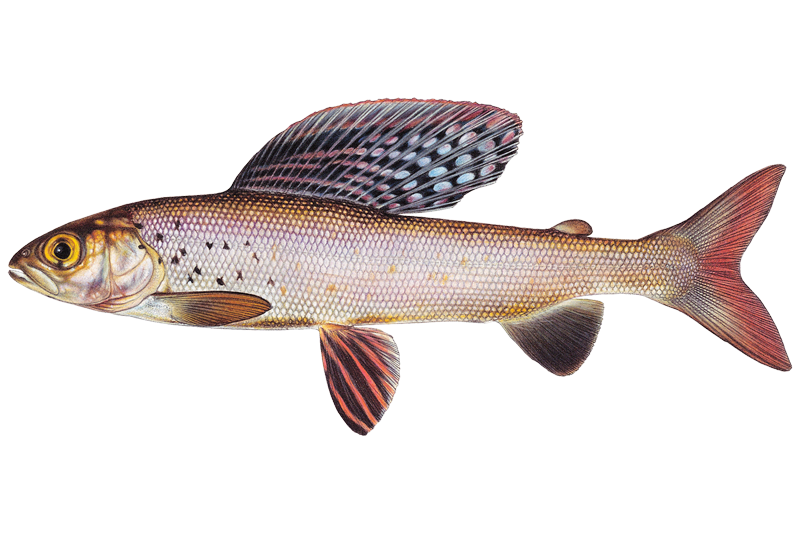
Arctic grayling are the signature fish of Canada's northern wilderness — a cold, clean-water salmonid that ranges from northern Alberta and BC through the NWT, Yukon, and northern Manitoba.
They're a fly fisher's fish: willing risers, visually spectacular, and found in some of the most remote water in the country. Most run 14–18 inches in the north, with master-angler fish pushing past 18.
Scientific Name: Thymallus arcticus
Also known as Sailfish of the North, Arctic sail-fin
- Large, sail-like dorsal fin dotted with iridescent red, aqua, or purple spots — the single most distinctive feature; males carry a longer, more dramatic fin than females.
- Body shades from deep purple to blue-silver with scattered black spots on the sides and head; a gold band separates the flanks from a white belly.
- Pelvic fins striped in iridescent orange, red, or pink; coloration intensifies on larger, older fish and during spawning.
- Typical catch in northern Manitoba and NWT runs 14–18 inches; Manitoba master-angler benchmark is 18 inches, with the provincial record at 23 inches.
What to know
Habitat Distribution
- Native across Arctic and Pacific drainages in Canada — from northern Alberta and central BC north through the NWT, Yukon, and across northern Manitoba and Hudson Bay drainages.
- Largely pushed out of southern portions of their historic range by introduced trout species; now found in greatest numbers and size in the far north where water stays cold and clean.
- Require cold, well-oxygenated, clear water — their presence is a reliable indicator of pristine conditions; disappear quickly from degraded or warming systems.
- Use both rivers and lakes: fast-water runs, deep river pools, and nearshore lake shallows with cover are all productive habitat depending on season.
Key Locations
- Northwest Territories — countless clear, slow-moving rivers across the territory, including waters near waterfalls, are among the most productive grayling fisheries in Canada.
- Northern Manitoba — rivers near lodges like Big Sand Lake and Munroe Lake, including Wolf Lake (home of the 23-inch Manitoba record), produce consistently large fish.
- Beaulieu River, NWT — flows into Hearne Lake and is a well-known grayling destination, with fast water and deep pools holding fish through the season.
- Northern Alberta and BC — upper reaches of Arctic-draining river systems still hold native grayling populations, though access is remote and populations are smaller than in the NWT or Manitoba.
Specific Spots
- Below waterfalls and in the fast water just upstream of deep pools — grayling hold in the current seam where food funnels through and they can dart into slack water to rest.
- Deep river pools in fall, when fish drop out of riffles and concentrate in slower, deeper water before winter.
- Nearshore lake shallows with structure (rocks, submerged timber) — grayling stay close to cover in lakes because larger pike and lake trout patrol open water nearby.
- Riffles and gravel runs in spring and early summer; fish are shallow and visible in crystal-clear northern rivers, making sight-fishing possible.
Arctic Grayling FAQ
Answers from onWater's species guide.
What are the best lures and bait for Arctic Grayling?
Small spinners in the 1/16 to 1/8 oz range are the most consistent conventional producers, Panther Martins, Mepps, and Blue Fox in sizes 0–2 cover most northern grayling water. Flash and vibration trigger strikes even when fish aren't actively surface feeding.
What flies work for Arctic Grayling?
Dry flies are the first choice when fish are rising, an Elk Hair Caddis (imitates adult caddisflies) and Parachute Adams (general mayfly imitation) in sizes 12–16 cover most hatches on northern Canadian rivers. Grayling will often rise repeatedly to a well-presented dry.
When is the best time to fish for Arctic Grayling?
Spring (post-spawn, May–June): fish are active in shallow gravel runs and riffles after spawning; surface feeding picks up as insect hatches begin. Summer (July–August): peak season across most of northern Canada; fish are in rivers and lakes, feeding actively on surface insects in early morning and late afternoon.
How do you catch Arctic Grayling?
Most anglers in Canada target grayling by wading clear northern rivers and working runs, riffles, and pools with dry flies or small spinners. Sight-fishing to visible fish in gin-clear water is common and one of the real pleasures of the fishery.
What do Arctic Grayling eat?
Surface and near-surface insects are the core of their diet through spring and summer, mayflies, caddisflies, midges, and stoneflies. Dry flies that match whatever is hatching (Elk Hair Caddis for caddis, Parachute Adams as a general mayfly imitation) are the go-to approach.
See it in the app
Most maps show you water.
onWater shows you Arctic Grayling.



- 01 · Species map filter
Map every Arctic Grayling water
Pick Arctic Grayling and the map zeroes in on the waters they call home. No more guessing which lake holds them.
- 02 · Waterbody species
Tap any water. See what lives there.
Species, behavior and seasonal patterns for every lake, river and pond, before you leave the driveway.
- 03 · Angler Intelligence
Ask how to catch Arctic Grayling
Tactics, gear and timing from onWater's AI fishing guide, tuned to the species and the water you're on.
Stop guessing where Arctic Grayling are.
Open the map, filter by Arctic Grayling, and head to water that holds them. Download onWater and plan your next trip in minutes.
- Species map filter
- Angler Intelligence
- Fishing journal
Explore other species
Trout, bass, salmon, panfish and everything in between. Each guide unpacks the behavior, seasons, and tactics that put fish in the net.
No species information available.
Smarter Fishing Starts in the App.
onWater Fish gives you everything you need to plan smarter, fish better, and own every trip from first cast to last.