American Shad
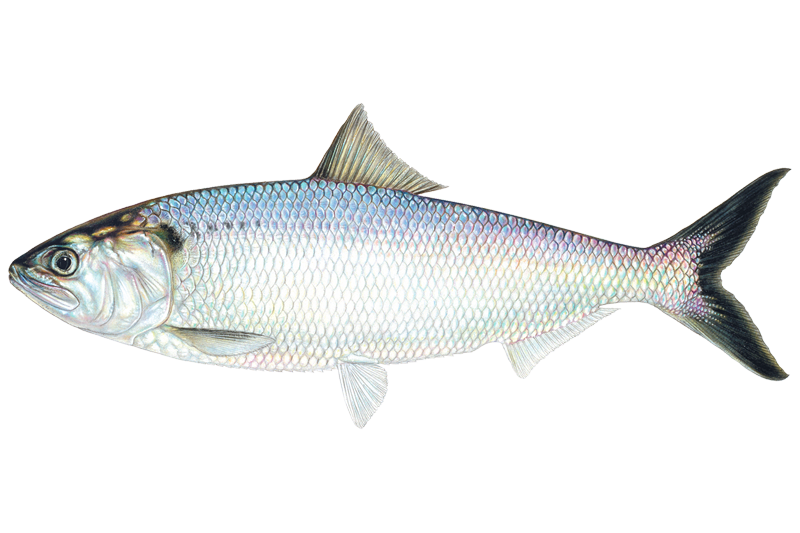
American shad are the largest member of the herring family and the only one that draws serious recreational attention in Canada.
Native to the Atlantic coast from Labrador to Florida, they spend years at sea before returning each spring to the rivers where they hatched.
That spawning run — brief, dense, and predictable — is when Canadian anglers target them, wading coastal rivers from the Maritimes to the St. Lawrence system with light tackle and fly rods.
Scientific Name: Alosa sapidissima
Also known as White shad, Atlantic shad, the poor man's salmon, the found fish, alose savoureuse (French)
- Blue-green to dark brown back with bright silver sides; large, easily shed scales and a saw-toothed belly edge formed by sharp scutes — distinctive among Atlantic fish.
- One prominent dark spot just behind the gill cover, often followed by a row of smaller spots fading toward the tail — the quickest field ID mark.
- Deeply forked tail; in freshwater, adults take on a coppery sheen, and males often develop a reddish head and belly during the spawn.
- Typical adults run 40–60 cm and 1–3 kg; females are noticeably larger than males, with the largest fish pushing 12 lbs in exceptional cases.
What to know
Habitat Distribution
- Native to Canada's Atlantic coast; the natural range runs from Labrador and Newfoundland south through the Maritimes and into the St. Lawrence River system.
- Anadromous — they mature in the open Atlantic and return to freshwater rivers only to spawn, spending the rest of their lives at sea.
- On the Pacific side, shad introduced to California in 1871 eventually spread north; they appear occasionally along the British Columbia coast and are rarely caught in the Fraser River, mostly as strays from American rivers to the south.
- During the spawning run, fish move through tidal reaches and into the freshwater sections of coastal rivers; juveniles rear in river nursery areas before migrating to the ocean in early fall.
Key Locations
- St. Lawrence River — documented spawning population; the subject of Canadian fisheries research on shad spawning dynamics.
- Maritime rivers of New Brunswick and Nova Scotia — part of the native Atlantic range where spring runs still occur.
- Labrador and Newfoundland coastal rivers — northern edge of the native range; fish arrive later in the season as water warms.
- British Columbia coast and Fraser River — occasional strays appear, but no established recreational fishery; fish are rare and incidental.
Specific Spots
- Shad follow defined travel lanes upriver — current seams, the inside edges of bends, and the slack water just behind mid-river obstructions are where fish stack as they push upstream.
- Tail-outs and the heads of pools concentrate fish that are pausing before moving through faster water; positioning a lure or fly to intercept that flow is the core of the game.
- Shallow gravel bars and sandy flats near the main channel are active spawning areas once water temperatures climb into the mid-60s°F; fish are visible and catchable here at dusk and into the night.
- In tidal reaches, fish hold in deeper water during low tide and push shallower on the flood — timing your wade to the tide cycle can make a big difference in contact rate.
American Shad FAQ
Answers from onWater's species guide.
What are the best lures and bait for American Shad?
Shad darts, small, weighted jig-heads with a painted body, usually 1/8 to 1/4 oz, are the classic shad lure. Chartreuse, white, and red-and-white are proven colors. Tandem rigs with two darts on the same leader double your chances.
What flies work for American Shad?
Small bright wet flies, size 6 to 10, in chartreuse, white, pink, or red-and-white, are the go-to. Patterns like the American Shad Fly or simple Clouser Minnows (which imitate small baitfish) swung across current on a sinking-tip line cover water efficiently and put the fly in front of traveling fish.
When is the best time to fish for American Shad?
Spring run: shad enter Maritime and St. Lawrence rivers as water temperatures climb through the mid-50s°F, typically from late April through June depending on latitude and year. Northern populations (Labrador, Newfoundland) arrive later, May to early July, as colder waters warm more slowly.
How do you catch American Shad?
Most Canadian shad fishing happens from the bank or by wading, with anglers positioning themselves at current seams and pool heads to intercept fish moving upriver.
What do American Shad eat?
In the ocean, shad eat zooplankton, small crustaceans, and tiny fish. Once they enter freshwater to spawn, they stop feeding entirely, every strike is a reaction, not hunger. Because they aren't eating, presentation and irritation matter more than imitation.
See it in the app
Most maps show you water.
onWater shows you American Shad.



- 01 · Species map filter
Map every American Shad water
Pick American Shad and the map zeroes in on the waters they call home. No more guessing which lake holds them.
- 02 · Waterbody species
Tap any water. See what lives there.
Species, behavior and seasonal patterns for every lake, river and pond, before you leave the driveway.
- 03 · Angler Intelligence
Ask how to catch American Shad
Tactics, gear and timing from onWater's AI fishing guide, tuned to the species and the water you're on.
Stop guessing where American Shad are.
Open the map, filter by American Shad, and head to water that holds them. Download onWater and plan your next trip in minutes.
- Species map filter
- Angler Intelligence
- Fishing journal
Explore other species
Trout, bass, salmon, panfish and everything in between. Each guide unpacks the behavior, seasons, and tactics that put fish in the net.
No species information available.
Smarter Fishing Starts in the App.
onWater Fish gives you everything you need to plan smarter, fish better, and own every trip from first cast to last.