Silver Carp
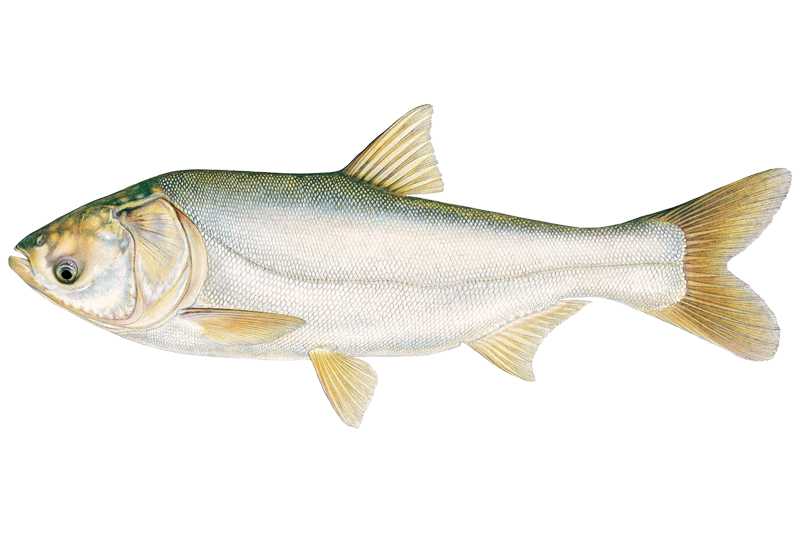
Silver carp are a non-native species in Brazil, introduced from eastern Asia for aquaculture and water-quality management. Research at Paranoá Reservoir near Brasília tested stocking them to control blue-green algae blooms.
They're not a primary sport target, but their size and filter-feeding behavior make them an unusual catch in waters where they've been stocked.
Scientific Name: Hypophthalmichthys molitrix
Also known as Carpa prateada, carpa-prateada
- Deep-bodied and laterally compressed, with a distinctly silvery color — greenish-gray on the back fading to white on the belly, no dark blotches on the sides.
- Eyes sit unusually low and forward on the head, below the midline — a reliable ID feature that separates them from common carp and most native species.
- Large, upturned mouth with no jaw teeth; scaleless head; a sharp keel running from the chest all the way back to the anal fin.
- Can reach over 100 cm and 50 kg at maximum, though most fish encountered in Brazilian waters run considerably smaller.
What to know
Habitat Distribution
- Introduced to Brazil — not native. Brought in for aquaculture and as a biological control agent in eutrophic reservoirs, including Paranoá Reservoir near Brasília.
- Occupies the middle and upper water column in large, warm-water rivers, reservoirs, and backwaters; also found in ponds and canals connected to larger systems.
- Prefers warm water above 21°C for active feeding; requires long river reaches with turbulent flow to reproduce successfully.
- Carp fishing reports from São Paulo, Paraná, Santa Catarina, Rio de Janeiro, and Rio Grande do Sul suggest silver carp may be present across a range of southeastern and southern Brazilian waters, though common carp dominate most of those fisheries.
Key Locations
- Paranoá Reservoir, Brasília — the site of documented silver carp stocking research for algae control in eutrophic water.
- Represa Billings and Represa Guarapiranga, São Paulo — major urban reservoirs with active carp fisheries, though common carp dominate reports.
- Rio Tietê and Rio Sorocaba, São Paulo — river systems with documented carp fishing activity.
Specific Spots
- In reservoirs, look for silver carp near the surface or just below it in warm, calm bays and backwater arms where phytoplankton concentrates.
- During cooler periods they move to deeper, slower sections of reservoirs and river channels — mid-depth structure near drop-offs can hold fish.
- Inflows and areas with slight current can concentrate fish, especially after rain events that flush nutrients into a reservoir and trigger algae blooms.
Silver Carp FAQ
Answers from onWater's species guide.
What are the best lures and bait for Silver Carp?
Paste baits and dough balls made from grain or algae-based mixtures are the most consistent producers, the idea is to create a cloud of particles near the hook that mimics the fish's natural filter-feeding environment.
When is the best time to fish for Silver Carp?
Warm months (roughly October through March, Brazil's summer) bring the most active surface feeding as water temperatures climb above 21°C. Cooler austral winter months (June–August) slow feeding significantly; fish move deeper and are harder to locate in reservoirs.
How do you catch Silver Carp?
Most anglers targeting carp in Brazil fish from the bank or from anchored boats using paste or dough baits on bottom or float rigs, waiting for fish to feed near the surface in warm, calm conditions.
What do Silver Carp eat?
Silver carp are filter feeders, straining phytoplankton (microscopic algae) and zooplankton directly from the water through sponge-like gill rakers, they don't chase or strike prey the way most sport fish do. Juveniles also eat zooplankton.
Where do Silver Carp live?
Introduced to Brazil, not native. Brought in for aquaculture and as a biological control agent in eutrophic reservoirs, including Paranoá Reservoir near Brasília.
See it in the app
Most maps show you water.
onWater shows you Silver Carp.



- 01 · Species map filter
Map every Silver Carp water
Pick Silver Carp and the map zeroes in on the waters they call home. No more guessing which lake holds them.
- 02 · Waterbody species
Tap any water. See what lives there.
Species, behavior and seasonal patterns for every lake, river and pond, before you leave the driveway.
- 03 · Angler Intelligence
Ask how to catch Silver Carp
Tactics, gear and timing from onWater's AI fishing guide, tuned to the species and the water you're on.
Stop guessing where Silver Carp are.
Open the map, filter by Silver Carp, and head to water that holds them. Download onWater and plan your next trip in minutes.
- Species map filter
- Angler Intelligence
- Fishing journal
Explore other species
Trout, bass, salmon, panfish and everything in between. Each guide unpacks the behavior, seasons, and tactics that put fish in the net.
No species information available.
Smarter Fishing Starts in the App.
onWater Fish gives you everything you need to plan smarter, fish better, and own every trip from first cast to last.