Largemouth Bass
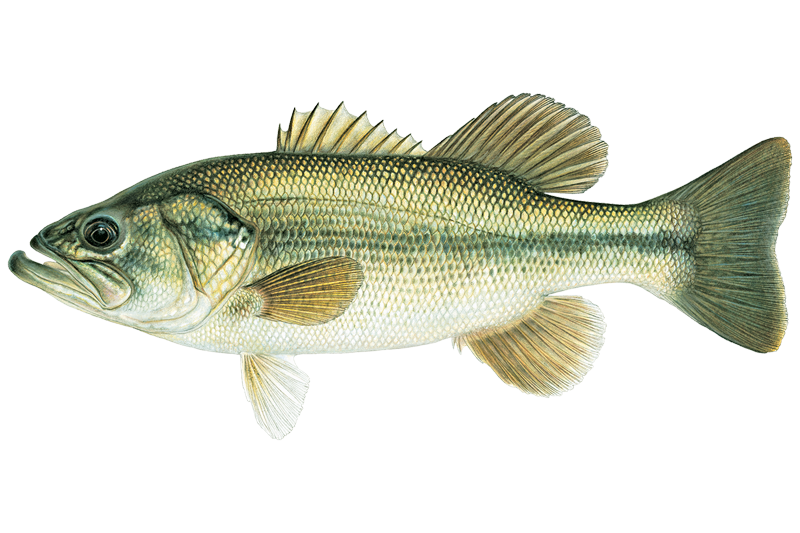
Largemouth bass arrived in Brazil in 1922 as an introduced sport fish and have since established populations mainly in the southern region.
They're fished in reservoirs and still waters, and at least one Brazilian angler — Alex Koike, a prominent fishing journalist — names them as a current favorite, using swimbaits and rubber jigs to study their behavior.
Not a headline species here the way tucunaré or dorado are, but a growing niche in the Brazilian freshwater scene.
Scientific Name: Micropterus salmoides
Also known as Black-bass, bass
- Distinctive dark lateral stripe running the length of the body, from gill plate to tail, on a green-to-olive background with a pale belly.
- The upper jaw extends well past the rear edge of the eye — the clearest single feature separating largemouth from smallmouth or spotted bass.
- Deep notch nearly divides the dorsal fin into two sections; body is deeper and more compressed than most other bass species.
- Common fish in Brazilian reservoirs run 30–45 cm; larger individuals exceeding 50 cm are possible in well-established populations.
What to know
Habitat Distribution
- Introduced, not native — first recorded in Brazil in 1922 and now established across multiple populations, concentrated in the southern region.
- Occupies reservoirs, small impoundments, and still or slow-moving waters; the SciELO study documented a self-sustaining population in a small reservoir in southern Brazil.
- Prefers clear water with submerged vegetation, flooded timber, and firm-bottomed shallows for spawning.
- Grows faster in Brazil's warmer subtropical and temperate waters than in the northern parts of its native North American range.
Key Locations
- Southern Brazil — the region with the most documented established populations, studied in small reservoirs in the context of invasion biology.
- Reservoirs in the southern states are the primary habitat where self-sustaining populations have been confirmed through scientific sampling.
Specific Spots
- Submerged vegetation edges are key holding water — bass use weed lines to corner baitfish and small prey.
- Flooded timber and submerged stumps in reservoirs give bass overhead cover; cast tight to structure and work the fly or lure back through the shadow.
- Points and drop-offs where shallow flats fall into deeper water concentrate fish, especially during midday heat when bass move off the shallows.
- Shallow, firm-bottomed coves with sand, mud, or gravel bottom draw fish during the spawning season in late winter and spring.
Largemouth Bass FAQ
Answers from onWater's species guide.
What are the best lures and bait for Largemouth Bass?
Swimbaits, including glide baits, are a named favorite of Brazilian bass anglers; work them with a steady retrieve or subtle pauses to imitate a cruising baitfish. Rubber jigs with craw or paddle-tail trailers cover the crayfish and bottom-feeding side of the diet; slow-roll them along the bottom near structure.
What flies work for Largemouth Bass?
Deer-hair or foam poppers imitate frogs and struggling surface prey, fish them over weed edges and flooded timber with long pauses between strips. Woolly Buggers and larger streamers imitate baitfish and crayfish; a slow, erratic strip retrieve near submerged structure covers both food types.
When is the best time to fish for Largemouth Bass?
Late winter through spring (August–November in southern Brazil) is the spawning period, fish are shallow and accessible, though actively guarding nests rather than feeding aggressively.
How do you catch Largemouth Bass?
Brazilian anglers fish largemouth bass from boats on reservoirs, working structure such as submerged timber, weed edges, and points with swimbaits, glide baits, and rubber jigs. Shore fishing is possible where reservoir banks provide access to vegetated shallows.
What do Largemouth Bass eat?
Adults eat smaller fish, crayfish, and frogs; juveniles start on aquatic insects and small crustaceans before shifting to fish as they grow. Swimbaits and paddle-tail soft plastics imitate the baitfish side of that diet directly.
See it in the app
Most maps show you water.
onWater shows you Largemouth Bass.



- 01 · Species map filter
Map every Largemouth Bass water
Pick Largemouth Bass and the map zeroes in on the waters they call home. No more guessing which lake holds them.
- 02 · Waterbody species
Tap any water. See what lives there.
Species, behavior and seasonal patterns for every lake, river and pond, before you leave the driveway.
- 03 · Angler Intelligence
Ask how to catch Largemouth Bass
Tactics, gear and timing from onWater's AI fishing guide, tuned to the species and the water you're on.
Stop guessing where Largemouth Bass are.
Open the map, filter by Largemouth Bass, and head to water that holds them. Download onWater and plan your next trip in minutes.
- Species map filter
- Angler Intelligence
- Fishing journal
Explore other species
Trout, bass, salmon, panfish and everything in between. Each guide unpacks the behavior, seasons, and tactics that put fish in the net.
No species information available.

Smarter Fishing Starts in the App.
onWater Fish gives you everything you need to plan smarter, fish better, and own every trip from first cast to last.